
The Boy Who Collected Sunlight
“In a village where the shadows were long and the hearts were longer, one boy believed that the sun could be saved, even in the darkest days.”

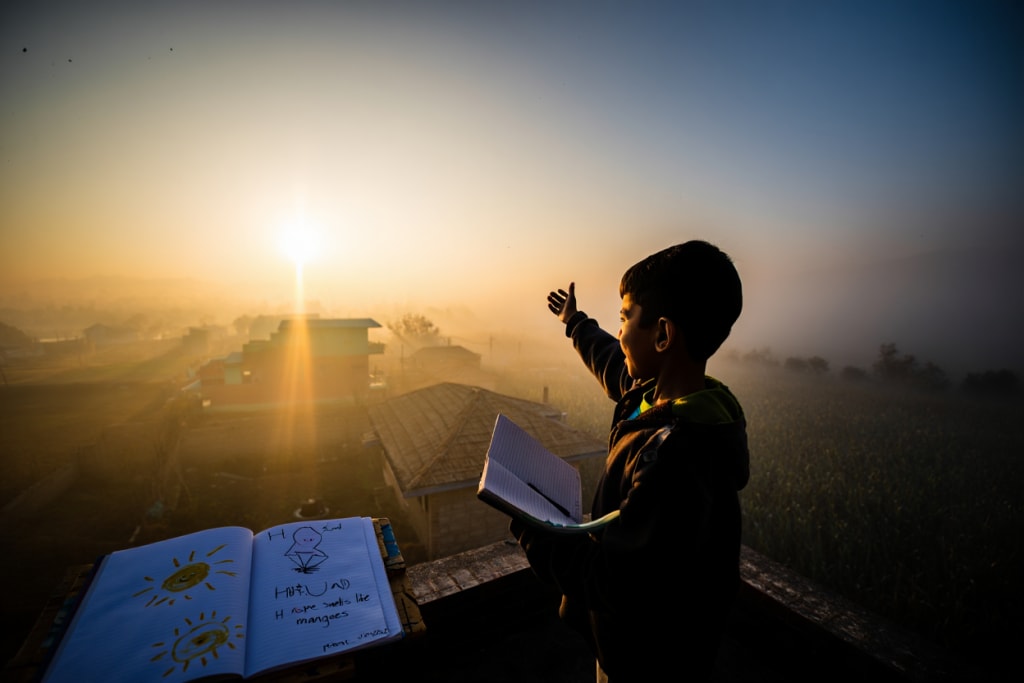
In the valley of Darvesh, surrounded by towering hills and thick forests, there lived a boy named Sami. His skin was the color of almonds, his eyes sparkled like river stones, and he had a strange habit—he collected sunlight.
Not in bottles or jars. No, Sami believed that sunlight lived in memories, in laughter, and in the gold-painted dust that danced when his grandmother swept the floor just after sunrise.
He was nine when the fog came.
It crept into Darvesh like a thief—silent, slow, and unwelcome. It stole the colors from flowers, turned mornings into dull gray sketches, and sent the birds searching for clearer skies. People stopped gathering in the courtyard, markets closed early, and windows stayed shut. The sun, once the soul of the valley, had disappeared behind a curtain that never lifted.
But Sami didn’t stop collecting.
Each morning, he stood on the rooftop, notebook in hand, recording what he remembered about the sunlight. He wrote:
“July 8th — The sunlight smelled like ripe mangoes and my mother’s bangles.”
“July 11th — It made our old cow’s horns glow like polished brass.”
“July 14th — When Baji laughed, her cheeks looked like sunrise.”
His grandmother watched silently, her heart both proud and heavy. People in the village began to call him pagal—crazy. They said the fog had made his mind soft, that he should stop this nonsense and accept that the sun was gone for good.
But Sami knew something they didn’t.
He remembered a story his father once told him, about a time long ago when the sky had hidden itself for years. It was a little girl then, his father had said, who sang every day to the clouds, and finally, the sun had returned just to hear her song more clearly.
So Sami decided he would sing too—in his own way.
He visited the sick with his book of sunlight memories, telling them about how the sun used to turn the river into silver snakes. He whispered warmth into the ears of sleeping babies, describing how sunshine made the world smell like roasted corn. He drew pictures in the dirt for sad children—bright yellow suns with giant smiles and arms like spaghetti.
And slowly, something happened.
The fog didn’t lift, not right away. But inside homes, lamps burned longer. People began talking again over steaming cups of chai. A few even cracked open their windows just a little. The marketplace filled once more—not with sunlight, but with hope.
And then came the visitor.
A tall man, dressed in grey from hat to shoes, arrived one dusk, his boots sinking into the soft mud of Darvesh. He said he was from the “Weather Bureau” in the city, come to measure the fog and understand its behavior.
But he didn’t understand the people of Darvesh.
He asked questions with no ears for answers. “What’s the barometric pressure here?” he demanded.
Sami stood before him, barefoot and holding his notebook.
“I don’t know about pressure,” Sami said. “But the sunlight here smells like hope.”
The man frowned. “That’s not a measurable metric, boy.”
Sami simply smiled. “Maybe not in your machines.”
That night, Sami wrote in his journal:
“The sunlight came back a little today—in a girl’s giggle, in the glow of my grandfather’s lantern, and in the way Baji’s story made everyone laugh even though they’d heard it a thousand times.”
A week later, the first beam broke through.
It wasn’t loud. No thunder or fanfare. Just a golden line that fell across Sami’s rooftop and warmed his feet. Then another. And another.
The fog began to retreat, confused and defeated by something it couldn’t measure—something like faith.
By the end of the month, the valley of Darvesh had bloomed once more.
And in the center of it all stood a small boy with a notebook full of sunlight, a quiet smile on his face, and a heart full of the warmth he’d never really let go.
💡 Moral / Reflection:
Sometimes, even when the world goes dark, there are those who remember the light—not because they’ve seen it, but because they’ve believed in it. And belief, as it turns out, is the brightest light of all.
About the Creator
Kamran khan
Kamran Khan: Storyteller and published author.
Writer | Dreamer | Published Author: Kamran Khan.
Kamran Khan: Crafting stories and sharing them with the world.
Keep reading
More stories from Kamran khan and writers in Fiction and other communities.
When the Shelter Closes
Across the street from my house, a man slept under a tree, his dog by his side. My first, naive thought: he must be traveling through. But he kept coming back, often sleeping there during the day. Then it hit me—that person might not have a home.
By Bride of Sound4 days ago in Humans




Comments
There are no comments for this story
Be the first to respond and start the conversation.