
The Boy in the Ashes
What happens to the world when we stop seeing each other as human?

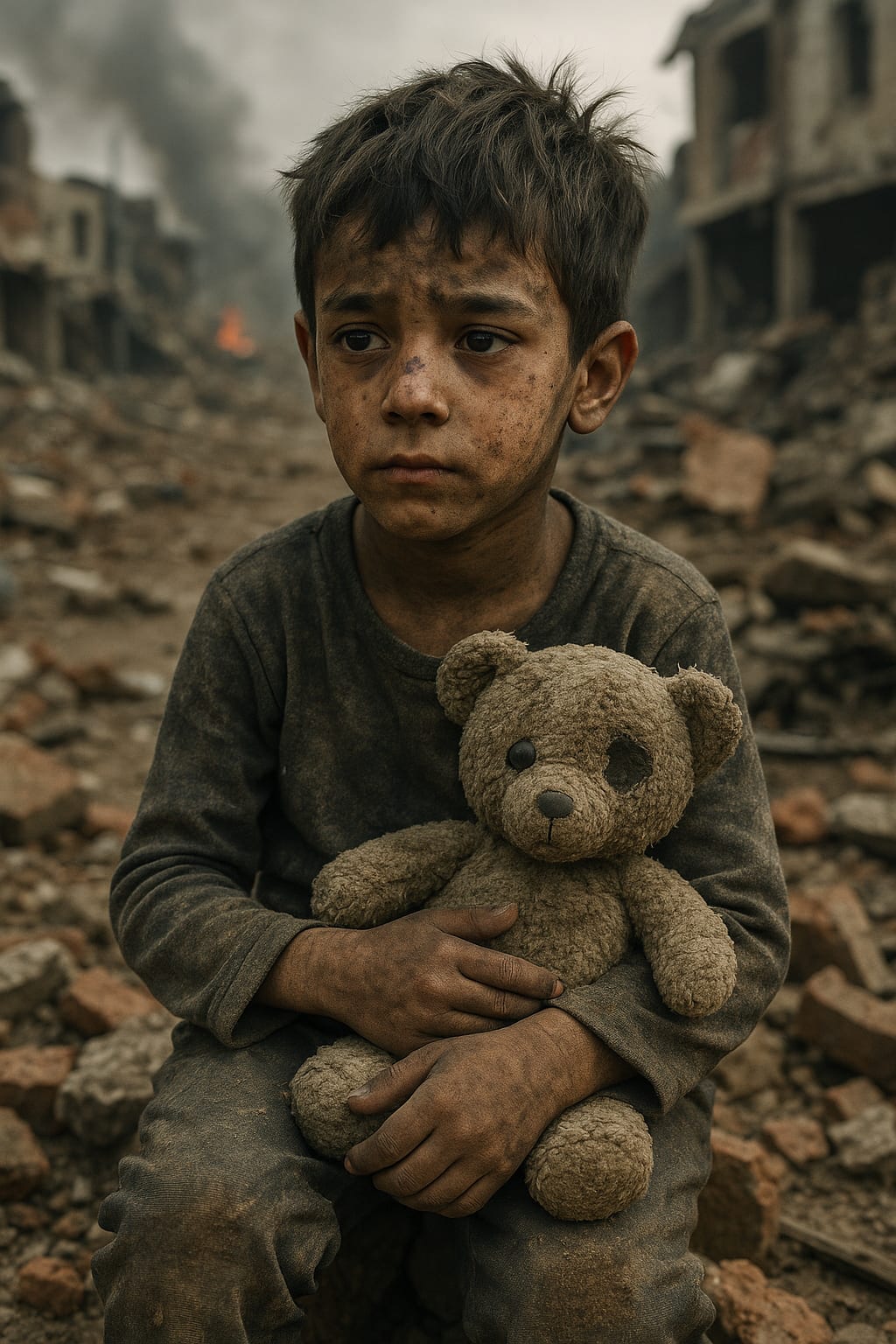
The first time I saw the boy, he was covered in ash.
His hands clutched a ragged teddy bear, burnt at the edges. One eye missing. Just like his brother, I’d later learn.
He didn’t speak. Not at first. He simply stared at the walls of the camp — tattered canvas soaked in yesterday’s rain — like they might crumble with the weight of silence. He had the kind of stare that aged children carry. The kind that makes you forget they’re still kids.
His name was Omar.
I was there as a volunteer — medical aid, temporary shelters, words that felt too clean for a place so broken. My country had the luxury of distance, but his had the misfortune of geography. A border drawn generations ago, and yet still bleeding.
He sat near the aid station every morning, waiting. For what, I didn’t know. He didn’t ask for food. He never cried. But he showed up, like hope in human form.
One day, I offered him a biscuit and a juice box. He took them without a word, walked three paces away, and gave them to a girl younger than him — maybe his sister, maybe a stranger. I didn’t ask. It didn’t matter.
That night, I wrote in my journal:
> “There’s a boy who no longer speaks,
But everything he does is louder than a scream.”
---
The other volunteers were tired. So was I. Not just physically, but spiritually. You can only stitch up so many wounds before you realize the ones that hurt most can’t be seen.
One of the nurses asked, “Do you ever feel like we’re just mopping up blood while the knife’s still in?”
I didn’t answer. Because yes. Every day.
The bombs kept falling.
The governments kept talking.
The donations kept thinning.
The world kept scrolling.
---
On my seventh day, a new group arrived — freshly displaced, mostly women and children. Among them, a woman barely standing, a baby in her arms, and burns on her face. She collapsed in front of the medical tent. I rushed to help, but someone beat me there.
It was Omar.
He laid down his teddy bear, held the baby like he had done it before, and sat by the woman’s side while we cleaned her wounds. Still silent, but more present than any of us.
Later, one of the translators told me his story.
His father was killed in a raid. His mother buried in rubble. His brother — the one with the same missing eye as the teddy bear — had died in front of him, arms shielding Omar from debris.
He hadn’t spoken since.
I asked the translator what his name meant.
“Long life,” she said, quietly.
---
I watched Omar day after day. He helped wherever he could — carrying water, holding frightened children, sharing what little he had. A ghost of a boy who had decided to be someone else's reason to survive.
It made me think of all the times I’d looked away.
From the headlines.
From the images of bombed-out cities.
From stories that didn’t touch me directly.
And I realized something deeply uncomfortable:
Indifference is a privilege.
And I’d worn it like armor.
---
One night, a storm rolled in. The kind that makes every child cry and every tent feel like paper. I found Omar huddled with three other children, his arms wrapped around them like they were all he had — maybe they were.
I sat beside him. I didn’t speak. He didn’t either. But for the first time, he leaned against me, like a truce between two broken worlds.
And then, just above a whisper, I heard him.
"Where is the world?"
I didn’t have an answer. But it broke me.
Because the world was here.
It just wasn’t looking.
---
The war lasted four more years.
I stayed as long as I could. Then I returned home — to safety, to lights that stayed on, to beds without gunfire in the distance.
But Omar stayed in my mind like a scar.
So I wrote.
Every day.
Stories, articles, open letters.
Sometimes people read them.
Sometimes they didn’t.
But I remembered Omar’s voice — soft, cracked, questioning:
"Where is the world?"
And every time I typed a word, I tried to answer that question.
---
Because the world is not just borders and policies.
It’s people.
It’s voices.
It’s boys in ashes who still choose kindness over silence.
---
The End.
About the Creator
The Red Hatred
Sometimes I feel like I hate you. A kind of red magma forms inside me, in my chest, and rises to my throat. In that moment, I want to destroy. I want to grab a plate and smash it into pieces. I want to take scissors and shred that red, sexy underwear I bought to please you.
By Anastasia Tsarkovaabout 10 hours ago in Fiction
Ludacris and Nelly draw backlash over bookings at MAGA-coded music festival
Ludacris and Nelly headlining a mostly right-wing event is good for them. It’s also great for the genre of hip hop. The two rap veterans have showcased their talents on other stages. Why can’t they perform for mostly MAGA folks and grab that bag?
By Skyler Saunders6 days ago in Beat


Comments (1)
Hi bro