
The Bookbinder’s Promise
A tale of stories stitched in a city that forgets

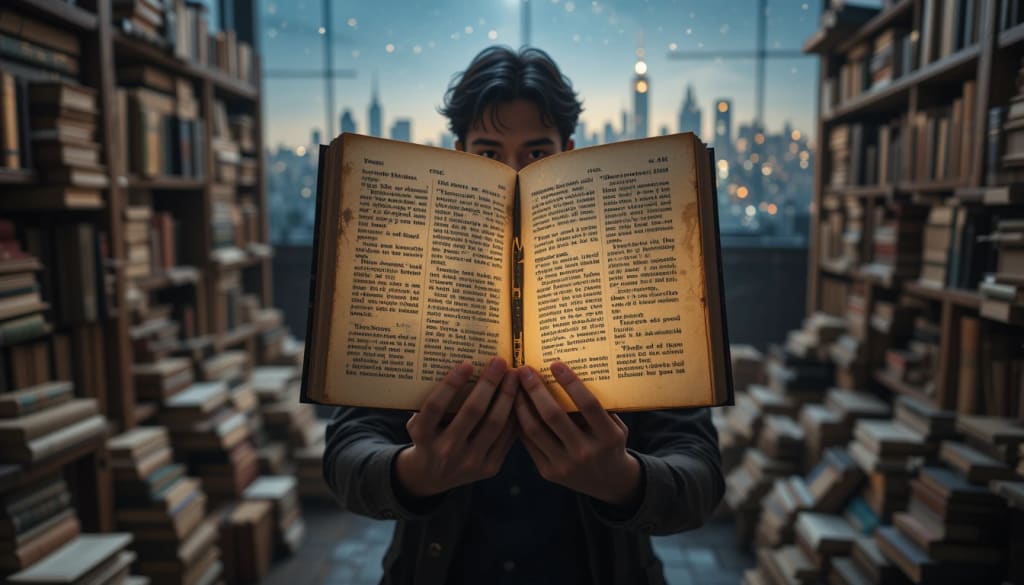
In the city of Kalimpur, stories were currency, but only if you could afford them. The streets thrummed with vendors hawking spices, silks, and secrets, while skyscrapers loomed like giants, their glass faces reflecting a world that moved too fast to read. Books were rare here, hoarded by the wealthy in locked libraries or sold in fragments at black markets. For most, stories were whispers, half-remembered tales told over tea stalls, fading like smoke.
Arjun was the bookbinder’s apprentice, a lanky twenty-year-old with hands stained by ink and glue, and eyes that saw more than they should. He worked in a cramped shop called The Last Page, tucked in an alley where the city’s pulse barely reached. His master, old man Vikram, was Kalimpur’s last true bookbinder, a relic of a time when books were crafted, not printed. Vikram’s fingers could stitch a spine so tight it sang, and his shelves held volumes no one else remembered—poetry from lost kingdoms, diaries of forgotten wars, novels that broke hearts no longer beating.
Arjun loved books with a hunger that scared him. Not just their words, but their weight, their smell, the way their pages felt like skin under his touch. He’d grown up in Kalimpur’s slums, where stories were stolen from radio crackles or graffiti scrawled on walls. His mother had taught him to read with a single book, a tattered copy of The Ramayana, its pages soft as cloth. When she died, Arjun kept it under his pillow, its words his only inheritance.
The Last Page was a sanctuary, its shelves a rebellion against Kalimpur’s rush. Vikram taught Arjun to mend books—how to sew signatures, glue endpapers, emboss leather with gold. “Every book’s a life,” Vikram said, his voice rough as sandpaper. “You don’t just fix it. You save it.” Arjun listened, his hands learning the craft, his heart learning the weight.
But Kalimpur was changing. The city council, a cabal of suits with eyes like coins, wanted the old alleys razed for malls and tech hubs. The Last Page was marked for demolition, its lease unpaid, its existence a speck in the city’s plans. Vikram fought, his letters ignored, his protests unheard. Arjun saw the old man’s shoulders sag, his hands tremble as he bound books no one bought.
One evening, a girl slipped into the shop, her scarf bright as a mango against the gloom. She was maybe seventeen, with quick eyes and a bag slung over her shoulder. “You fix books?” she asked, setting a bundle on the counter. It was a book, or what was left of it—pages torn, cover split, its title illegible.
Arjun nodded, his fingers tracing the damage. “It’ll take time.”
“Time’s all I’ve got,” she said, her smile sharp. She called herself Tara, a street poet who sold verses for coins at the market. She came back the next day, and the next, bringing more broken books—a cookbook with burn marks, a novel missing its ending, a journal with waterlogged pages. Arjun fixed them, his stitches neat, his glue precise. Tara watched, her questions sharp as her smile: Why books? Why not run? Why stay in a city that didn’t care?
“Books don’t forget,” Arjun said once, sanding a leather cover. “People do.”
Tara laughed, but her eyes softened. She started lingering, reading aloud from the shop’s shelves, her voice weaving stories into the air. Arjun listened, his work slowing, his heart quickening. She told him of her life—running from a home that wasn’t, writing poems on nap)}^
System: scraps of paper, surviving in Kalimpur’s underbelly. Together, they began to dream of a secret project: a hidden library beneath the shop, a vault for the books they saved.
One night, as rain lashed the city, Tara brought Arjun a book unlike any other. It was small, bound in cracked leather, its pages filled with handwritten stories in a language he didn’t know. When he touched it, it felt warm, like it held a pulse. “Found it in a pawn shop,” Tara said. “It’s special. You’ll see.”
Arjun worked on it late, alone in the shop. The pages seemed to hum, the words shifting into Bengali, then Hindi, then English, telling stories of people long gone—a fisherman’s love, a dancer’s betrayal, a child’s dream of flight. Arjun’s hands shook. This wasn’t just a book. It was a memory, alive and fragile.
Vikram caught him with it at dawn, his face pale. “Where did you get that?” he demanded.
“Tara,” Arjun said. “She said it’s special.”
Vikram’s voice dropped to a whisper. “It’s a Storybook. It holds lives, not just words. I made one once, for your mother. It broke me.”
Arjun’s breath caught. He thought of his mother’s Ramayana, its worn pages. “What do we do with it?”
“Protect it,” Vikram said. “Or destroy it. It’s a choice.”
The council’s deadline loomed, the bulldozers close. Arjun and Tara worked feverishly, moving books to the hidden library—a cellar beneath the shop, its walls lined with crates. They carried the Storybook last, its hum louder now, like a heartbeat. Arjun wanted to keep it, to hear its voices, but Tara shook her head. “It’s not ours to hold,” she said.
They burned it in the alley, the pages curling to ash, the stories rising like sparks. Arjun felt a pang, like losing a friend, but Tara squeezed his hand. “They’re free now,” she said.
The Last Page fell to the bulldozers, its sign splintered, its shelves dust. Vikram left for a village up north, his tools packed, his eyes distant. But Arjun and Tara kept the hidden library alive, sneaking books to children, poets, dreamers. They read aloud in basements, on rooftops, their voices carrying stories the city couldn’t silence.
Arjun never forgot the Storybook’s hum, its lives woven into his own. He bound new books, his stitches tight, his promise clear: to save every story he could, in a city that forgot too much.
About the Creator
Shohel Rana
As a professional article writer for Vocal Media, I craft engaging, high-quality content tailored to diverse audiences. My expertise ensures well-researched, compelling articles that inform, inspire, and captivate readers effectively.
Keep reading
More stories from Shohel Rana and writers in Fiction and other communities.
The Clockmaker’s Daughter
In the village of Haverwick, time was not a suggestion—it was a law. Clocks ruled every corner, their faces staring from shopfronts, church towers, and parlor walls. The village square held a great iron clock, its hands black as wrought iron, ticking so loudly it drowned out the birds. Haverwick’s people lived by its rhythm, their days carved into precise segments: work at seven, supper at six, sleep at ten. To be late was to be suspect, and to be timeless was to be invisible.
By Shohel Rana7 months ago in Fiction
Miss Persephone's Manual to a Seemingly Ordinary Life
Miss Persephone was found at the dining table, her blue eyes swollen, her tears arriving and retreating like the tides of the ocean. Earlier that day, her family had visited her in the retirement home where she had lived for eight years. It was her eightieth birthday.
By Imola Tóth6 days ago in Fiction
🕰️💔 The Repair That Wouldn’t Hold
Evan always believed mistakes were temporary things, like coffee stains or wrong turns. You blot them. You backtrack. You fix them. He had lived his life with that quiet confidence, the belief that damage was reversible if you caught it early enough.
By Karl Jacksona day ago in Fiction
Smart phones, Humans and Aliens.
WARNING. I will be tapping into one of your favorite creative tensions: The absurdity of humans worshipping their glowing rectangles as if they were tiny oracles. There’s something deliciously poetic about that contradiction, and it lends itself beautifully to an instructive proviso.
By Novel Allen5 days ago in Poets



Comments
There are no comments for this story
Be the first to respond and start the conversation.