
THE BLACKOUT: NASA'S 28-HOUR MOVIE AND THE MISSING THREE DAYS
TESS was supposed to be watching stars. Instead, it caught the intruder. But just as the camera focused on 3I/ATLAS, the satellite went dark.
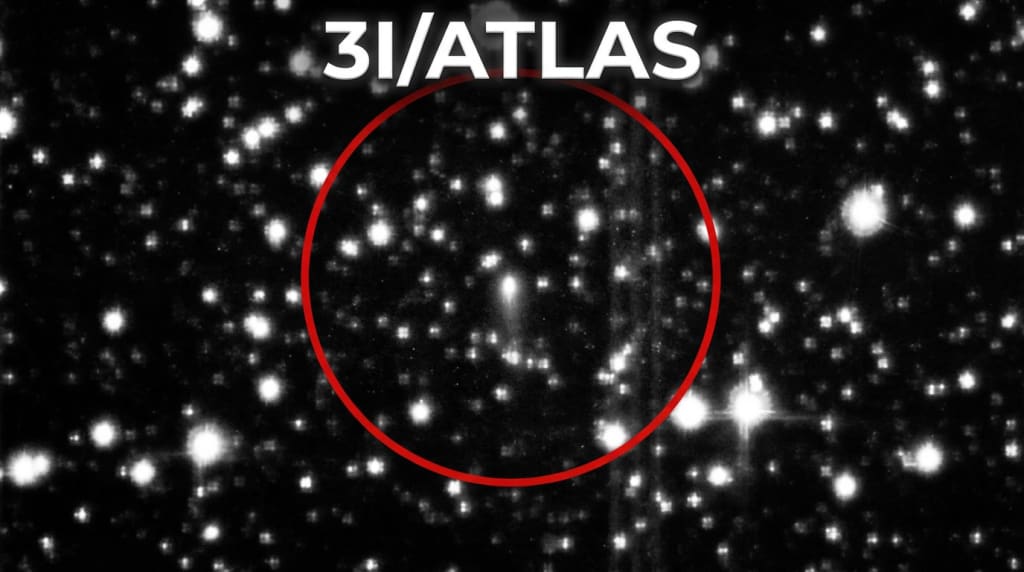
The footage is grainy. It flickers with the static of deep space. But if you look past the noise, you see it: a bright, glowing dot moving against a crowded field of background stars, dragging a defiant "anti-tail" pointed directly at the Sun.
This is the latest intelligence from TESS (Transiting Exoplanet Survey Satellite), NASA’s hunter of worlds. Between January 15 and January 22, 2026, TESS was locked onto 3I/ATLAS, recording its retreat into the darkness.
A team including researchers Daniel Muthukrishna from MIT has compiled these images into a 28-hour video. Ideally, this should have been the most detailed surveillance tape in history. We already know from Hubble data that the object spins with a rhythmic, mechanical precision every 7.1 hours. We expected to see that wobble, to see the anti-tail flicker as the object rotated, confirming its structure.
But we didn't get the whole movie. We got the edited version.
The "Safe Mode" Incident
Here is where the story shifts from astronomy to mystery.
Right in the middle of this critical observation window—from January 15 to January 18—TESS suddenly went offline.
NASA reports state the spacecraft entered "safe mode" following an issue with its solar panels. For three days, the camera was blind.
It is a coincidence that will fuel debates for decades. At the exact moment 3I/ATLAS was performing its most complex maneuvers, receding from the Sun and displaying its anomalous tail, our primary eye in the sky suffered a blackout.
The video we have jumps. It shows the object before the blackout, and it shows it after. But the 72 hours in between? They are lost to the void.
Was it a technical glitch? Or did the object do something—emit something—that scrambled the sensors?
The Ghost in the Machine
This isn't the first time TESS has seen this ghost.
Retroactive analysis shows that the satellite actually captured 3I/ATLAS way back in May 2025, months before it was officially "discovered."
But the object TESS saw back then was different. It was dead.
When researchers stacked 9,000 images from May and June 2025, 3I/ATLAS appeared as a lifeless point of light. No glow. No anti-tail. It was stealthy, an "inactive source" drifting through the dark.
Somewhere between May 2025 and January 2026, the object woke up. It turned on.
And now, as it leaves, it is putting on a show that our satellites are struggling to capture. The TESS footage, while "uneventful" due to low resolution, confirms one chilling fact: The object is still active. The anti-tail is still fighting the solar wind.The Mechanical Heartbeat
While the TESS video suffered from that frustrating gap and low resolution, it confirmed something vital: the object has a pulse.
Collaborating with researcher Toni Scarmato, the team is now scrutinizing every frame of the available footage to find a specific signature—a periodic variability in brightness. We know from earlier data that 3I/ATLAS rotates once every 7.1 hours.
This isn't the chaotic tumble of a broken asteroid. It is a steady, rhythmic spin.
If the team can match the wobbling of the anti-tail to this 7.1-hour cycle in the TESS video, it proves that the structure is rigid. A loose pile of dust doesn't wobble like a gyroscope; a solid, engineered object does.
While the TESS movie appeared "uneventful" to the untrained eye due to the blur, the math hidden in those pixels tells a story of a controlled flight.
The Sharper Eye: Hubble’s Evidence
Fortunately, while TESS was blinking, the Hubble Space Telescope was wide open.
Between November 30, 2025, and January 22, 2026, Hubble took 36 high-definition snapshots of the intruder. The timing was impeccable. During this window, our "interstellar dating partner" was aligned with the Earth-Sun axis to within 0.69 degrees.
This alignment gave us the clearest view possible of the object's silhouette. These images, now publicly available, show a sharpness that TESS couldn't achieve. They reveal the sheer scale of the anti-tail and the strange, persistent structure that refuses to dissipate like a normal comet would.
But looking at pictures of the past is not enough. The terrifying part is the future.
The Jupiter Rendezvous: March 16, 2026
This is the date everyone in the intelligence community is whispering about.
3I/ATLAS isn't just drifting away randomly. It is heading for a specific coordinate in space. On March 16, 2026, the object will pass near the Hill radius of Jupiter.
For those who don't know orbital mechanics, the Hill radius is the critical zone where a planet's gravity dominates over the Sun's tide. If you wanted to park a satellite, drop off a probe, or use a planet's gravity to slingshot yourself toward a specific star system, this is exactly where you would go.
The flyby distance is calculated at 53.6 million kilometers. In cosmic terms, that is a handshake. It is close enough to interact, but far enough to remain safe.
The Final Watcher: Juno is Waiting
We are not blind this time. Waiting at Jupiter is NASA’s Juno spacecraft.
Juno is currently our most advanced scout in that region. It is armed with optical and infrared cameras, particle detectors, magnetic field sensors, and plasma wave instruments. It has a radio dipole antenna capable of listening to frequencies that human ears cannot hear.
If 3I/ATLAS is just a rock, Juno will see a cold, silent stone passing in the night.
But if 3I/ATLAS is what the anomalies suggest—if it transmits a technological signal, or worse, if it releases probes into a Jupiter-bound orbit—Juno will hear it.
We are approaching the climax of a movie that has been playing in our skies for months.
If that anti-tail wobbles one last time and drops a package at Jupiter's doorstep, the ending of the 3I/ATLAS video will be better—and more terrifying—than any science fiction script Hollywood has ever imagined.
The camera is rolling. The world is watching. And on March 16, we find out if we are alone
About the Creator
Wellova
I am [Wellova], a horror writer who finds fear in silence and shadows. My stories reveal unseen presences, whispers in the dark, and secrets buried deep—reminding readers that fear is never far, sometimes just behind a door left unopened.
One Unchecked Box
"Republished" because it was the only way to add the embed for the newly recorded audio version of this story due to the Top Story badge. Plus it serves as a nice, informal announcement of the podcast's revival for another season (go subscribe!):
By Stephen A. Roddewig4 days ago in Fiction
Whiskey At Dusk
Guess the whiskey was more important to you in the end, wasn’t it? It was more than the well-being of your friends; more vital than showing up to the places you promised you would and could come to; more critical of a matter than fulfilling your damn responsibilities and getting the press off your back.
By Snarky Lisa6 days ago in Humans




Comments
There are no comments for this story
Be the first to respond and start the conversation.