
The Black Bull of Norroway
A retelling of the Scottish Fairy Tale

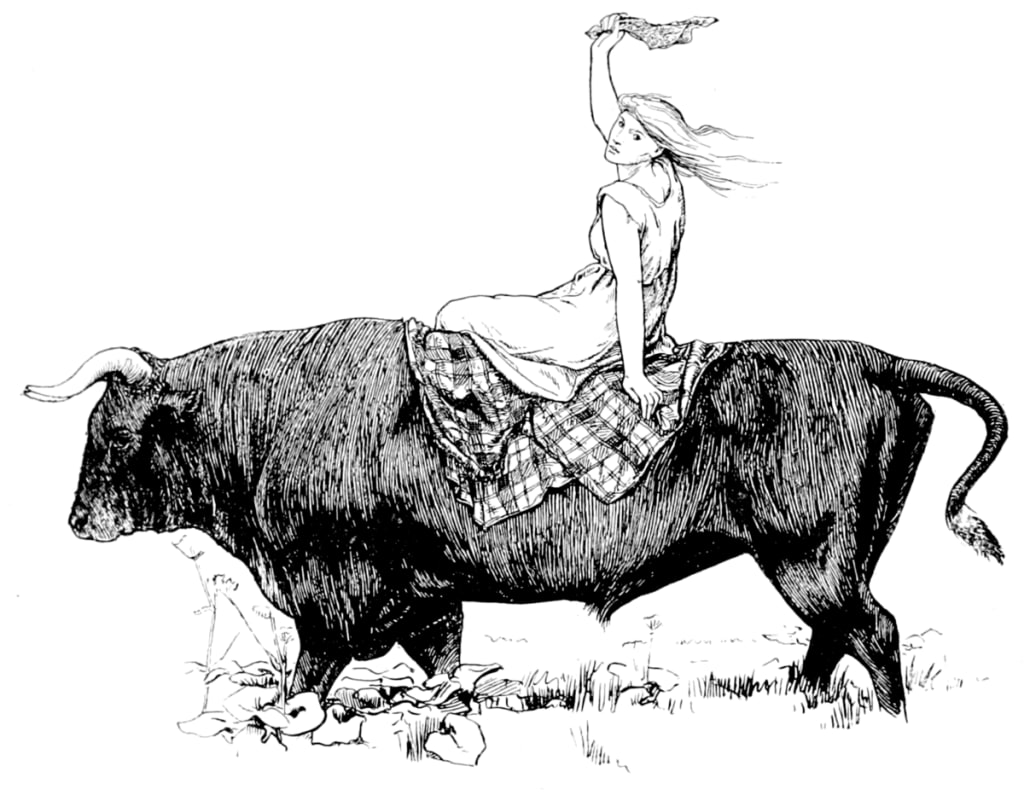
The wind is swift today; the highland grasses are swaying. The stalks bob up and down with each gust, rippling like the wavelets of the ocean. In a fit of inspiration, I undo my braid and let my hair loose to the winds. My hair is wavy, bright orange to match the freckles that spatter my face. It billows out behind me and for a moment I am lost in wild bliss.
“Eliza!” my mother shouts. “Get inside this instant! Upon my word, that wind will be the death of you!”
My reverie is broken. “I’m coming, mama!” I shout back, trying to keep the irritation out of my voice. Why must she always interrupt my rambles? She wants me to be a proper young lady, feminine yet practical. But I am young and free as spring grass itself, which continually drives her and my sisters to frustration.
“Tea time, Eliza,” Mama says. Then adds, under her breath, “Your hair is a mess. You mustn’t spend so much time outdoors.” I run to the sitting room. A fireplace crackles at the room’s end. Our windows are not glass, but covered up with blankets to keep the cold out. Our couch is old and worn. The room is, on the whole, modest but cozy. Mama is a washerwoman: we make enough money for a comfortable existence, but nothing more than that.
Mama pours me a cup of tea. I sit on our couch between my older sisters Mary and Catherine. Mary is taller than me, with dark hair curling around her head in an elaborate braid. Catherine has light hair and blue eyes, and a delicately upturned nose, and always wears pink ribbons woven into her hair and tied on her simple plaid woven dress to make herself as lovely as possible.
Mother walks in. “You girls are all old enough to marry, you know. Even Eliza is already seventeen. How much longer must I work my fingers to the bone to take care of you all? I was your mother at your age!” She throws up her hands in exasperation and storms out. Mary, Catherine, and I look at one another. Mother has been cranky lately.
Mary stares into the fireplace. “I haven’t married because no village boy suits me. These coal miners and farmers’ sons are too uncouth. I shall marry a duke so I can see more of the world.”
“That’s lovely, Mary!” I nearly shout.
“Hush, Eliza. Don’t let Mama hear you, she’s chided you quite enough for your high spirits,” says Catherine. Unfortunately, she’s right, so I bite my tongue and remain silent.
“What say you, Catherine?” asks Mary.
Catherine sits back and raises her head, looking down her lightly freckled nose onto the tattered rug. Her expression is stony, nearly queenly. Catherine has always carried herself like a lady far above her station, but I am particularly impressed now.
“I shall do one better than you, Mary. I will marry a prince! I shall have washerwomen and maidservants to look after me, rather than being washerwoman to some third-rate minor nobility; and there will be fine clothing, and dances, and important people to meet and things to see and do. I wish to be royalty.”
“Well, you certainly dress up and walk about as if you were royalty,” I tease her. Catherine takes it as a compliment and adjusts one of the fine silk ribbons in her hair.
“What about you, Eliza? Who would you marry—the King of Anglia himself?” The only prince higher than the Prince of Scotia is the Prince of Anglia, the kingdom that recently conquered Scotia.
I take a deep breath. I want to tell them everything I think about on my rambles on the highlands, about poetry and freedom and true love. I scrounge through the kitchen-drawers of my mind, searching for the right words, as I absently blow on my tea.
“Well,” I begin. “I would never marry a man just for wealth. I will marry for love, and love alone.”
Catherine scoffs. “Love won’t pay for glass windows and a solid meal, let alone finery.”
“Yes,” I counter, “But, to me, love is the glass through which I see the world twice as beautiful as before, the food I dine on, and the finest jewelry with which I could adorn my life. I want a love that is a perfect meeting of souls. A love that sets me free.”
Catherine and Mary burst out laughing. “True love? Eliza, you read too much poetry. You know such a thing does not exist in the real world.”
“It does!” I protest. “I know it does!”
“Suit yourself,” says Catherine dismissively.
“For love, I would marry anyone, no matter how poor or plain. I would even marry…” I think of something perfect! “I would marry the Black Bull of Norroway!”
“The Black Bull? Eliza, you don’t know what you speak of,” whispers Mary.
The Black Bull of Norroway is a specter, a legend all too real. The farmers speak of an enormous, shaggy black bull who brings curses and trouble wherever he goes. Nobody quite believed in him, but I have heard the farmer men who bring soiled overalls to my mother to wash say they have seen him with their own eyes, who have witnesses to confirm it.
“I would marry even the Black Bull if I loved him and he loved me,” I say resolutely.
“Well, it’s all just idle talk, anyway,” says Catherine, regally waving her hand. “She may as well speak of marrying the wind.”
“Girls!” Mama shouts from the kitchen. “Stop talking nonsense and get back to your chores!”
Catherine rolls her eyes, and we rise from the couch to don our overcoats and feed the cows and chickens. We go to bed exhausted, as always, with no hope of a better life. But I know deep down that in these parts haunted by the Black Bull, wishes come true, for there is magic in the air. I only know this by night, in dreams. I forget by day.
***
That morning, sunlight breaks against my eyes and I awake in the room I share with Mary and Catherine. We rise to do morning chores, but suddenly, there is a jangling of bells, the clatter of hooves, and a knock on the door.
Mother answers. A few minutes later, she bursts into our room out of breath. “Mary, a stranger wants to speak to you.”
Catherine and I eagerly follow her. Standing framed by our simple wooden door is a young, handsome man wearing the most splendid clothes I have ever seen: a pure white, unsoiled shirt and fine silk trousers, with a plaid band tied around his waist and a thick wool traveling-coat. I recognize the plaid: the royal clan MacCullough. A duke.
“Which of you fine young ladies is Mary, daughter of the washerwoman?”
Mary steps forward.
“Ah, lovely! See, miss, I had the strangest dream last night. I dreamed my true bride would be the eldest daughter of a washerwoman.”
“I am she,” says Mary, blushing and trembling.
The young Duke MacCullough sinks to one knee and takes Mary’s hand. “Then, dear lady, would you accept my suit and come away with me?”
“Why, yes! Anything for you, my duke!”
“Then,” he says, rising to his feet, “Let us go away together and be married!”
“What utter tomfoolery is this?” asks my mother indignantly.
“None, ma’am,” says the Duke. “For I have never seen a prettier girl, even among royalty, and I must have her for my bride.”
“Ah. Well, then,” says Mama, still skeptical. “By all means, take her off my hands. I have trouble enough with these girls and their mad dreaming.”
Mary joyously follows the duke to his carriage. I wave goodbye, my heart sinking. I am sure I will never see her again.
***
The next morning, I awake to louder bells, a heavier-thundering carriage, and an even more dignified-sounding knock on the door than yesterday’s. Once again, mother bursts into our room, looking for Catherine.
The man stands in our doorway regally. His hair is golden, and falls to his shoulders dreamily. He looks down his nose and stands perfectly straight. His shirt is purple, his trousers red, and I nearly gasp when I see the pattern of his plaid cloak: he is the prince of Scotia himself. Catherine and I curtsy.
“Fair lady,” he says, his voice powerful and commanding. “ I am Prince James of the Isle of Scotia. I had the strangest dream last night, that my true bride would be the middle daughter of a washerwoman, and you are so beautiful and so fine that I must have you. Will you come away and be my bride?”
“Gladly!” shouts Catherine, and nearly flings herself into his arms before regaining her usual poise. She adjusts the ribbons in her hair to be extra-comely.
“Well, I never,” mutters Mama. “My middle daughter, married to a prince! But this will be well for us, yes, it will.”
The prince leads her away by the hand, and I run out to the edge of our plot of land and wave until long after their carriage has disappeared.
***
I can’t sleep through the night. I am glad for Mary and Catherine, yes, but also deeply grieved. I have no friends other than my sisters. I will be desperately lonely without them. And the odds that the Black Bull will come for me are nothing—he is just a legend, after all.
Or is he?
Dawn arrives and I set logs for the fire. Then I boil barley to make breakfast mash. I must feed the cows and chickens and gather eggs, too, and wash, and cook, and everything else. A mountain of chores has descended on me since my sisters left. No more time to read poetry and novels…while Catherine and Mary have all the time in the world now, and they don’t even read.
I stew in my bitterness. Suddenly, there is a knock on my door and my mother appears behind me.
“Eliza, come quick. It might be another prince.”
But when I open the door, it is no prince I see. Instead, it is a huge shaggy black bull. Yet his eyes—deep green, and almost…human? I cannot say.
A deep voice rumbles from the beast’s throat. “I am the Black Bull of Norroway, and I have come to claim my bride.”
My heart rises to my throat. It can’t be…he was just a legend.
“The youngest, yes.” My mother pushes me forward.
“Good sir bull,” I say timidly. “This is a mistake. I didn’t mean to say I would marry—”
“You said what you meant, and marry me you shall. Come away with me, my bride.”
“I—”
I realize I have no choice. With tears stinging my eyes, I follow him outside. The bull sinks to his knees.
“Get on my back.”
“I—”
“I won’t bite, you know.”
“Very well,” I sigh, and hop on. The beast’s back is spiny, his hair bristly. He rises and begins walking.
“Don’t be afraid, my dear,” he says. “I am a gentle beast, no monster like the legends say.”
I try to breathe steadily. It’s hard to believe he’s gentle with that deep, rumbling voice. But he carries me over the hills with hardly a bump, and when I throw my arms out and let my hair loose, he doesn’t chide me as mother does.
“It is a fine thing, to feel the wind in one’s hair,” he says, thoughtfully.
We set off towards the high mountains that form Scotia’s central spine. I try to remember the bravest-sounding poems I’ve read about journeying into uncharted lands, but riding a talking bull beyond the horizons of everything I’ve ever known tops them all.
I trust the Bull. I don’t have any other choice.
To Be Continued…
About the Creator
Anna Hamilton
scientist, artist, aspiring author. teacher. idealist. person who likes to think a lot about the world. Aspergerian. follower of Jesus. person who cares a lot.
I am trying to be a writer :)
Keep reading
More stories from Anna Hamilton and writers in Fiction and other communities.
40 Days of Quarantine
Day 1 It's 3 in the morning , and what's happening seems important. I don't think I'll be able to remember this when I get a few hours of decent sleep, so I'm writing it all down. At 2 in the morning, the most ungodly hour to wake someone up, I was woken up by a person in a face mask. I was still very cloudy-minded , so I didn't hear all of what he (even though, for all I know, it could have been a woman) said, but it sounded like I had to be tested for some disease. I asked what they were talking about and the person in the mask just said there was a huge pandemic going around.
By Anna Hamilton4 years ago in Fiction



Comments
There are no comments for this story
Be the first to respond and start the conversation.