
The Bells of Saint Aurelia
In a quiet European village, the silence of a ruined church hides something far older than faith.
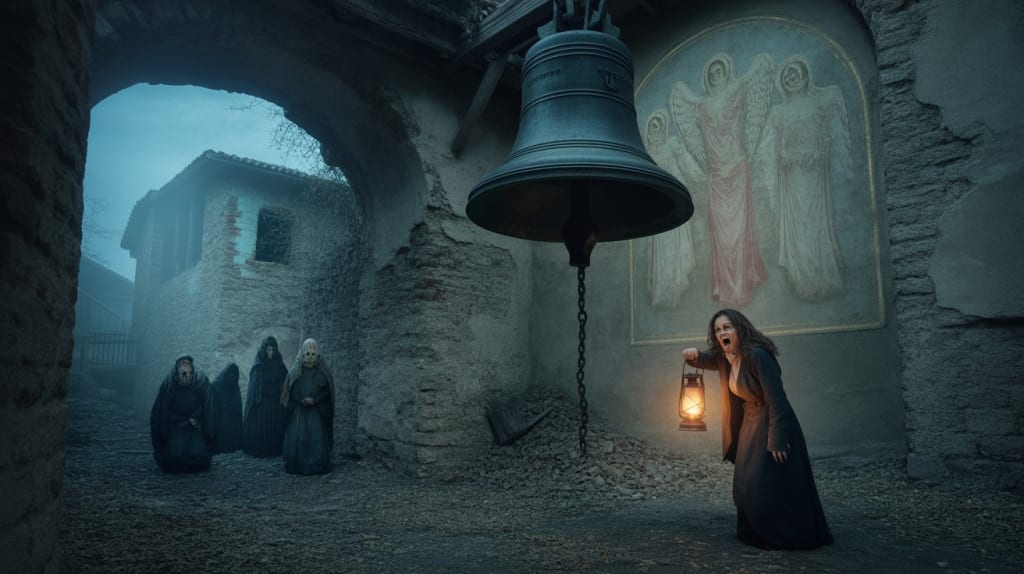
The village of Drovnik, tucked deep within the Carpathian hills, was the kind of place travelers passed through quickly. Its cobbled streets wound between stone houses, their roofs sagging with age, and at the highest point of the village stood the ruined church of Saint Aurelia. No one prayed there anymore. Its bell tower had long collapsed, leaving only the shattered walls and a hollow archway that locals avoided at all costs.
Elena, a young art historian from Prague, had come to Drovnik in search of forgotten religious icons. She had read in an old manuscript that Saint Aurelia’s church once housed frescoes painted by a mysterious 15th-century monk. The locals, however, were less than welcoming. When she mentioned the church, the innkeeper crossed himself. “Do not go there at night,” he whispered. “The bells ring when no one pulls the rope.”
Elena laughed politely. She had heard such warnings before in small villages—legends crafted to keep children away from dangerous ruins. But the next morning, curiosity pulled her up the winding path to the church. The air grew colder as she approached, and silence pressed down on her. Ivy strangled the stone walls, and the wooden doors, half-rotten, leaned against their hinges. Inside, the floor was broken, and damp moss spread across the cracked stones. Yet faint fragments of color remained on the walls: faded halos, the outline of wings, the trace of a solemn hand.
As she sketched the remnants, a low sound vibrated through the air. A bell. Her pencil froze. She looked up sharply. The tower was gone; no bells had hung there for over a century. But she heard it clearly, the slow toll of iron echoing through the empty nave. She stepped back, her breath caught in her chest.
That night at the inn, Elena asked if others had heard the bells. An old woman spat into the fire. “It is not a sound you hear,” she said. “It is a calling. Once you answer, it will not let you go.”
Elena should have left. She even packed her sketchbook, telling herself she would catch the morning coach back to Prague. But as the night deepened, she felt restless. Her window looked up toward the hill, where the ruins glimmered faintly in the moonlight. And then, she heard it again—the tolling of the bell, carried on the night air. One… two… three. Her heart pounded with each strike. Without thinking, she found herself walking toward the church, lantern in hand.
The ruins seemed different at night. The archways yawned like open mouths, and the frescoes she had admired in daylight now looked twisted, their faces smeared into grotesque masks by shadow. The bell tolled again, and she followed the sound into what had once been the sacristy. There she found a door she had not noticed before, half-buried under rubble. Against her better judgment, she pulled it open.
A spiral staircase descended into darkness. The air was damp and foul, carrying the metallic scent of rust—or blood. The bell was louder here, vibrating through the stones. Her lantern trembled in her hand. Step by step, she descended, until she reached a crypt. Rows of broken coffins lined the walls, and in the center stood a massive iron bell, blackened and cracked, yet somehow whole. It swung slowly though no rope touched it.
Elena’s knees weakened. She turned to flee, but from the shadows, figures stirred. Thin, robed shapes emerged, their faces hidden beneath decayed hoods. Their movements were soundless, their hands skeletal. As the bell tolled again, they all turned their heads toward her, in perfect unison.
A voice seeped into her mind, not spoken but felt. “You have answered.” Her lantern sputtered, then died, plunging the crypt into darkness. The last thing she heard before she screamed was the toll of the bell, deafening and endless.
The next morning, the villagers found the church doors wide open. No one saw Elena again. But some nights, when the wind carries down from the hills, the bells of Saint Aurelia still ring, and those who hear them swear they sound like a woman crying.
About the Creator
Wellova
I am [Wellova], a horror writer who finds fear in silence and shadows. My stories reveal unseen presences, whispers in the dark, and secrets buried deep—reminding readers that fear is never far, sometimes just behind a door left unopened.
The Ritual
Every night at nine, Mara set the second place. She did it even when she ate standing at the counter, even when the sink was full and the radio was still murmuring to itself. She took the blue plate from the cupboard—the one with the chipped rim—and set it across from her. She folded the napkin into a neat rectangle. She put the fork on the left, the knife on the right, blade facing in, as if someone had taught her manners she was determined not to forget.
By Nina Pierce3 days ago in Fiction



Comments
There are no comments for this story
Be the first to respond and start the conversation.