
The Baroque Mirror: What Classical Art Tells Us About Today
Finding modern meaning in timeless brushstrokes

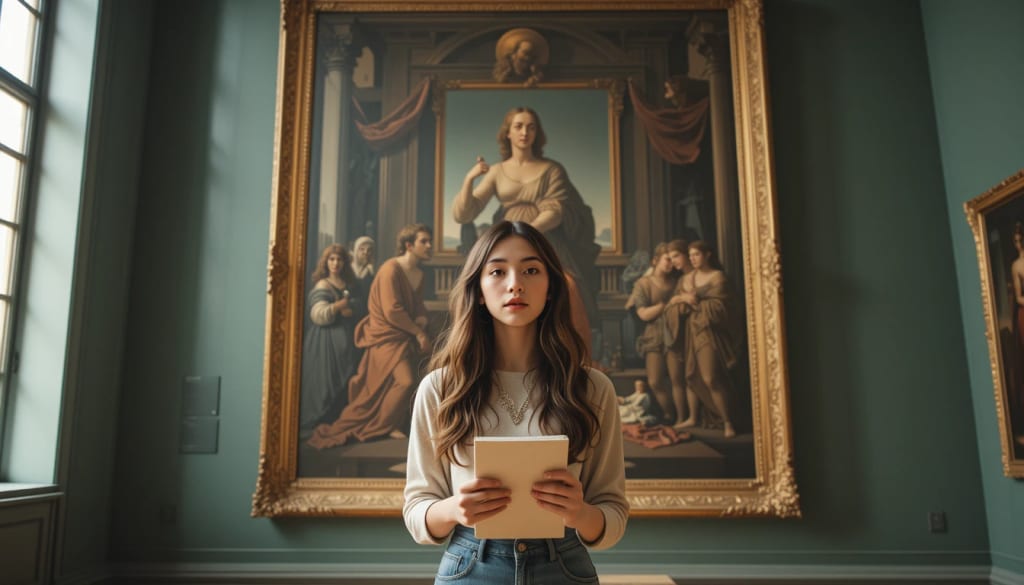
The morning sun poured through the tall windows of the art gallery, casting golden streaks across the polished wood floor. Lena stood before a massive Baroque painting, her sketchbook tucked under her arm, her eyes tracing the swirling drama of Caravaggio’s The Calling of St. Matthew. At 28, she was an art history graduate student, part-time curator, and full-time searcher for meaning in a world that felt increasingly fractured. Today, in this quiet Chicago gallery, the painting was more than a masterpiece—it was a mirror, reflecting truths about her life and the chaos of the present.
Lena’s day had started early, as always. She woke at 6:00 a.m. in her cramped apartment, her desk buried under books on Caravaggio, Bernini, and the Baroque era. Her thesis was due in three months, a study of how 17th-century art spoke to modern anxieties. But the words weren’t coming. Her laptop was open to a blank document, and her phone buzzed with notifications—news alerts about political divides, climate protests, and economic uncertainty. The world felt like it was unraveling, and Lena’s own life wasn’t much steadier. Her boyfriend, Sam, had moved out last month, leaving a silence louder than their arguments. Her part-time job at the gallery paid the bills, but it left her little time to think, let alone write.
She arrived at the gallery by 8:00 a.m., her sneakers squeaking on the floor as she unlocked the staff entrance. The space was empty except for the paintings, their colors vivid against the white walls. Lena’s job was to prepare for a new exhibit, a collection of Baroque works on loan from a museum in Florence. She loved the Baroque—its drama, its shadows, its unapologetic emotion. Unlike the restrained lines of the Renaissance, Baroque art was raw, human, alive. It felt like a rebellion against order, a mirror to the messiness of now.
As she adjusted the lighting for The Calling of St. Matthew, Lena paused, drawn into the painting’s story. Caravaggio’s light slashed through the darkness, illuminating Matthew, a tax collector, as Christ called him to a new life. The figures were flawed—grubby hands, weathered faces—yet the moment was divine. Lena saw herself in Matthew, caught between who she was and who she might become. She opened her sketchbook and jotted a note: Light finds us, even in the dark. It wasn’t a thesis statement, but it was a start.
Her colleague, Javier, arrived soon after, his coffee thermos in hand. “You’re here early,” he said, eyeing her sketchbook. “Still wrestling with that thesis?”
Lena sighed. “It’s like the world’s too loud to think. How do you write about art when everything feels so… urgent?”
Javier, a curator in his fifties with a knack for seeing through people, shrugged. “Art’s always been about the urgent. Baroque painters lived through plagues, wars, upheaval. They didn’t hide from it—they painted it.” He gestured to the Caravaggio. “Look at that. It’s chaos, but it’s also hope. Sound familiar?”
Lena nodded, her eyes back on the painting. She thought of her X feed, a mix of outrage, memes, and fleeting moments of beauty. The Baroque was like that too—turbulent, excessive, but searching for something eternal. She scribbled another note: Baroque is excess, but it’s also truth. Her thesis was starting to take shape, not as an academic argument but as a story, one that connected her to the past and the present.
The gallery opened at 10:00 a.m., and visitors trickled in—tourists, students, an elderly couple holding hands. Lena led a small tour, her voice steady as she explained Caravaggio’s use of chiaroscuro, the stark contrast of light and shadow. A college student in a hoodie raised his hand. “Why does this stuff matter now? It’s, like, 400 years old.”
Lena hesitated, then pointed to the painting. “See how the light hits Matthew? It’s a moment of change, of being seen. Back then, people were scared—disease, poverty, war. Sound familiar? This art says we’re not alone in the mess. It’s a mirror for today.” The student nodded, and Lena felt a spark of clarity. Maybe her thesis wasn’t just about art history; it was about survival.
By noon, Lena was alone again, cataloging frames in the back room. Her phone buzzed—a text from Sam: Can we talk? Miss you. Her chest tightened. They’d broken up over small things that grew big—her late nights studying, his frustration with her distraction. She typed a reply, then deleted it. Instead, she opened her sketchbook and wrote: Love is a Baroque painting—beautiful, broken, full of shadows. The words felt true, and for the first time in weeks, she didn’t feel stuck.
During her lunch break, Lena sat in the gallery’s courtyard, a sandwich untouched beside her. The sun was high, warming the stone bench. She pulled up X on her phone, scrolling through posts about art, politics, and personal confessions. One caught her eye: a photo of a Bernini sculpture, its marble figures twisting in ecstasy, captioned, “Art reminds us we’re human, even when we forget.” Lena saved it, her mind racing. The Baroque wasn’t just about beauty; it was about feeling everything—grief, joy, fear—in a world that didn’t make sense. She wrote: We’re still Baroque, chasing light in the chaos.
Back inside, Javier found her staring at a Rubens painting, its fleshy figures bursting with life. “You’re onto something, aren’t you?” he said, leaning against the wall.
“I think so,” Lena replied. “It’s like… the Baroque isn’t just history. It’s us. The way we’re all trying to find meaning in this mess—social media, politics, heartbreak. It’s all there, in the paint.”
Javier smiled. “Write that down. That’s your thesis.”
Lena spent the afternoon in a quiet corner, her laptop finally open, words flowing. She wrote about Caravaggio’s shadows as a metaphor for modern anxiety, about Bernini’s sculptures capturing the raw emotion of a tweet gone viral. She wrote about herself, too—her fear of failing, her grief over Sam, her hope that art could still save her. The Baroque, she argued, was a mirror for today, reflecting a world that was both falling apart and fiercely alive.
By 4:00 p.m., the gallery was bustling. Lena overheard a visitor, a woman in her sixties, talking to her friend about a Rembrandt portrait. “It’s like he’s looking right at me,” she said, her voice soft. “Like he knows what I’ve been through.” Lena smiled, recognizing the feeling. Art had always done that for her—seen her, even when she felt invisible. She added a line to her notes: Art doesn’t solve the world’s problems, but it holds them, like a friend.
As the day ended, Lena locked up the gallery, the Caravaggio glowing faintly in the dim light. She felt lighter, as if the painting had taken some of her weight. On her walk home, the city was alive—horns blaring, street vendors calling, a busker playing a violin. It was Baroque, all of it, a symphony of excess and beauty. Lena stopped at a café, ordered a tea, and kept writing, her pen moving faster now. She wasn’t just a student or a curator; she was a storyteller, weaving the past into the present.
At home, Lena’s apartment felt less like a cage. She lit a candle, its flicker reminding her of Caravaggio’s light. She opened X again, this time posting a photo of her sketchbook, a page filled with notes and a quick sketch of The Calling of St. Matthew. Her caption read: “The Baroque is us—messy, searching, alive. What’s your mirror?” Comments poured in, from strangers and friends, sharing their own moments of connection with art. One wrote, “Thank you for this. I needed it today.” Lena’s eyes stung. She wasn’t alone.
Before bed, she texted Sam: Maybe we can talk. But I’m figuring myself out first. It wasn’t closure, but it was honest. She opened her laptop and added a final paragraph to her thesis draft: The Baroque mirror shows us who we are—not perfect, not finished, but human. In its brushstrokes, we see our fears, our hopes, our fight to keep going. It’s not about escaping the chaos but finding meaning within it. She closed the laptop, her heart full. The words weren’t perfect, but they were hers, and they were enough.
The next morning, Lena woke to the same sun, the same city. But something had shifted. She walked to the gallery with her sketchbook in hand, ready to face the paintings again. The Baroque wasn’t just art—it was a map, guiding her through the darkness of today. And in its light, she saw herself, not as a student or a lover or a curator, but as someone who could still create, still feel, still find her way.
About the Creator
Shohel Rana
As a professional article writer for Vocal Media, I craft engaging, high-quality content tailored to diverse audiences. My expertise ensures well-researched, compelling articles that inform, inspire, and captivate readers effectively.
Keep reading
More stories from Shohel Rana and writers in Fiction and other communities.
The Baby and the Pen: My Journey to Feeling Like a Real Writer
The morning light filtered through the kitchen window, casting a soft glow on the chaos of breakfast dishes and a half-empty bottle of formula. Sophie sat at the table, her laptop open, a blank document staring back at her. Her six-month-old daughter, Lily, gurgled in the highchair, smearing mashed banana across her tray. At 34, Sophie was a writer—or she had been, before motherhood reshaped her days and her identity. The pen, once her lifeline, now felt like a stranger, and the words that used to flow were buried under diapers and doubt. But today, something was stirring, a quiet rebellion against the silence that had settled in her chest.
By Shohel Rana8 months ago in Fiction
Ludacris and Nelly draw backlash over bookings at MAGA-coded music festival
Ludacris and Nelly headlining a mostly right-wing event is good for them. It’s also great for the genre of hip hop. The two rap veterans have showcased their talents on other stages. Why can’t they perform for mostly MAGA folks and grab that bag?
By Skyler Saunders6 days ago in Beat



Comments
There are no comments for this story
Be the first to respond and start the conversation.