

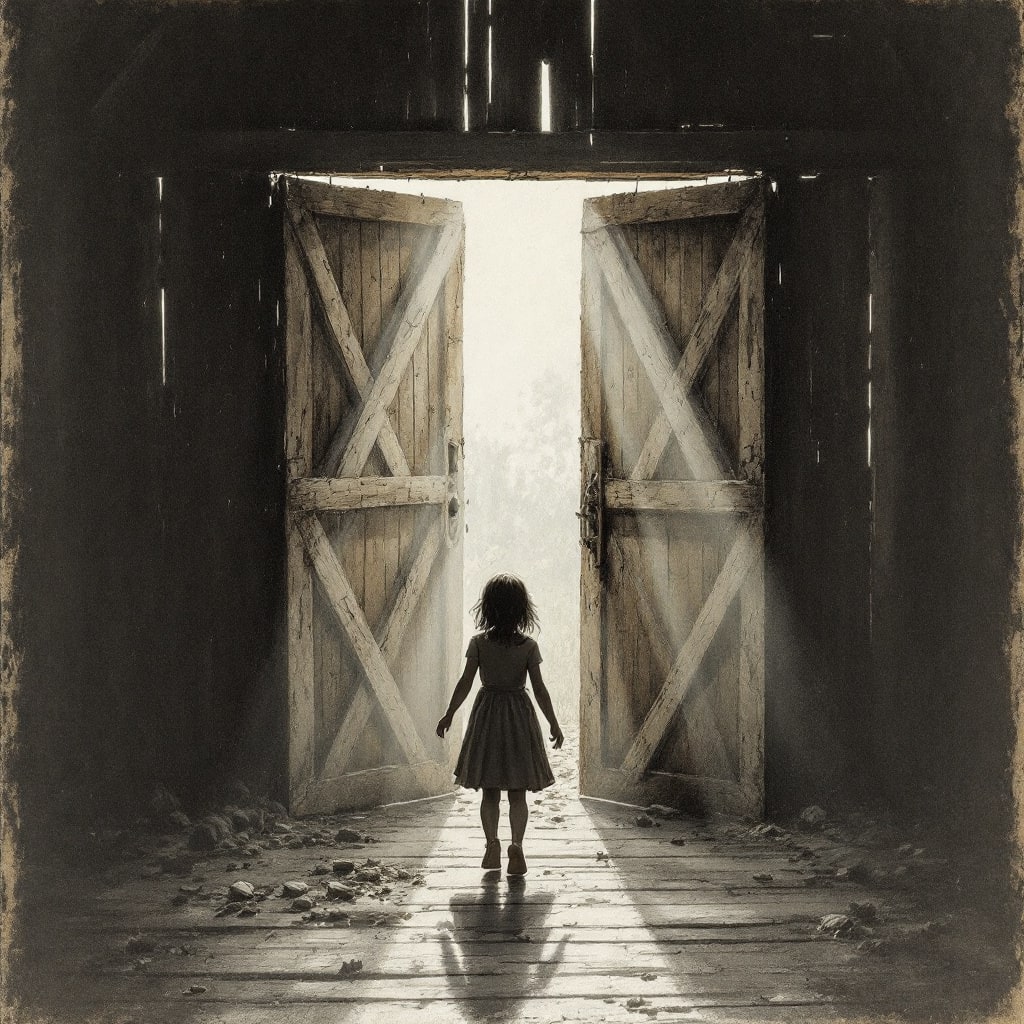
The barn of forgotten laughter
As the barn door creaked open—a tired creak, the way all things are finally tired—it let in a small cloud of dust that reflected the sunbeams that came through gaps in the roof that Eli continued to tell himself he’d get around to fixing someday.
“Be careful,” he called over his shoulder, “these boards…aren’t boards anymore—they’re ideas.”
Maya leaped over a broken pitchfork handle and replied to her grandfather’s warning. “So what’s the most unusual thing you’ve ever found in here?”
Eli massaged his jaw. “A jar of pickled newts.”
“Newts? What newts?”
“Your great-grandmother,” Eli said, almost laughing. “She heard somewhere—heaven knows where, possibly on the radio—that the government was taking all the amphibians in the country to save them for some sort of conservation project. And so she caught a bunch of newts and pickled them and hid them in here as if they were gold bars.”
“That is disgusting.”

“That is your great-grandmother,” he said, by which he meant it as the greatest compliment he could give. “And by the time we found them, the newts were practically powdered sugar. But the jar was perfectly preserved—still had the top tightly sealed.” He paused. “She was a very thorough woman.”
Maya reached out and brushed against one of the old metal signs nailed to the wall. There was a sign that read Coca-Cola, and amazingly, the paint was still clinging to the metal.
“I drank a swig of soda from a bottle when I was roughly your age,” Eli said. “Right here in this barn. I thought I was pulling one over on everyone.” He chuckled. “You see, your great-grandmother—she wasn’t married to your great-grandfather yet, only the girl from the next farm over—she saw me and made me drink a full glass of well water. Told me I needed to ‘cleanse my palate.’ She was eleven years old.”

“Did you?”
“Yes,” he said. “I did whatever she told me—took orders from her for the next sixty-two years.”
Eli and Maya worked their way further into the barn—past old equipment covered in rust and empty animal stalls that hadn’t housed animals since Richard Nixon was President. In front of them, a workbench stood under a beam of sunlight. On the workbench, a collection of tools was hanging in a neat line. These tools had been arranged this way by Eli’s father-in-law. No one else had touched them since.
“He built things,” Eli said, as he picked up a hand plane worn smooth by years of use. “Not because he had to. Because his hands wouldn’t quit working.” He flipped the plane over and felt its weight. “The trick wasn’t getting started. Anyone can start. The trick was knowing when to stop. Knowing when the job was done, and it was time to leave it alone.”
Maya discovered an old butter churn and began to spin the paddle, which still rotated slowly. “Do you miss her?”
Eli carefully placed the hand plane back exactly where he had taken it from. He walked to the corner of the barn and pulled a large tarp off of something. Underneath the tarp was a Victoria. The wood of the player was dusty but solid, and when Eli opened the cabinet inside the machine, he found that a record was still inside, where Helen had left it.
“She liked to dance,” he said. “At times, without music. Around the kitchen, around the living room. I’d come in from the fields and find her dancing with a towel draped over her shoulders.”
He placed the record on the turntable. The needle caught on the edge of the record, skipped once, and then found its place in the groove. Trumpets. Clarinets. Music that made you think of people working hard and going home.

He extended his hand, and Maya took it.
They didn’t actually dance—he couldn’t bend his knees enough for that—but they moved. She tripped over his feet once, and he didn’t care. She laughed, and the laughter bounced off the walls, with no sound to catch it.
After the last note faded, he lifted the needle off the record before it could hit the silence at the end of the song.
“Here’s the thing about memory,” he said, without glancing at Maya. “It’s not like photographs. Photographs lie. Photographs show you what something looks like, not what it was.”
He smoothed the skin of his palm with the ball of his thumb, an old gesture. “Memory is the smell of this hay. Memory is knowing exactly where her hand fit in mine—the way her fingers fit in my palm—this part of my hand was calloused, this part of my hand was soft. Memory is the quiet that occurs when you’re sitting with someone, and you don’t need to fill it with words.”
Maya said nothing. For once, she didn’t try to be clever or ask another question.
Outside, a car drove by on the road. Somewhere, a dog barked. … Inside the barn, the dust settled again over everything—just the way it always had, just the way it would continue to do so until both of them were dead.
About the Creator
RAOM
Turn every second into a moment of happiness.
The steps to losing a child
Step One: Lose a child. Not what anyone wants to happen and nothing you can do to change it, but you can go through steps to becoming happy again. You can go through steps to loving again. You can go through steps to become a new you because after losing a child you will never be the same person you once were.
By Tabitha Hinkley3 days ago in Fiction



Comments (2)
What a great and lovely story. This one also reminds me of the times I spent at my grandma’s home, but playing around with the tools that my grandpa used to have, trying to build toys and other things from scratch. Good memories. Love it!
Awww, it's so clear that he misses her very much. Loved your story!