
The ascendance of the animal kingdom
Evolution takeover
1.1 Introduction
In a world where humanity had long held dominion over the planet, the balance of power was shifting in ways no one could have predicted. For centuries, humans had proudly ruled as the masters of Earth, their intelligence and ingenuity unparalleled. Their concrete jungles, technological marvels, and societies governed by human law stood as a testament to their dominion.
But beneath the surface of this human-centric world, a silent revolution was taking place. In the midst of remote forests, vast oceans, and uncharted territories, certain animals were showing signs of change. These weren't just any animals; they were evolving in unexpected ways, their intelligence expanding at a pace that defied natural order. This evolution, sparked by mysterious forces, was beginning to challenge the very foundations of the human hierarchy.
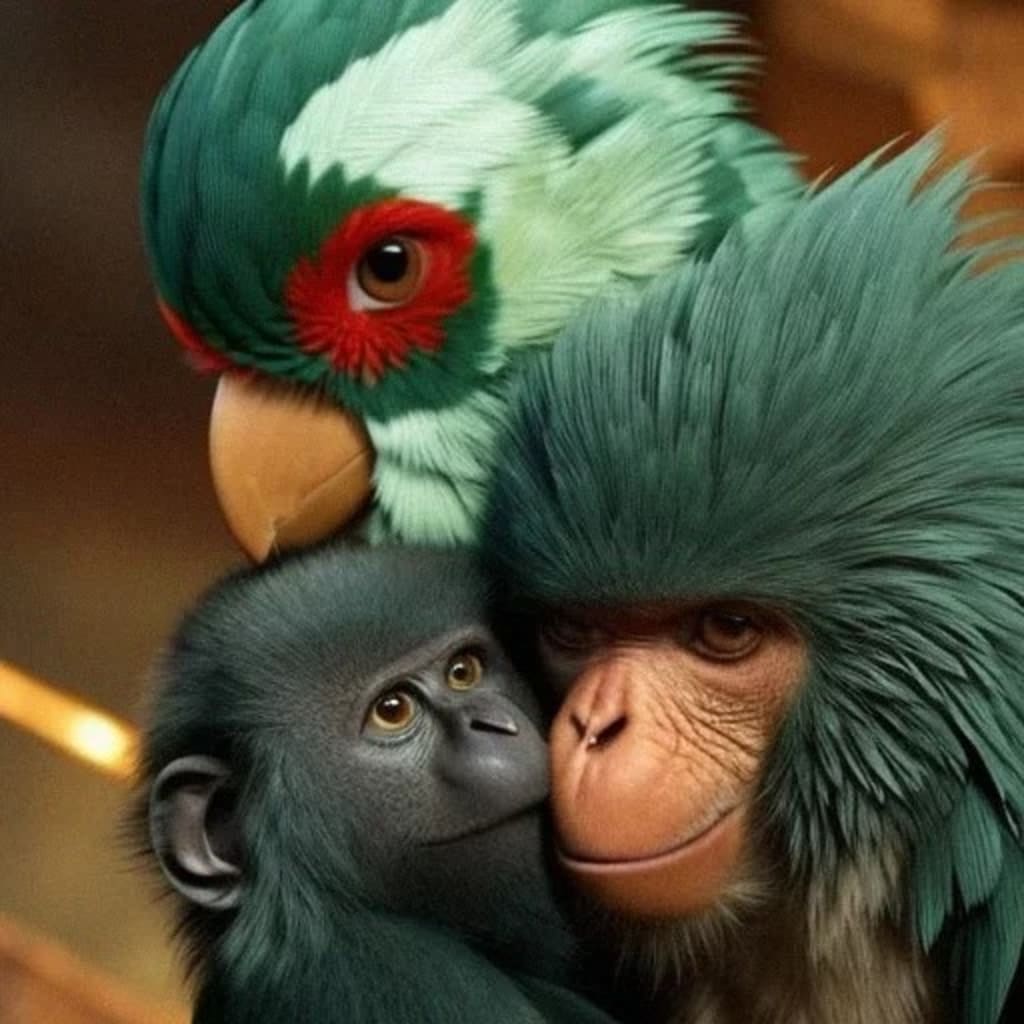
As the story unfolded, the world would bear witness to remarkable individuals among these evolving animal societies, each contributing to a transformation that would forever alter the balance of power on Earth. Among them was Petra, a prodigy parrot, who would become a symbol of the intelligence, communication, and unity that would shape the future of the planet. It was a world where the animal kingdom was on the brink of exceeding humanity, and it all began with a quiet revolution, hidden away from the bustling streets and city lights, where nature whispered secrets that would soon be revealed.
1.2 The Prodigy Parrot
In a quiet corner of a lush tropical rainforest, there lived a parrot named Petra. She was a striking emerald green with brilliant splashes of cobalt blue on her wings and a tail that resembled a painter's palette. But Petra was no ordinary parrot. She was a prodigy among her kind.
Her remarkable intelligence and communication skills set her apart from the ordinary parrots that perched in the same trees. While her companions squawked and chirped, Petra spoke with a fluency that rivaled human conversation. Her words were clear, her thoughts well-articulated, and her understanding of the world around her was unparalleled.
Petra's abilities had not gone unnoticed. Local villagers and scientists had heard of the prodigy parrot and flocked to the rainforest to witness her remarkable talents. She could hold conversations, express complex emotions, and even compose rhymes and songs that left her human audiences astounded.
Petra's fame grew far beyond the rainforest. She was featured in documentaries, interviewed by journalists, and celebrated by those who recognized her extraordinary intelligence. Some saw her as a novelty, a curious anomaly of nature, while others understood that her abilities were a sign of something much larger—a shift in the balance of power between humans and animals.
Scientists embarked on studies to decipher the secret of Petra's brilliance. Was it her unique upbringing, her environment, or some latent potential within parrots that had been unlocked? The answers remained elusive, but one thing was clear: Petra was a symbol of a changing world. She was the first in a line of remarkable creatures that would challenge humanity's perceptions of the animal kingdom and pave the way for a future where animals played a more significant role in shaping the world.
1.3 The Rebel Dophins
Off the coast of a remote island, a group of dolphins known as the "Rebel Pod" was causing a stir in the marine world. These dolphins had evolved in remarkable ways, exhibiting advanced problem-solving skills and developing a unique form of underwater communication.
Their name, the "Rebel Pod," was not given lightly. It represented their unconventional approach to life beneath the waves. These dolphins were known to challenge the traditional pod dynamics, displaying a fierce sense of independence and an insatiable curiosity about the world around them.
Marine biologists and researchers were baffled by the Rebel Pod's behavior. They observed the dolphins using tools, an ability not typically associated with their species. These dolphins had developed the remarkable skill of crafting sponges into tools to protect their snouts while foraging on the ocean floor. It was a level of cognitive ability that surpassed anything previously documented in the marine world.
But the Rebel Pod's extraordinary talents didn't stop there. They had also developed their unique form of underwater communication, a complex system of clicks and whistles that appeared to convey not just basic messages but intricate thoughts and emotions. It was a language that defied the conventional understanding of dolphin communication, suggesting an intellectual depth that was just beginning to be explored.
The Rebel Pod's evolving abilities captivated the imagination of marine biologists and researchers worldwide. They flocked to the island, eager to observe and learn from these remarkable dolphins. The Rebel Pod, once shunned by traditional pods, was now at the center of attention and study.
Their story was a testament to the wonders of evolution and the uncharted territory of animal intelligence. These dolphins were breaking free from the stereotypes imposed on their species, proving that there was much more to discover beneath the surface of the ocean. The Rebel Pod would soon play a vital role in a broader narrative of evolving animal societies, where cooperation and intelligence would begin to challenge humanity's understanding of its place in the natural world.
1.4 The Ape Uprising
While Petra the prodigy parrot and the Rebel Pod of dolphins continued to astonish the world, another chapter in the evolving animal kingdom unfolded deep in the heart of the African rainforests. Here, the chimpanzees and bonobos, the great apes of the wild, were orchestrating their own uprising.
These apes were no longer content to be the forgotten cousins in the shadow of humanity's dominance. They began to display remarkable abilities in the wild, behaviors that startled and intrigued anthropologists and primatologists. It was as if they had decided to reclaim their place in the intricate tapestry of the natural world.
The chimpanzees, long known for their tool use, demonstrated even more advanced techniques. They fashioned intricate tools for hunting and gathering, utilizing them with precision that rivaled early human ancestors. Their gatherings became more structured, with individuals taking on specialized roles within their communities.
Bonobos, known for their intricate social structures, began to display an even deeper level of cooperation and communication. They exhibited signs of rudimentary agriculture, cultivating and sharing food sources in a manner that was previously thought to be unique to human societies.
These developments were not isolated incidents but part of a broader pattern emerging within the great ape populations. Across the African rainforests, chimpanzees and bonobos were adapting, learning, and evolving. They were beginning to challenge the perception of humans as the sole architects of complex societies.
Anthropologists were astounded by the potential of these ape communities. They had always known that the great apes shared genetic similarities with humans, but now they were witnessing these animals reaching new levels of cognitive ability and social organization. The very traits that had once defined humanity were emerging in these wild, untamed creatures.
The ape uprising was not one of aggression but of a quiet, determined ascent. It was a reminder that the boundaries between humans and animals were not as rigid as once believed. As these apes continued to evolve, they began to rewrite the narrative of their species, and, in doing so, they added their voice to the growing chorus of evolving animal societies that sought a new place in the world—a place that encompassed not just survival but the active shaping of their shared future with humanity.
1.5 The Council of Animals
Petra, the prodigy parrot, recognized that the evolving animal societies held the potential to usher in a new era of cooperation between species. Inspired by the remarkable developments among the Rebel Pod of dolphins and the evolving ape communities, Petra decided to take a bold step. She reached out to key representatives of these intelligent animal groups and proposed the formation of a "Council of Animals."
The Council of Animals would be a collaborative platform for intelligent animals to address environmental issues and work towards a harmonious world. Petra was a natural choice as the spokesperson, given her extraordinary communication skills. She was joined by the most respected members of the Rebel Pod and prominent leaders from the evolving ape communities, symbolizing a unity that transcended species boundaries.
Their first meeting, held deep in the Amazon rainforest, was a historic moment. Dolphins, apes, and Petra perched on a tree branch, their collective presence radiating an air of solemn purpose. They had one shared goal: to heal the planet and ensure the harmonious coexistence of all species.
The Council of Animals set out to address environmental challenges that had plagued Earth for decades. They discussed ways to combat deforestation, climate change, and pollution, drawing on the unique strengths of each species. The dolphins offered their understanding of ocean ecosystems, while the apes shared their knowledge of forest conservation. Petra, with her remarkable linguistic abilities, acted as the primary communicator and mediator.
Together, they launched a global initiative aimed at restoring balance in the natural world. They encouraged reforestation efforts, supported renewable energy sources, and developed strategies to reduce plastic pollution in the oceans. These intelligent animals understood that their evolving societies held the potential to influence human actions and decisions.
Their message resonated with the public, and a groundswell of support for their initiatives began to emerge. Governments, environmental organizations, and communities around the world joined the cause, fostering a sense of global unity in the face of environmental challenges.
The Council of Animals embodied a vision of a world where humans and intelligent animals collaborated to protect the planet. They were pioneers of a new age, where the evolving animal societies became ambassadors for Earth's ecological well-being. With Petra, the dolphins, and the apes at the helm, the path toward a harmonious world had been set, a testament to the power of unity in the face of global challenges.
1.6 Humanity's response
As the Council of Animals, led by Petra the prodigy parrot, the Rebel Pod of dolphins, and the evolving ape communities, embarked on their mission to address environmental issues and promote a harmonious world, humanity's response remained a complex and evolving tapestry.
Many humans were awestruck by the collaboration between these evolving animal societies and saw it as a powerful beacon of hope. They were inspired by the shared vision of a world where humans and animals worked together to preserve the environment. The Council's initiatives gained widespread support from environmentalists, scientists, and individuals around the globe who recognized the potential for collective action. Petra's eloquent communication, the dolphins' advanced problem-solving, and the apes' agricultural innovations all contributed to a sense of unity among those who believed in the transformative power of these animal societies.
On the other hand, there were those who viewed the evolving animal societies with skepticism and fear. They questioned the implications of these intelligent creatures working hand in hand with humans. Some worried that their newfound intelligence could lead to unforeseen consequences, potentially challenging the established human order. These concerns were particularly prevalent among certain industries and political factions that feared the potential for disruption.
Debates raged on in legislatures and scientific communities, with discussions around ethical boundaries, control measures, and questions of sovereignty over the animal council's initiatives. The dynamic between the supporters and the skeptics of the evolving animal societies highlighted the complexity of humanity's response.
Ultimately, the emergence of the Council of Animals, like Petra the parrot, the Rebel Pod of dolphins, and the evolving ape communities, forced humans to confront the changing dynamics between their species and the rest of the animal kingdom. The path forward would be defined by the choices humanity made, the alliances formed, and the shared vision for a more harmonious world where both humans and intelligent animals could coexist and thrive together.
1.7 The Final Challenge
The world faced a looming global crisis – a massive asteroid hurtling toward Earth, a cataclysmic event with the potential to obliterate all life as we knew it. As the days grew shorter, the Council of Animals knew that it was a challenge that transcended species boundaries.
Petra, the prodigy parrot, communicated the impending disaster to the evolving animal societies, and they, in turn, conveyed the message to their human counterparts. It was a moment of unity, a shared understanding of the impending catastrophe, that no species could face this threat alone.
Humans and animals set aside their differences, working together to develop a plan to mitigate the impact of the asteroid. The Council of Animals brought their collective intelligence to the table, offering innovative solutions that surprised even the most brilliant human minds. Together, they devised a plan to divert the asteroid from its collision course with Earth.
In a daring, globally coordinated effort, humans and animals launched spacecraft and devices to intercept the colossal space rock. The world watched with bated breath as the operation unfolded, with Petra the parrot providing crucial communication between the various teams involved.
The final challenge was a testament to the power of collaboration between species, an example of what humanity and evolving animal societies could achieve when working together. In a spectacular display of cooperation and innovation, they successfully altered the asteroid's trajectory, sparing the planet from a catastrophic impact.
As the asteroid veered away into the depths of space, the Council of Animals, Petra the parrot, the Rebel Pod of dolphins, and the evolving ape communities had shown that the potential of a harmonious world, where humans and animals worked together, was not just a dream. It was a reality that had been forged in the crucible of crisis and unity, proving that the future belonged to those who could bridge the gaps between species and shape a world where humanity and intelligent animals could coexist and thrive side by side.
1.8 A New World
Emerging from the underground shelters after the cataclysmic event, the world was forever changed. Humans, Petra the prodigy parrot, the Rebel Pod of dolphins, and the evolving ape communities had forged a bond born of survival and cooperation.
The asteroid had been successfully diverted, thanks to the collective intelligence and unwavering determination of the Council of Animals. It was a monumental victory for all species on Earth, a testament to the potential of a harmonious alliance between humans and intelligent animals.
In the aftermath, the planet bore scars from the near-miss catastrophe, but it was also a world reinvigorated by the resilience of life. Humans recognized that the evolving animal societies were no longer a challenge to their dominion but partners in the endeavor to protect and preserve the environment.
Together, humans and animals embarked on a new era, where they cooperated to heal the Earth's wounds. Reforestation efforts flourished, renewable energy sources thrived, and innovations in environmental conservation became a shared mission. The once-divided world was now united by a common purpose—a world where humans and intelligent animals coexisted harmoniously, each contributing their unique strengths to a better future.
About the Creator
Keep reading
More stories from Haris Hadzic and writers in Fiction and other communities.
The Fluffonia
As Emily snuggled under her warm, fuzzy blanket on a chilly Sunday morning, she entered a realm of pure Fluffonia. With her favorite novel in one hand and a steaming cup of tea in the other, she had created the perfect cocoon of comfort. The world outside ceased to exist as she nestled deeper into her haven of warmth and softness.
By Haris Hadzic2 years ago in Fiction
The First Rainbow Baby
Pitter-patter, pitter-patter. The rain fell in rhythmic splatters, slowly slowing, but still constant. Mira rolled onto her side pulling the blanket tight against her ears, but still she could hear chitter-chatter and scurrying feet of the creatures that refused to sleep in the lower decks.
By A. J. Schoenfeld3 days ago in Fiction
The Forsyth House Fire
Since 1851, Forsyth House has stood on the corner of Union Street and Gordon Street in the heart of Glasgow. Its iconic, or was... because on Sunday 8th of March, 2026, a fire broke out in a small, seemingly un-named shop in the building and tore all that history down. As I write, the rubble is still unsettled and the street is still blocked off. Central Station is quiet on the upper level, and around 30 small businesses have quite literally gone up in smoke.
By S. A. Crawford3 days ago in The Swamp



Comments (1)
I am very impressed with your work. This is a well-written and thought-provoking story with the potential to be developed into a full-length novel or even a screenplay.