
The Architect of Light
Where Hope Blooms in the Grey

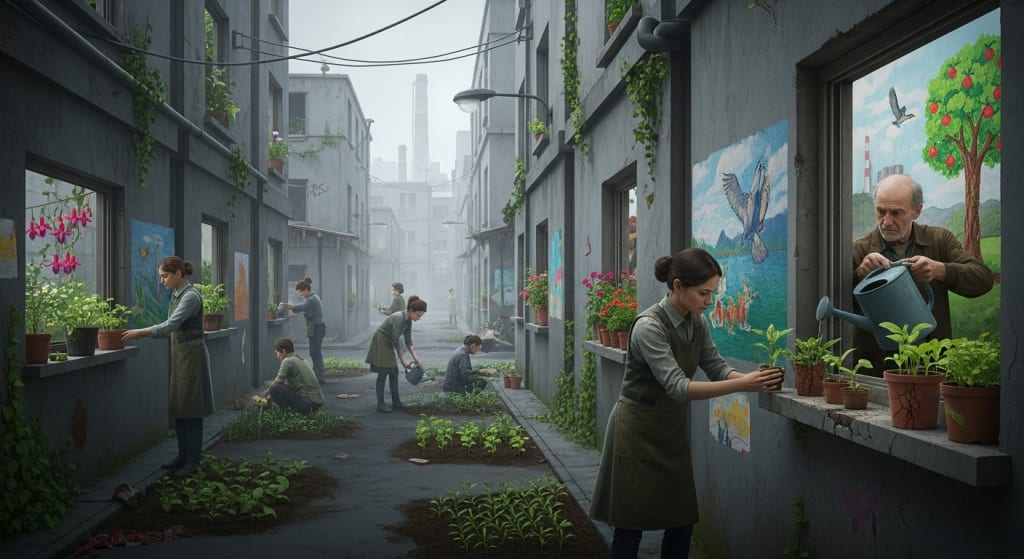
The city of Veridia was a canvas of muted greys and faded browns. Once celebrated for its vibrant architecture and sprawling gardens, it now lay under a perpetual shroud of industrial haze, a monument to a forgotten future. Its people moved like shadows, their footsteps hushed, their eyes mirroring the desaturated landscape – vacant, resigned, utterly devoid of the spark that once defined humanity. A slow, insidious despair had seeped into every crack and crevice, silencing laughter, dimming aspirations, and ultimately, stealing colour from the world.
Elias, a former cartographer, now spent his days sifting through old, brittle maps of a Veridia that no longer existed. He lived in a cramped, dust-choked apartment overlooking a street where even the wind seemed too weary to stir. The 'Grey Sickness,' as some called it, wasn't a plague of the body, but of the spirit. It manifested as an pervasive apathy, a belief in the futility of effort, a quiet surrender to the inevitable. Elias felt it, too, a cold hand squeezing his own heart, threatening to extinguish his last ember of defiance.
One particularly bleak morning, as the weak light struggled to penetrate his window, Elias noticed something impossible. Wedged between two cracked paving stones just outside his building, a single, defiant sprout of green pushed its way through the asphalt. It was no more than a few millimetres tall, fragile, yet fiercely determined. For a long moment, Elias simply stared, mesmerized. It was an anomaly, a breach in the monochrome order of despair.
A flicker ignited within him, a warmth he hadn't felt in years. He felt a sudden, irrational urge to protect it. He carefully fetched a small cup of water and trickled it onto the parched earth around the sprout. His neighbour, Mara, a woman whose face was etched with years of hard-won cynicism, watched him from her own window. "Foolishness," she rasped, her voice as dry as the dust motes dancing in the gloom. "What good is one weed against a city of stone?"
Elias didn't respond. He knew her words held the weight of Veridia's collective sorrow. But as he watched the tiny leaves unfurl slightly, he felt a strange sense of purpose, a quiet rebellion taking root in his own soul. He began to tend to the sprout daily, sometimes even speaking to it, whispering forgotten names of flowers. He scavenged for tiny fragments of soil, for discarded pebbles to create a miniature barrier around its nascent life.
His small act of devotion attracted no immediate change, only more bemusement and scorn. Yet, a subtle shift began within Elias. He started looking for other anomalies, other whispers of life. He found a stubborn vine clinging to a crumbling wall, a lone bird's nest tucked beneath a broken awning. He began to draw them, not just as they were – withered and struggling – but as they *could be* if the city remembered its vibrancy. He sketched verdant leaves, vibrant blossoms, birds in full, soaring flight. He started pinning these drawings, anonymously at first, in forgotten corners of the city, on walls scarred by neglect.
The first responses were predictable. Some were torn down, others defaced with bitter scribbles. "False hope," someone scrawled beneath a sketch of a blooming rose. "A lie." Elias wrestled with his own doubts. Was he simply indulging in a dangerous delusion? Was hope merely a gilded cage, trapping people in an unrealistic fantasy while their world crumbled around them?
But then, he saw it. A young woman paused before one of his drawings, a depiction of a towering, fruit-laden tree from Veridia's past. Her finger traced the outline of a leaf, and for a fleeting moment, a flicker of something akin to curiosity, perhaps even wonder, touched her eyes. It was gone as quickly as it appeared, but it was enough. It was a ripple in the vast ocean of apathy.
Elias realized that hope wasn't about ignoring reality; it was about choosing a different lens through which to view it. It was about actively seeking out the possibility of light, even when surrounded by shadows. It wasn't a passive wish, but a defiant act of creation. It was a weapon, not against the physical decay of Veridia, but against the internal decay of its people.
He became bolder. He began to speak, first to his small sprout, then to the few curious onlookers who would occasionally stop. He spoke of Veridia's forgotten stories, not with nostalgia for a lost past, but with a vision for a potential future. He described the tenacity of life, the audacity of a seed to break stone, the profound human capacity to find beauty and purpose even in the most barren landscapes. He started a small "garden," a designated spot where he encouraged people to bring any seed, any plant, however small or withered, and simply begin.
Many scoffed. Some called him mad. The City Council, custodians of Veridia's pervasive gloom, issued vague warnings about "unauthorized gatherings" and "disrupting civic peace." But slowly, tentatively, a few people started joining him. A child brought a single, forgotten onion bulb. An old man, his hands trembling, began carefully tilling a patch of hard earth with a broken trowel. They weren't growing food, not yet. They were growing something far more vital: agency.
The movement was slow, like a glacier melting, almost imperceptible. Elias didn't preach a grand revolution; he championed micro-rebellions. A shared smile. A story told. A song hummed quietly. A small pot of herbs tended on a windowsill. Each act, no matter how tiny, was a declaration against the Grey Sickness, a vote for life. It was a conscious choice to imbue meaning where there was none, to generate light where darkness reigned.
Mara, his cynical neighbour, remained aloof, observing his efforts with a mix of disdain and grudging fascination. "You're only postponing the inevitable, Elias," she'd grumble. "The city is dying. Let it die in peace."
"Peace," Elias would respond, his voice quiet but firm, "is not the absence of struggle, Mara. It is the presence of purpose."
The climax of Veridia's transformation wasn't a dramatic event. There was no sudden burst of sunlight, no magical reversal of the environmental blight. The sky remained a muted grey. But the city's heartbeat had changed. In small courtyards, hesitant patches of green began to appear. On windowsills, a riot of potted plants bloomed, some with flowers so vibrant they seemed to almost glow against the dull backdrop. Quiet laughter, once a foreign sound, began to echo in the streets. People exchanged glances that held not just resignation, but a subtle acknowledgment of shared purpose, a flicker of light in their eyes.
One afternoon, Elias found Mara standing by his small, thriving garden. She held a tiny, withered seedling in her gnarled hands, her gaze fixed on the earth. She didn't look at Elias, but her voice, when it came, was softer than he had ever heard it. "This… this thing," she said, nodding at the struggling seedling. "It won't make it, will it?"
Elias knelt beside her, gently taking the seedling. "Perhaps not," he admitted, his fingers carefully brushing away a speck of dust. "But it has the potential. And the act of tending it… that has its own strength." He handed it back to her. "The fight isn't for the outcome, Mara. It's for the fight itself."
Mara looked at the seedling, then at the small, flourishing garden that had once been barren earth. She didn't smile, but a hint of something unreadable softened the harsh lines around her mouth. She walked away, but later that day, Elias saw her on her own windowsill, carefully placing the seedling in a small, cracked pot, a tiny rebellion of her own.
Elias understood then. Hope was not a naive expectation that everything would be alright. It was a profound, defiant act of human will. It was the decision to cultivate possibility in the face of certainty, to choose to build light even when surrounded by the deepest shadows. It wasn't a passive emotion; it was an active, generative force, a powerful, quiet weapon that reshaped not just the external world, but the very essence of human spirit. Veridia was not saved from its greyness, but its people were saved from the void. They had learned to become architects of their own light, choosing, every single day, to defy despair with the simple, profound act of living, truly living.
About the Creator
Mehrdad Rajabi
A quiet observer of the human heart and the cosmic dance. Diving deep into the beauty and complexity of what it means to live, feel, and strive.
Keep reading
More stories from Mehrdad Rajabi and writers in Fiction and other communities.
The Silent Roar of Veritas
The Veritas Dam stood as a benevolent colossus, a century-old sentinel cradling Lake Veritas high above the idyllic valley of Aethel. For generations, its concrete curves had cradled the lifeblood of the village below, feeding their fields, powering their mills, and ensuring their serenity. It was more than a structure; it was a promise, a bedrock of their existence.
By Mehrdad Rajabi5 months ago in Fiction
The Duelist
The rays of a dying red sun flashed against the onrushing blade. The grey beards say the key to dueling lies in size, speed, reach, righteous fury, whatever the person in front of them pays them to say. Matteo knew better than any it was none of these and had an undefeated record on these sands to prove it.
By Matthew J. Fromm3 days ago in Fiction
📢 Raise Your Voice Thread: 01/22/2026
Our “Raise Your Voice Threads” are hosted most alternating Thursdays at 12PM ET to offer creators more avenues to uncover exceptional stories on Vocal. As we are continuously searching for fresh creators and inspiring stories, this thread provides an opportunity to exchange and discuss the stories that have moved and motivated us on Vocal.
By Raise Your Voice by Vocal7 days ago in Resources



Comments
There are no comments for this story
Be the first to respond and start the conversation.