
The Archaeology of Sorrow
A September Story

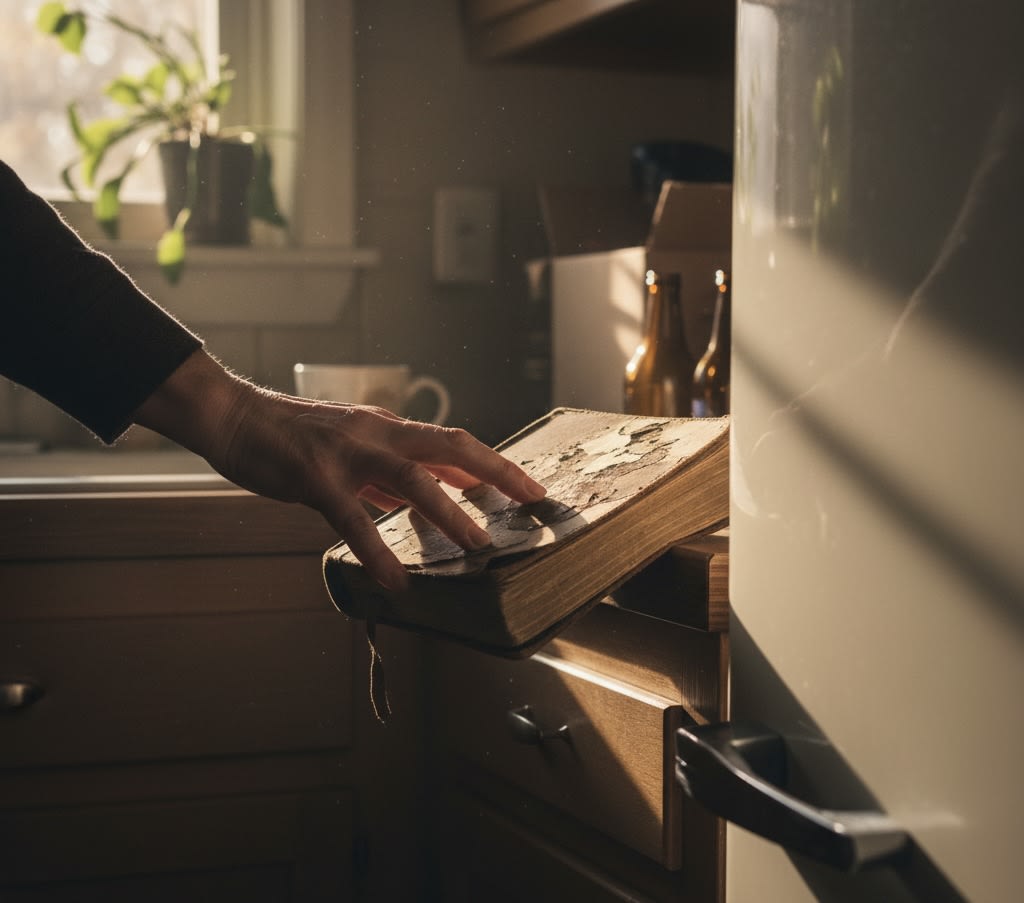
Dorothy Kelloway had learned that grief was an archaeologist, uncovering layers of a life she'd never known existed, one heartbreaking artifact at a time.
She stood in Martin's apartment three weeks after the funeral, cardboard boxes stacked like small monuments to the impossible task of reducing twenty-four years of living into manageable parcels. September light slanted through windows he would never see again, illuminating dust motes that danced with the indifference of particles that had outlived the boy who'd watched them spiral through these same golden beams.
How do you pack up a son? she wondered, touching the coffee cup still sitting in the sink, still bearing the ghost of his lips on the rim. How do you fold dreams into boxes and label them for Goodwill?
The apartment breathed with his presence—books spine-cracked and margin-noted, clothes draped over chairs as if he'd just stepped out for groceries, a houseplant drooping by the window in desperate need of water she could never bring herself to give it, as if keeping it alive might somehow call him back.
I watered your plants, Martin. Time to come home.
But the silence answered with its own terrible mathematics, the kind that subtracted sons from mothers and left remainders that would never balance.
Dorothy began with the kitchen, where cereal boxes revealed the eating habits of someone who'd forgotten how to care for himself. Expired milk. Bread growing civilizations of mold. A refrigerator that held more bottles than food, amber soldiers lined up like a liquid army she'd never known was occupying his life.
When did food become the enemy and bottles become friends?
She found the first journal wedged between the refrigerator and counter, its pages swollen with spilled whiskey and tears that had dried to brown stains. Her hands trembled as she opened it, recognizing handwriting she'd watched form in second-grade practice books, now transformed into desperate hieroglyphics of a soul drowning in its own depths.
"September 3rd - Mom called today. Told her I was fine. Easier than explaining that fine feels like a foreign language I never learned to speak. The bottles understand English, though. They speak fluent disappearance."
Dorothy sank into his reading chair, the journal heavy as lead in her lap, each page a window into a country of pain she'd never been granted a visa to visit. The entries chronicled months of careful deception—family dinners where he'd practiced smiling, phone calls where he'd reported fictional job interviews and imaginary social plans, holidays where he'd arrived bearing gifts wrapped in forced cheerfulness and tied with ribbons of lies she'd never thought to question.
"October 15th - Ran into Mrs. Peterson at the grocery store. She asked how I was doing, and for a moment I almost told her. Almost said, 'I'm dissolving, Mrs. Peterson. A little more each day, like sugar in rain.' Instead I bought another bottle and told her I was great, just great, couldn't be better."
The apartment held its breath as Dorothy read, each entry a small gravestone marking another day her son had survived alone while she'd believed his careful performances of wellness. The journal revealed a parallel universe that had existed three blocks from her own kitchen, where Martin had fought battles she'd never known were being waged, where bottles had become bandages for wounds that wouldn't heal and couldn't be discussed at Sunday dinner.
"November 22nd - Thanksgiving tomorrow. Will drive to Mom's and pretend to be grateful. Grateful for what? For mornings that feel like drowning? For nights when sleep comes only in liquid form? For the particular talent I've developed for disappointing everyone who ever believed I might amount to something? But I'll carve the turkey and ask about Aunt Helen's arthritis and compliment Mom's stuffing, because that's what sons do. They perform wellness until everyone believes the performance is the person."
Dorothy remembered that Thanksgiving, remembered thinking how much better Martin had looked, how his color had improved, how he'd even asked for seconds of her green bean casserole. She'd congratulated herself on his recovery from what she'd assumed was a temporary rough patch, never suspecting that his appetite was chemically enhanced and his good mood was borrowed against a future he was already planning to forfeit.
"December 31st - New Year's Eve. Everyone making resolutions. Mine is simpler than theirs - just make it stop. The noise inside my head, the weight in my chest, the way every morning feels like waking up in someone else's life. Mom called to invite me to watch the ball drop with her and Dad. Told her I had plans with friends. The bottles and I will watch time change together. They never judge my resolutions or expect me to keep them."
The journal entries grew shorter as winter deepened, despair condensing into haikus of hopelessness that broke Dorothy's heart with their terrible poetry. Martin had inherited her way with words, but he'd used his gift to document his own dissolution with the precision of a scientist recording the failure of an experiment he'd never wanted to conduct.
"January 16th - Three weeks sober. Mom actually hugged me yesterday, said I seemed like my old self again. If she only knew my old self died somewhere around junior year of college, and what she's seeing now is just muscle memory, reflexes that remember how to smile and nod and pretend that life is something that happens to me instead of something that's slowly draining away."
"January 18th - Bought a bottle. Just one. Just to sleep."
"January 19th - Just to sleep became just to wake up. The mathematics of addiction are simpler than algebra but harder than calculus. One drink equals two equals twelve equals calling in sick equals Mom asking if I'm okay equals lying equals hating myself for lying equals needing another drink to quiet the shame. The equation never balances."
Dorothy found empty bottles hidden throughout the apartment like landmines of sorrow—behind books, inside the tank of the toilet, wrapped in winter coats that would never see another season. Each discovery revealed new depths to the deception, new levels of the careful architecture Martin had constructed to hide his disintegration from people who loved him but couldn't save him from the particular gravity that pulled him toward the bottom of every bottle.
The final journal entry was dated two days before the funeral, written in handwriting so shaky it looked like words drawn during an earthquake:
"September 12th - I keep thinking about that story Mom used to read me. The one about the dandelions that turned into wishes when you blew on them. I used to believe that worked. Used to believe wanting something badly enough could make it real. Now I know better. Some wishes dissolve before they reach heaven. Some stories end in the middle of sentences. Some sons disappoint their mothers so completely that disappearing becomes an act of mercy. I'm tired of being the sad story she tells herself has a happy ending. Time to let someone else be her son. Someone better at it than I was."
Dorothy closed the journal and pressed it against her chest, trying to absorb the pain her son had carried alone, trying to understand how love could live in the same house as despair without either knowing the other existed. The September light had shifted while she read, painting the apartment in shades of amber that reminded her of the bottles she'd found, the liquid promises that had whispered lies to her beautiful boy until he'd believed them more than he believed in tomorrow.
I would have held you, she thought, speaking to the empty room where his presence still lingered like cologne on forgotten clothes. I would have held you through every dark night. I would have learned the language of bottles if that's what it took to translate your pain. I would have been brave enough to love you broken if you'd given me the chance.
But the apartment held its silence, keeping its secrets now that their keeper was gone, leaving Dorothy to pack up not just possessions but the terrible knowledge that somewhere beneath her roof, her son had been dying of thirst while drowning in sorrow, and she'd never learned to read the signs that were written in a language she'd never known he was speaking.
Outside, September continued its patient transformation, leaves practicing their annual surrender while Dorothy learned the hardest lesson of motherhood—that sometimes love isn't enough, isn't big enough, isn't loud enough to drown out the voices that whisper to beautiful boys that the world might be better off without them.
Some stories end in the middle of sentences, Martin had written, and Dorothy understood now that her job wasn't to finish his story but to carry it forward, to speak its truth at kitchen tables and church basements and anywhere people gathered who needed to know that bottles were liars and sons were precious and sometimes the bravest thing you can do is admit that the person you love most in the world is drowning right in front of you.
The journals would go home with her, not packed in boxes for Goodwill but preserved in the sacred space where mothers keep the artifacts of children who slipped away when no one was watching. And maybe someday she would find the words to transform his pain into something that might save someone else's son, might teach another mother to recognize the language of despair before it became fluent in goodbye.
I love you, Martin, she whispered to the empty room. I love you broken. I love you gone. I love you enough to tell your story until someone else's story gets a different ending.
The September light faded, but the love remained, patient as archaeology, enduring as sorrow, strong enough to carry the weight of what was lost and what might yet be saved.
About the Creator
Caleb Lahr
Step into a world where the boundaries of reality and magic interlace. My stories blend the extraordinary with the everyday to illuminate the complexities of the human experience.
Keep reading
More stories from Caleb Lahr and writers in Fiction and other communities.
The Whispers of Pages
In the city where silence reigned and shadows grew long, Evelyn walked with her head bowed, careful not to meet the eyes of the Watchers that stood on every corner. Their visors gleamed in the harsh light of the street lamps, reflecting a world drained of color and life.
By Caleb Lahrabout a year ago in Fiction



Comments
There are no comments for this story
Be the first to respond and start the conversation.