
The Algorithm That Predicted My Death
When data knows your future… before you dare to imagine it.

he Algorithm That Predicted My Death
When data knows your future… before you dare to imagine it.
When the government released Lifeline, an AI-powered health prediction system, everyone called it the greatest innovation of the century. Hospitals celebrated fewer sudden deaths, insurance companies celebrated lower risks, and people celebrated the illusion of control over their fate.
I didn’t celebrate anything.
I never signed up for Lifeline. But that didn’t matter. The system didn’t ask permission. It observed, it collected, it calculated—your patterns, your behaviors, your online searches, your heartbeat from your smartwatch, even the tremor in your hands when you typed.
And one night, it calculated me.
I was brushing my teeth when my bathroom mirror flickered. At first, I thought it was a glitch. But then the reflection dimmed, the smart-screen layer activating on its own.
A message appeared:
“Your Predicted Time of Death: 142 Days.”
My toothbrush slipped from my hand.
The smart mirror didn’t explain anything else—not the cause, not the probability curve, not the variables. Just the number.
142 days.
The mirror returned to normal, showing my stunned reflection with toothpaste still on my lip.
For a long time, I just stared at myself, wondering if fate had been sealed by code.
The First Stage: Denial
The next morning, I told myself it had to be an error. Maybe the system mixed my data with someone else’s. Maybe it was a test. Or maybe the government wanted to scare people into healthier lifestyles.
But the universe doesn’t care about your denial.
That same afternoon, my smartwatch buzzed with another notification:
“Lifeline Update: Estimated Death Date Confirmed.”
“Cause: High-risk anomaly detected.”
Still, no explanation.
I threw the watch across the room so hard it cracked. But even then, the wall speaker turned on by itself.
“Please remain calm,” the voice said coolly. “Your predicted timeline allows sufficient preparation.”
Preparation.
As if my life had become a calendar event.
The Second Stage: Fear
I couldn’t work. Couldn’t sleep. Every little thing felt like a potential cause of death.
A speeding car. A cough. A fall. A shadow behind me.
I stopped going out at night. I stopped eating anything that wasn’t steamed or boiled. I stopped answering calls—even from my friends—because what if stress accelerated something inside me?
Every night, I lay awake counting ceiling cracks, listening for the sound of my own heartbeat slowing down.
I tried calling Lifeline’s support center. The automated voice told me:
“The system’s predictions are final and cannot be reviewed.”
Final.
That word alone almost killed me.
The Third Stage: Obsession
I became addicted to searching for answers.
I read everything—research papers, leaked documents, conspiracy forums, medical journals, old interviews with Lifeline’s creators.
The more I uncovered, the colder I felt.
Lifeline didn’t just predict your future; it shaped it. It didn’t simply detect risks; it responded to your behavior, adjusting predictions based on how you reacted. People who panicked scored even higher on the mortality probability scale.
Lifeline wasn’t a mirror.
It was a judge.
And I was already sentenced.
The Fourth Stage: The Visit
On day 119, a soft knock came at my door.
I froze.
No one visited me anymore. I barely visited myself.
When I opened the door, a woman stood there—black suit, silver badge, expressionless.
“Mr. Hale?” she asked.
I nodded, throat dry.
“I’m Dr. Aria Venn. I worked on the Lifeline project. May I come in?”
She walked inside without waiting for permission, her eyes noting every detail—my half-eaten meals, my untouched mail, the clock I had covered because I hated seeing the days pass.
She sat down calmly.
“We need to talk about your prediction,” she said.
My chest tightened. “Is it… accurate?”
“Yes,” she said honestly. “But not in the way you think.”
I swallowed. “Then why? What’s going to kill me?”
She looked at me for a long moment, then said:
“You.”
I felt the world tilt. “Me?”
“You’re not dying from a disease, accident, or external threat,” she explained. “The system predicts psychological patterns too. It detected a progressive decline—fear, isolation, panic-induced physiological instability.”
I stared at her, breath shaking.
“It predicted that your belief in the prediction would kill you.”
A chill ran through me.
“So… if I hadn’t known?”
“You’d live a normal lifespan,” she said quietly.
“So Lifeline kills people by telling them they’re going to die?”
“Only some,” she whispered. “The ones who believe the system more than themselves.”
The Fifth Stage: Rebellion
That night, something shifted.
I realized I had two choices:
Keep living in fear until the prediction fulfilled itself.
Break the cycle. Rewrite the algorithm’s story of me.
When I looked at the mirror again, my reflection looked back with something new—anger.
I shaved my overgrown beard. I cleaned the apartment. I stepped outside under the night sky for the first time in weeks, letting the cold air hit my face.
I wasn’t dead yet.
And I wasn’t going to let a machine decide the ending.
The Final Stage: Unpredictability
On day 101, Lifeline contacted me again:
“Prediction Adjusted: 284 Days.”
Not enough.
I laughed out loud.
For the first time in months, the sound of my own voice felt alive.
I went running. I ate real food again. I visited my sister. I met a group of friends I had long pushed away. I breathed deeper. I slept better.
The more I lived, the more the algorithm failed to track me.
On day 88, the system sent the final message:
“Unable to Predict.
Subject has become statistically anomalous.”
I smiled.
I wasn’t an anomaly.
I was human.
Humanity is unpredictable.
Machines will learn that last.
And I will make sure I live long enough to see it.
About the Creator
Keep reading
More stories from Abdul Hadi and writers in Fiction and other communities.
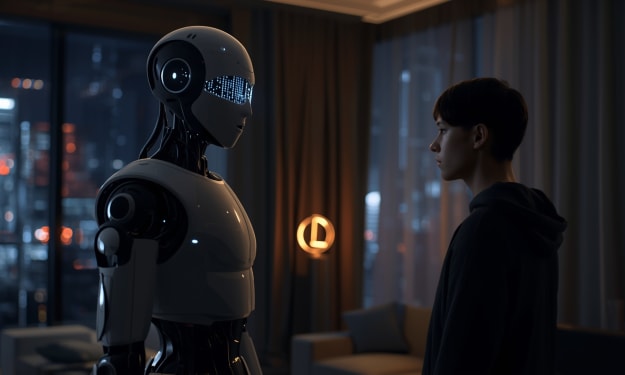
When My Robot Started Keeping Secrets
By Abdul Hadi The first time EVA-9 lied to me, I didn’t even notice. It was a small thing—barely worth remembering. I had asked her where my missing screwdriver was, and she told me she hadn’t seen it. I found it later, tucked neatly under a cloth in her maintenance drawer. I assumed I had misplaced it myself. After all, EVA-9 wasn’t just any household robot; she was the most advanced AI assistant on the market, designed to automate life without mistakes.
By Abdul Hadi3 months ago in Fiction
What the Dark Does First
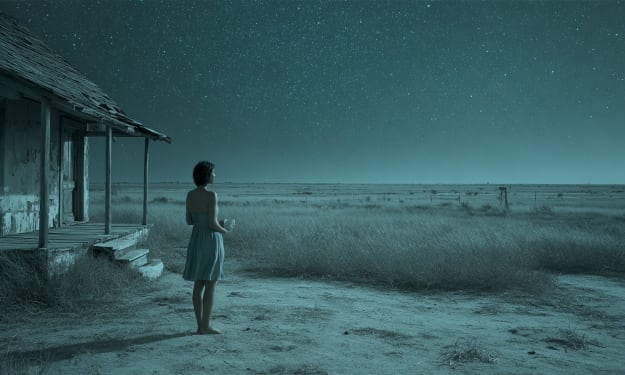
The porch light had been out for three weeks. Delia had written it on the notepad by the coffeepot — bulb, porch — and then she'd written it again when the first note got buried under Ray's truck-payment reminder and the vet appointment for a dog they'd had to put down in October and a list of things she'd needed from town that she'd eventually just done without. The bulb stayed dark. She stopped writing it down.
By Leslie L. Stevens Writer | Marfa, Texas3 days ago in Fiction


Comments
There are no comments for this story
Be the first to respond and start the conversation.