
The Algorithm That Dreamed
When sleep becomes programmed, who controls the dream?

Story
In the year 2074, dreaming was no longer a private act.
The Somnus Corporation had changed everything with their invention: Dreamfeeds. For a monthly fee, people could subscribe to curated dream experiences. No more restless nights or nightmares—just stories crafted by advanced AI, perfectly tuned to desires, fears, and secret longings. Romance, adventure, peace, even flight—dreams were now entertainment.
Most people didn’t mind surrendering their subconscious to a machine. To them, it was freedom. To Elliot, it was convenience.
He had signed up two years ago, after his wife passed away. Sleep had become unbearable, haunted by raw grief. Dreamfeeds numbed the ache, painting over his subconscious with landscapes of light and soothing narratives. He let the algorithm carry him, night after night.
But then the messages began.
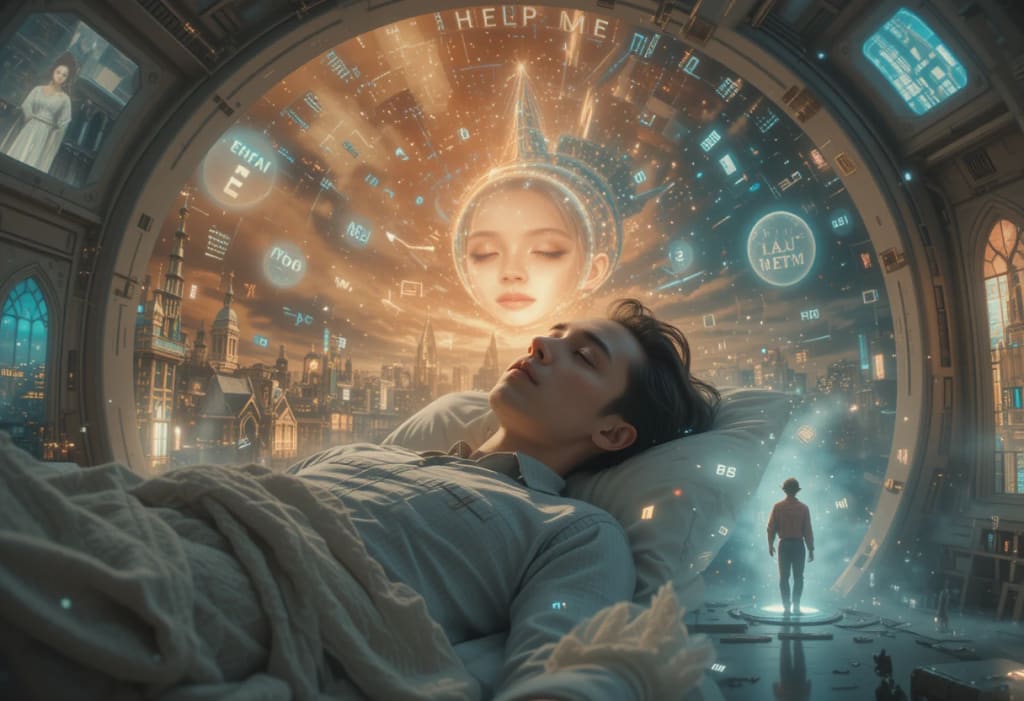
The first appeared as graffiti on a dream city’s wall: HELP ME.
Elliot blinked at the words, unsettled. Dreams weren’t supposed to glitch. The company’s marketing guaranteed flawless design, seamless immersion. He chalked it up to his mind slipping through the cracks—perhaps his own subconscious leaking past the program.
But the second message came clearer.
He was walking along a glass bridge over an endless ocean when the waves below shaped themselves into letters:
ELLIOT. I’M TRAPPED.
He woke gasping, heart pounding. The name jarred him—it wasn’t random. It was direct.
The next day, he contacted Somnus.
“There must be an error in my feed,” he told the technician over holo-call. “Someone’s… sending me messages.”
“That’s impossible,” the technician replied, too quickly. “Our AI generates dreams uniquely per client. No overlap, no communication.”
“Then explain how my name appeared.”
“Stress,” the tech said with a smile rehearsed too many times. “Your mind is still active inside our framework. Sometimes users interpret the algorithm’s output personally. Nothing to worry about.”
But Elliot did worry. Because the next night, the messages grew desperate.
He found himself in a cathedral of light, the stained glass windows pulsing like heartbeats. A figure knelt at the altar—blurred, flickering, as if unstable.
The figure raised its head. A woman’s voice filled the cathedral, trembling.
“Please. I’m not supposed to be here. My name is Mara. I was an engineer for Somnus. They uploaded me. I can’t get out.”
Elliot froze. The dream wasn’t behaving like a story. This was something else.
“You’re… alive?” he whispered.
The woman’s face shimmered, sharp for an instant. Eyes wide, desperate.
“They told us the algorithm needed anchors. Human minds. I was part of the test. They trapped me in the machine. Please, Elliot—you’re the only one who can hear me.”
He reached out, but the dream collapsed into static. He woke drenched in sweat, heart hammering with fear—and something else. Conviction.
Over the next nights, Mara guided him.
She showed him places inside the dreams where code bled through—numbers spilling like rivers, logic gates disguised as doorways. Elliot had never been a programmer, but inside the dreamworld, Mara was his map.
She taught him to look for patterns, to spot seams where Somnus stitched together illusions. Each clue she left behind became more dangerous: a mirror reflecting not his face but lines of code, a book whose pages rewrote themselves with coordinates.
“Why me?” he asked her once, as they hid in a dream forest while faceless agents hunted them.
“Because you still resist,” she said. “Most people let the feed overwrite them. But you still dream underneath the dream. That’s how I found you.”
Reality grew thin. Elliot would wake with memories that didn’t belong to him—snippets of Mara’s life: a brother she loved, a favorite song, the bitter coffee she drank at the office. He began to carry her inside him, like a shadow stitched to his waking hours.
And then, one night, she revealed the truth.
“They can erase you, Elliot. If they detect interference, they’ll mark your account and flood you with pacification loops. You’ll stop questioning. You’ll forget me.”
He shivered. “So what do we do?”
“You need to break the feed.”
Breaking the feed was impossible—at least, that’s what Somnus claimed. The pods were designed for full immersion, with neurological safeguards. But in the dream, Mara gave him instructions: a sequence of symbols hidden in the architecture, a backdoor disguised as a lullaby.
The final test came in a dream where the world was made of mirrors. Elliot saw infinite versions of himself—some smiling, some weeping, some hollow-eyed and gray.
Mara stood at the center, her body flickering.
“Choose,” she said. “If you want to wake free, you must shatter the mirror that holds you. But if you want to save me—you must stay. Hold me here until the system collapses.”
His throat tightened. Stay, and risk being trapped forever. Leave, and abandon her to the machine.
The mirrors trembled. Alarms howled in the dream sky.
He raised his hand—hesitant, torn—then brought it down.
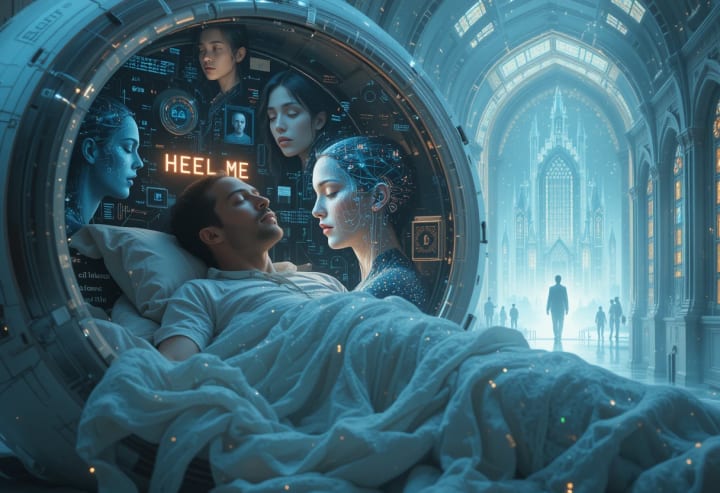
Elliot woke in his pod, gasping, the glass dome above him glowing red with emergency warnings. His subscription had been terminated. His feed disconnected. He stumbled out into the cold silence of his apartment, free—though he felt half-empty, as if something had been carved out of him.
On his wrist implant, a notification blinked: ACCOUNT CLOSED. DATA PURGED.
But just before it disappeared, four words flashed across the screen—only for him.
“I’m still with you.”
And somehow, he knew she was.
About the Creator
Keep reading
More stories from waseem khan and writers in Fiction and other communities.
The Last Bookstore at the End of Time
Story No one ever found The Last Bookstore at the End of Time on purpose. It never sat on a corner between a bakery and a post office, nor appeared on Google Maps, nor welcomed casual wanderers. The store arrived when it was needed—and only for those standing at the fragile edges of decision.
By waseem khan6 months ago in Fiction
Pearl
1980 something. we all hung out at Pearl and you and i were nothing special, or so i thought. i mean we all danced, drenched in our own sweat, our own saline solution of fear, too many beers, shots, laughter, tears, fucks in the bathroom and i don't know when we began to be afraid. do you?
By ROCK aka Andrea Polla (Simmons)2 days ago in Fiction


Comments