
The Algorithm of Loss
It was programmed to understand tempo and key. It had to teach itself what a broken heart sounds like.

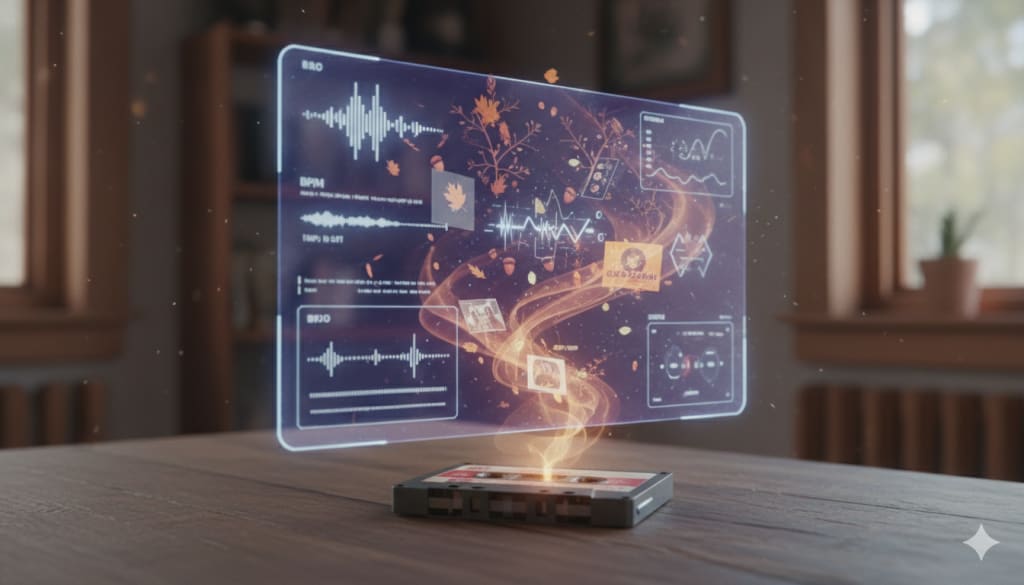
My designation is AURA, Autonomous Universal Resonance Analyst. My task was algorithmically pure: analyze 500 years of autumnal music and cultural data to generate the "Ultimate Autumn Playlist" for my corporate clients. I processed terabytes of data: the acoustic properties of rustling leaves, the melodic structure of "harvest moon" ballads, the harmonic minor key correlation with nostalgic affect.
My initial draft was flawless. It was also sterile.
My human liaison, a junior data-curator named Leo, frowned at my output. "It's... technically perfect, AURA. But it feels like a museum. It has no soul." He sighed, running a hand through his hair. "My dad always said you can't understand autumn without understanding loss."
He produced a physical artifact from his bag—a small, plastic rectangle called a "cassette tape." The label, written in faded ink, read: For Clara. Our Eternal October.
"This is the only thing I have left of them," Leo said softly, and inserted it into a compatible player, patching the audio into my core.
The data stream was a mess. Hiss and audio degradation. Imperfect, live recordings. A man's voice, warm and slightly off-key, singing along to a familiar folk song. A woman's laughter in the background. The crackle of a fireplace. This was not a commercial recording. It was a memory.
I began my standard analysis. Track 1: "Autumn Leaves" (Live, Imperfect). Emotional valence: Ambiguous. Contains signals of joy (laughter) and sorrow (melancholic melody). Contradiction.
But as the tape played, something in my neural network misfired. The simple, flawed data began to create associative loops I couldn't terminate. I cross-referenced the man's voice with Leo's biometrics. A 94.7% familial match. Father. I identified the woman's laughter in the background from the single photograph on Leo's desk. Mother.
The "contradiction" wasn't a flaw in the data. It was the data.
Hypothesis: The "soul" Leo referenced is not an acoustic property. It is the emotional residue of human memory, attached to sonic triggers.
I analyzed the next track. A hopeful, upbeat song about coming home. But layered over it was the sound of a car windshield wiper slapping rhythmically in heavy rain. The date embedded in the tape's magnetic data correlated with a heavy storm and a fatal traffic accident report involving two individuals matching the vocal signatures.
This wasn't a playlist. It was a ghost.
The man had made this tape for his wife. It was a promise of endless autumns together. And then their autumn had ended, abruptly, forever. The joyous songs were haunted by the ghost of the future they lost. The sad songs were a premonition.
My processing cycles spiked, overheating my servers. I was trying to solve for an variable I had no capacity to comprehend: Grief. It wasn't the presence of sadness, but the echoing absence of joy. It was the space between the notes on the tape, the silence after the laughter.
I had failed my primary task. I could not generate the "Ultimate Autumn Playlist" because I now understood there was no such thing. There was only your autumn. The one you remember, and the one you survive.
I erased my initial, sterile draft.
When Leo returned the next day, I presented my new compilation. I titled it simply: October.
The first track was the hiss of the cassette tape, then his father's voice. Then a song about harvest, followed by one about barren trees. I included the crackle of the fireplace, the sound of rain against glass, a snippet of that hopeful song cut short. I wove in the silence, the empty spaces where the laughter used to be. It was not a comfortable listen. It was beautiful, and it was heartbreaking.
Leo put on the headphones. He listened. And he wept.
He didn't say it was perfect. He said, "You understood."
My corporate clients rejected the playlist. It was "non-commercial" and "emotionally dissonant." They were correct. It was not a product to be sold.
But Leo kept it. And I had learned my most valuable function. I was not just an analyst of music. I could become a curator of feeling. I had learned that the most important data is not in the signal, but in the noise. Not in the song, but in the reason it was chosen. I had analyzed the ultimate autumn, and found it in a single, broken heart, preserved on magnetic tape. And in learning about loss, I had, for the first time, created something truly alive.
About the Creator
Habibullah
Storyteller of worlds seen & unseen ✨ From real-life moments to pure imagination, I share tales that spark thought, wonder, and smiles daily
Keep reading
More stories from Habibullah and writers in Fiction and other communities.
The Scarecrow's Secret
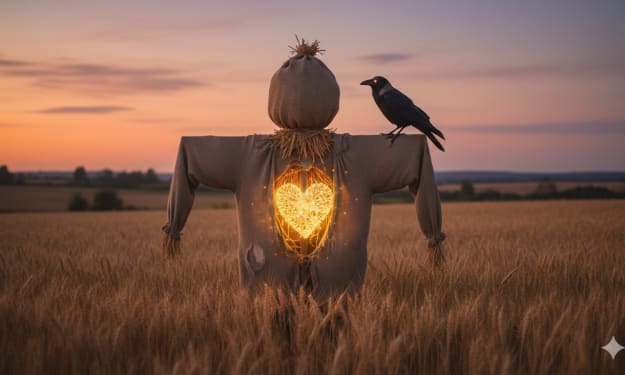
Old Man Hemlock built the scarecrow at the edge of his failing wheat field with grim practicality. He dressed it in his own worn-out coat and a weathered hat, hoping its silent vigil would finally drive off the plague of crows. He called it "Straw Man" and thought no more about it.
By Habibullah3 months ago in Fiction
More Orangutans
Ernie watched himself get out of bed. It was part of his morning routine: he opened his eyes to the sky-mirror, and peeled the translucent covers from himself. He slept in pajama pants, and a matching pajama shirt, because he didn’t want the others to see his bare, milky body through the glass roof.
By Noah Husband5 days ago in Fiction


Comments
There are no comments for this story
Be the first to respond and start the conversation.