
Sweetness from the Garden
a short story
He listened mouth agape for the millionth time tataia Stefan’s story about the old woman’s hidden treasure. No doubt it was buried somewhere within the crumbling walls of the old barn, tataia reassured him. Petru had just told him about his dream from the night before. The old woman had appeared to him and guided him to a place in the garden. But the boy was confused, because that wasn’t even close to the barn. He remembered vividly how he had tried to resist the apparition and kept pointing her back toward the barn. In his dream, they were communicating without talking to each other, so Peter could still feel a tinge in his right arm from ardently and vigorously having pointed towards the front of the small plot of land. “No, it’s there, under the barn!” he wanted to scream in the dream, but no words were coming out of his mouth. The stories he had heard so many times could not have been wrong…
*****
“Are you going with me today?” tataia woke him up that morning in his unique way, touching his hand softly. “I have to go early and feed the animals, then come back to the town for my doctor’s appointment,” he whispered trying not to wake up his grandmother. Petru blinked a few times and then jumped up. Tataia Stefan, his grandfather, had named him “his designated summer apprentice” and they have been going to the “garden” together every day for a few hours ever since the summer vacation had started. The “garden” was a small piece of land, no more than a half an acre, a few miles out of the city. Tataia was not from those parts and had been moved by the government there in the heart of the country's breadbasket all the way from the mountains of Transylvania, but he had inherited that land from an old woman he had taken care of for a few years before she had passed away.
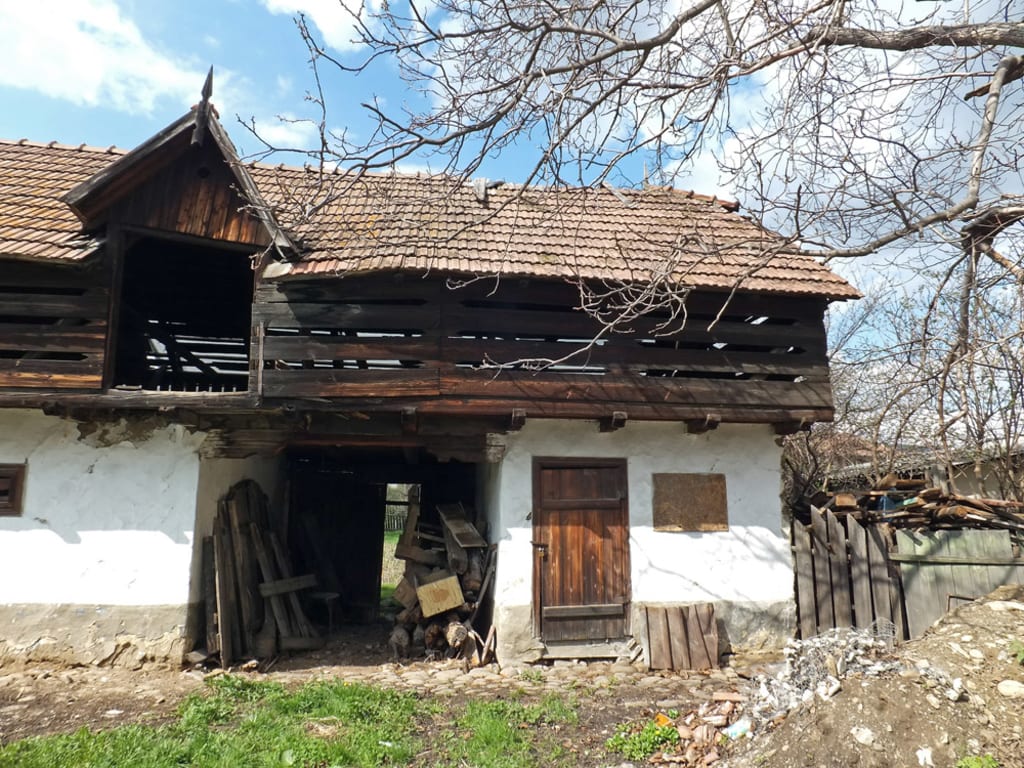
Petru and tataia were now building a new house on that land. The grandfather raised the forms and the grandson neatly arranged inside as many rocks and chunks of broken brick he could fit from the big piles amassed over the years by the old man. Then, tataia poured the concrete and filled the forms. They had already raised several of the exterior walls. The old house where the woman had lived could only be used now as a barn for the few pigs, goats and chickens tataia kept. He used to have rabbits too, but one morning a couple of years back he had gone there in the morning as usual only to find out that they had all been stolen. Neighbors? Other people from the village? The police didn't care much. And tataia hadn't said anything then, no curses, no fist waving at the skies, but Petru knew how much he must have hurt. Even though he raised animals for meat, a scarce commodity during the dictatorship, tataia cared about each and everyone of them. He spent a lot of time with the pigs, scratching their bags and making sure that they had warm food, and was always letting the chickens and the goats roam freely in the garden even though they’d sometime get into his vegetables. He did the same for the plants, the trees and the vegetables he was growing. He carried buckets upon buckets of water from a well a few hundred yards down the road, he carefully and lovingly pruned the fruit trees and the grape vines and weeded the corn and the beets and berry bushes, always bent over them under the merciless sun of the Romanian plains.
They took the train that morning. Soon after they arrived and finished feeding feeding the animals, they found themselves in the middle of a heavy summer rain. The sky turned dark in a matter of minutes and then the thunder filled the air. “Oh, this is good for the garden,” tataia murmured, a smile of satisfaction on his face. “Let’s get inside the barn. Go up on top of the hay, boy!” Petru ran up the ladder and waited for his grandfather to join him. The rain was getting steadily heavier, and Petru began to worry that tataia would get soaked. He could see him going from one patch of veggies to another picking something up, then carrying a bag, then a bucket half full with water. Finally, a bit wet, the old man joined him on top of the hay in the attic of the old house. He had brought their lunch, plus some green onions and tomatoes, freshly picked. He grabbed a few straws in his hand and cleaned the dirt off of the onions. “Sweetness from the garden,” he said and handed an onion and a tomato to the boy. That's how he always described anything coming from his garden. Vegetables and the visine sour cherries and figs and apples and corn and grapes and onions and garlic… they all were “sweetness from the garden.” He looked inside the bag and took out a chunk of mild telemea cheese wrapped in thick brown paper, smoked and salty pork slanina, hard-boiled eggs and a round loaf of dark bread. “It’s a bit early for lunch, but we might as well take advantage of this rain,” he said. “We then need to hurry back to the train, so I can go have my shot.” Tataia had been bitten by a dog on his way to the garden a week or so ago, and now he was doing anti-rabies shots in his stomach for forty days in a row.
Petru took a good bite of the onion and then one of the cheese. There was no better food anywhere in the world than their onions and tomatoes and cheese with dark bread, he thought. His mouth still full, he told tataia, who was biting the onion piece by piece making it all disappear inside his mouth, about the dream. “So where was she taking you, then?” the old man asked, suddenly interested. “It’s so strange though, cause you never met Baba Safta, so how could you see her in your dream…?” he pondered. “She was pointing somewhere in the back of the garden, nowhere near the barn…,” Petru said food shoved inside his cheek taking advantage of the fact that his mom couldn't see him and chastise him for bad table manners. He picked up three small cubes of slanina off the wooden cutting board. “Hmmm… well, you know, she told me a few days before she passed into the world of the always good and right…,” and tataia started again the story of the old woman who had not always been old and who had to run away from her country when she was young because she was from a very rich family and that whole country she was from collapsed and the government was overthrown by a revolution. All the rich people, the emperor, whom they called tsar, and his wife and their children and cousins and brothers and sisters were killed. And that whole world that had stood there as a big empire for centuries and had worked quite well for the rich people but not so great for everyone else was gone in a matter of months.
But Baba Safta as a young woman had managed to run away from her family’s mansion in the country and headed west towards the border and safety. She could only take a few things with her, an old icon encased in solid gold, and a handful of jewels and precious stones. No papers or anything, so that no one could guess her identity if she were caught. And she was caught once and she had to do different things for a chief of a band of revolutionaries, a barrel-chested short hairy man his comrades called the commissar. Tataia said she had to “serve” him, and Petru imagined this delicate young noble woman having to do this vile man’s laundry and polish his boots and his blood boiled with anger every time. But young Baba Safta ran away from the hairy commissar too and reached the border. And she only stopped in this village outside their town by the Danube River and bought a piece of land and built a house. That’s where she lived alone with only a few animals and two dogs to keep her company for the rest of her days. When she got too old to take care of the house and herself, she found tataia to help her. And to thank him for his dedication to a stranger, she left him the house and that small piece of land not even a half an acre in area. Then, before she died, she told tataia that her jewels were buried somewhere under the house, but that she could no longer really remember very well where… “I never needed them, and it was dangerous to sell them anyway…” she told tataia. “I lived off this land and the animals I kept. Then, the political order changed here as well, and the people in this country too got rid of their leaders and the rich and the educated and the ancient traditions. So, I hid my true identity forever. But you, you are such a wonderful young man, and I hope you can find that treasure, Stefan…” she had apparently told my tataia.
Tataia Stefan had never looked for the treasure, though. “What for?” he always answered Petru with a question whenever the boy prodded him to explain himself, his imagination feverish with the vision of precious stones shimmering in the moonlight. Tataia was happy to have good vegetables and fruit from the garden and enjoy his quiet life. For his life had not always been that quiet, but that is a story for another time. And although Petru had woken up that morning determined to start digging in the back of the garden in search of the elusive treasure, he now just sat there watching the heavy rain fall like a translucid water curtain while chewing slowly on a green long onion stem, its sweet sharpness numbing his tongue. He put his hand on his grandfather’s and held it down on his small knee. “Sweetness from our garden…” he said, but his words were covered instantly by a booming thunder close by.
About the Creator
George T. Sipos
George T. Sipos is a Romanian American writer, scholar of Japanese literature and culture and literary translator from Japanese into Romanian and English and has published four volumes of translated prose and novels.
Keep reading
More stories from George T. Sipos and writers in Fiction and other communities.
Nothing New to Report
Nothing New to Report “Nothing new to report. Outside observable area status: unchanged. Inside pod status: unchanged.” Petra turned off the observation cameras surveilling the ten-mile perimeter around the RUSH. She couldn’t shake the uncanny feeling that enveloped her whenever she was on duty and had to hear her own voice on the security recordings. She ignored it and recorded the status message in the three other languages that she had been assigned. First in French, then in Japanese and Romanian. Everyone on the pod was assigned languages and cultures to assimilate and preserve. Petra’s pod was a small one with only twelve residents in six couples, so she had been assigned one additional language. But she was happy about the Japanese. She had become quite fond of it over the years and watching old recordings of performance arts shows had become one of her favorite things to do on the pod. The haunting masks and chanting in the nō plays were one of the most spiritual experiences she has ever had.
By George T. Sipos5 years ago in Fiction
Miss Persephone's Manual to a Seemingly Ordinary Life
Miss Persephone was found at the dining table, her blue eyes swollen, her tears arriving and retreating like the tides of the ocean. Earlier that day, her family had visited her in the retirement home where she had lived for eight years. It was her eightieth birthday.
By Imola Tóth7 days ago in Fiction
G.I. Joe's Last Stand, Saturday, December 25th, 2010
This was Toby’s best Christmas ever!! He woke up to a mountain of presents, even ones he hadn’t dared ask Santa for. A brand new Playstation 2 sat amid the chaos along with two amazing new games: an adventurous SpongeBob game and Spyro the Dragon. There was also a football, a blue and orange frisbee, a fresh pair of shoes, a stack of new clothes, and not one but two big stockings overflowing with sweetness and joy.
By Anton Mathias Heft 3 days ago in Fiction
Center Stage with Paul Stewart
*** I'm keen to republish the interviews I did for my series with Vocal creators. It's been a few years and I thought it might be nice to revisit these wonderful conversations. I'll be releasing them one at a time for a few weeks/months.
By Heather Hubler7 days ago in Interview



Comments
There are no comments for this story
Be the first to respond and start the conversation.