
Surviving in the Abyss
Humanity's Salvation in the Deep

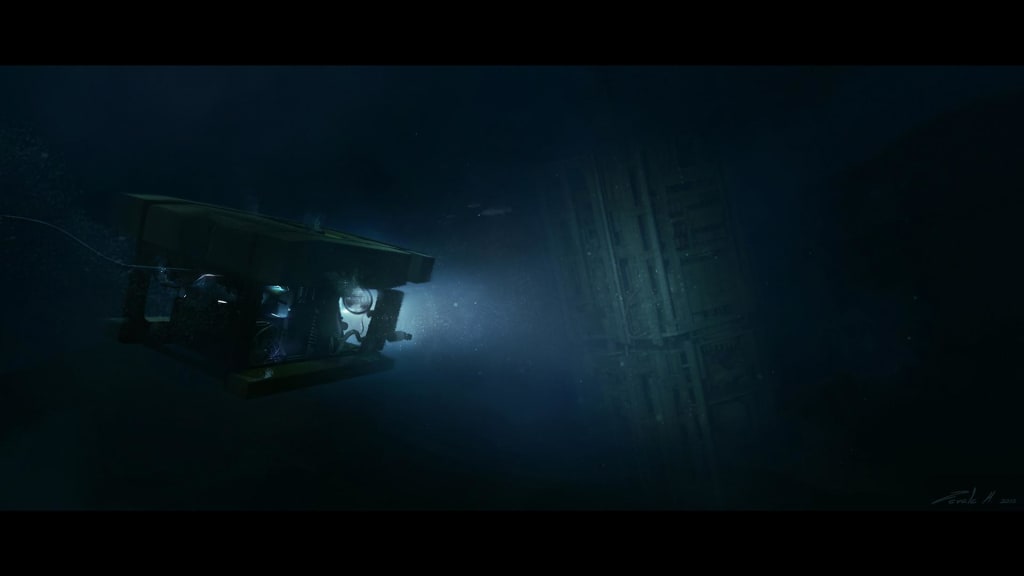
The cabin was cold, dark, and damp. I sat alone in a thick metal sphere crammed with computer monitors and caressed the heart-shaped locket on my necklace. As I sat alone, my mind wandered, and I thought about how far from home I was in the deep abyss. The computer screens, the only light source, compounded this feeling as they displayed the vast undersea landscape of the deep abyss.
The terrain was dark and intimidating and filled with life that would have been unfamiliar to most people in past years. Unlike sharks, whales, and other marine life people were accustomed to seeing in aquariums, species in the darkest depths of the world’s oceans looked like aliens from another planet. Some of these species tested the scientific community’s knowledge of how life evolved on our planet.
I always loved the sea growing up as a little girl along the Gulf Coast of Florida. My favorite memories were on the beach, exploring the shells along the sand, and seeing the fish swim in the warm ocean waters. After my father introduced me to Jules Verne’s 20,000 Leagues Under the Sea, I became interested in marine biology. As I grew older, I became fascinated by Charles Darwin’s theory of evolution and his premise that life formed in the oceans, and then evolved to live and thrive on land. I always wondered if life could evolve or devolve in the opposite direction if it needed to return to the sea. This question became the core of my doctoral thesis. At the same time, my father and friends were fascinated by the development of our nation’s space program and efforts for humanity to become a multi-planetary species. While I found space exploration interesting, I knew there was more to learn about planet Earth; however, I never imagined I would have to use my research of the ocean’s depths as a means for humanity’s survival.
Two years ago, Earth was unexpectedly blasted by large asteroids that altered life in unimaginable ways. The impact of the asteroids created explosions that were millions of times more potent than the nuclear arsenals of the world’s major powers. The devastation left whole areas devoid of life as the fire, and then ash consumed them. All the impacts destabilized the Earth’s fault lines leading to horrific earthquakes and volcanic eruptions, and the air became toxic to humans and animals alike. Humanity faced an existential level event.
Survivors hid in old bomb shelters built in the event of nuclear war during the middle to the late twentieth century to save critical members of society. Others hid in old mines and deep shafts. Sadly, billions of people were lost in the devastation, and society collapsed around the world. These shelters provided humanity a grace period for survival that depended on the food and clean water supplies stored within them. Unfortunately, the toxic air outside meant that plant and animal life died off, so that there was no means to resupply the shelters with needed food. As supplies dwindled, only the shelters closest to the seas could send parties out to find food in the world’s oceans; however, marine life in the shallow areas began to suffer and die as the seas became more acidic.
When the asteroids struck, I worked as a researcher for the Woods Hole Oceanographic Institution on a joint mission for the National Oceanic and Atmospheric Administration, popularly known as NOAA Office of Ocean Exploration and Research and the U.S. Navy. The Woods Hole Oceanographic Institution became famous when Robert Ballard discovered the wreck of the Titanic in 1985. Several years later, the Navy revealed that the search for the Titanic was used to cover up Ballard’s real mission; helping the Navy locate two lost nuclear submarines in the Atlantic Ocean.
Due to my scientific credentials, I was allowed to hide in a shelter designed to protect the nation’s collection of nuclear-powered submarines and deep submersible vehicles along the Atlantic Ocean. Sadly, I did not have time to contact my parents or brother. The only thing I had to remember them was the heart-shaped locket with their pictures. The locket was a gift given to me by my parents to wear when I was on my deep ocean research missions.
Inside the shelter was a collection of nuclear-powered submarines and deep submersible vehicles. Thankfully, the shelter housed the majority of the submarine crews and their families. The deep submersible vehicles were used to map the ocean’s floor, leading to discoveries of the Earth’s geology and life at extreme depths. As the food supplies began to decline and the seas became more acidic, I was asked to join a team to look for a new home that would ensure humanity’s survival.
The team and I used the submarines with the attached deep-sea submersibles to explore the ocean’s floor for suitable locations to establish underwater habitats. We needed to find an area that was safe to build structures that would withstand the underwater pressure and be large enough to house hundreds and eventually thousands of people.
As we searched the ocean floor, we discovered life became more abundant the deeper we went. We found that life in the deepest regions of the oceans did not need the same kind of nutrients as marine life closer to the surface. Additionally, underwater plant life appeared to thrive without sunlight.
One day, we sent an unmanned submersible into the deep ocean trench near Puerto Rico. What I saw from that mission amazed me. At depths beyond 25,000 feet below the ocean surface, images of deep marine life showed a world flourishing and undisturbed by the devastation above. I realized that the key to humanity’s long-term survival meant it had to move to the deepest parts of the world’s oceans.
However, to be a workable long-term plan, we needed to figure if we could survive off deep-sea marine life. My team and I needed to know if we could hunt or farm these species and decide whether they were fit for human consumption. What would a fish from the deep taste like? Would it be the same as the salmon, crabs, and shrimps people used to enjoy? During later missions, we had the unmanned submersibles bring back deep-sea creatures and plants. We found that the marine animals and plants were edible, but the taste took some getting used to for most people.
After several unmanned missions, I volunteered to go down into the depths in a manned submersible. As I scanned the computer images, I softly touched the heart-shaped locket necklace around my neck. At that moment, I had found humanity’s new oasis. It was a flat area in the darkest region of the trench. Unseen to the naked eye, the area was covered in marine life that looked like the underwater version of the Garden of Eden.
Once I found the location, I knew that construction of the new underwater habitats would begin within weeks and last several months. There was a sense of urgency as the food and water supplies, even when rationed, would not last more than a year. Despite my excitement of finding a new home for humanity, I knew that not all humanity that remained on the surface would survive. There was no way to communicate with those in shelters far away from the ocean. The only communications were with shelters close to the coastal areas that our submarines could obtain and maintain contact with during our explorations. The communication with the shelters close to the seas meant we could organize our efforts and gather the materials needed for the deep-sea habitats.
As I sat there contemplating the discovery of a new home and the future of humanity in the abyss, I knew that if humankind were to survive, it needed to adapt to its new environment. This new reality meant that society had to learn to not only survive but thrive again. I thought back to my readings on Charles Darwin’s theory of evolution. Darwin’s theory stated that life evolved from the sea, moved onto land, and thrived for millions of years. The devastation that hit Earth meant that humanity had to evolve or devolve to return to the sea. How society would adapt to thrive in the ocean’s abyss, I did not know. Still, I touched my heart-shaped locket again, knowing that the memories it represented of my family would motivate me to discover that answer in due time while surviving in the abyss. As I looked at the new home, I remember a saying my father once said, "from the sea we came and the sea we shall return."
About the Creator
Chad Pillai
Military Officer, World Traveler, and Author.
Keep reading
More stories from Chad Pillai and writers in Fiction and other communities.
Haunted Rumors
I heard the rumors. More accurately, whispers. No one wanted to speak of the ancient ruins atop the hill. Out of curiosity, when I asked folks in town, all I received were frightened or angry looks with comments under their breath. I was the new naive person in town, unaware of the town’s history and lore.
By Chad Pillai2 years ago in Fiction
Bomb Scare
It was 2027, and the world never thought it would happen. A missle hit the United States, but it wasn't where they had anticipated. A little town in the northeast was hit by a missile strike, they didn't know why, and they didn't know exactly where it hit, but they did know it was a coastal community, somewhere between Maine and Delaware.
By Gregory Paytona day ago in Fiction
Víðarr Óðinnson
Maybe I shouldn’t have come; most here don’t even know my name. To many, I am invisible, but to the one who has summoned me, I appear in all my fearsome splendor. Alas, woe to anyone I am summoned against, for they shall feel the sharpness of my blade before they see me.
By Mother Combs3 days ago in Fiction


Comments
There are no comments for this story
Be the first to respond and start the conversation.