

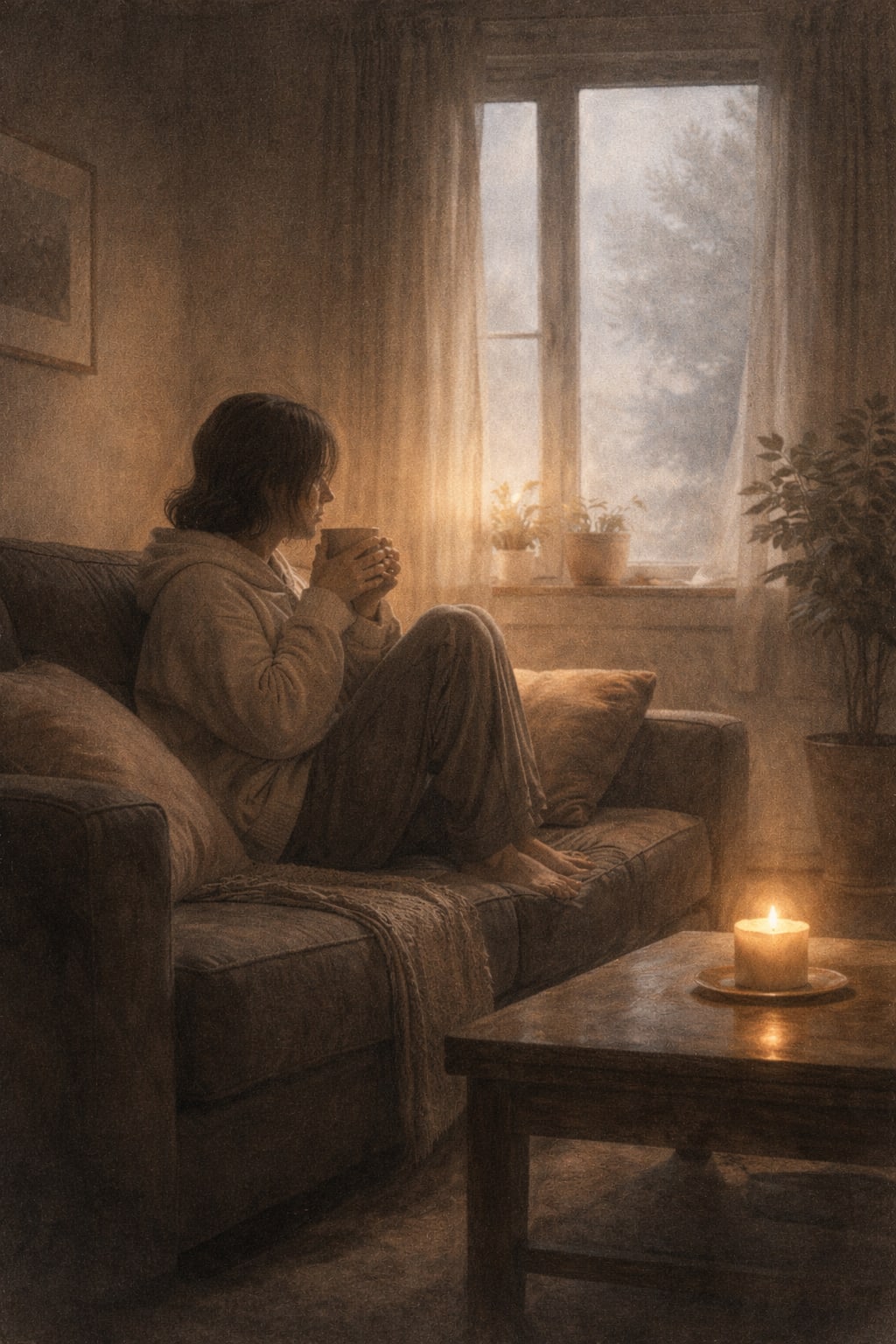
Important Notice: This guide is written for one occupant. If you are reading it aloud to someone else, lower your voice. The walls are thin. The house remembers volume.
Materials Required
- One set of keys that still feel wrong in your palm
- A mug with a chipped rim (optional but recommended)
- A small source of light (candle, desk lamp, the phone you promised not to sleep beside)
- A sponge that has seen better days
- A notebook you will insist is “for lists”
- One human body with a heart that hasn’t yet agreed to be ordinary
- Patience, measured in teaspoons, replenished daily
Step 1: Entering
1- Stand outside the door for exactly three seconds.
Do not negotiate with yourself. Negotiation becomes a hobby. Hobbies become lives.
2- Insert the key.
If your hand shakes, blame the cold. The house prefers weather to honesty.
3- When the lock clicks, pause.
The sound will be louder than you remember. That is normal.
The first time you left, the house swallowed the click and kept it.
Now it returns the sound to you, like a bill.
4- Open the door with a neutral expression.
The hallway will be watching. Hallways always watch.
Step 2: Removing Evidence
1- Take off your coat immediately.
Do not keep it on "just for a minute."
Minutes are slippery. A coat becomes armor. Armor becomes refusal.
2- Hang it where it belongs.
If you do not remember where it belongs, choose a hook and commit.
Commitment to small things is how you practice living.
3- Remove your shoes.
Dirt is easier to clean than grief, but both stain if you ignore them long enough.
Step 3: Checking the Air
1- Inhale once, slowly, in the entryway.
You are assessing the atmosphere. This is not sentimental. This is safety.
2- Identify the primary scent:
- Dust means time passed without you.
- Soap means you tried too hard before you left.
- Something burnt means you forgot a pan once and never forgave yourself.
- Nothing at all means the house has gone quiet on purpose. Proceed gently.
3- If the air smells like a person who is not here, do not panic.
Houses store people the way books store pressed flowers.
The smell will fade. Or it won’t.
Either way, you will learn to move while carrying it.
Step 4: Turning on Lights
1- Begin with one light only.
Flooding the room is tempting. Do not do it.
Brightness can feel like interrogation.
2- Prefer lamps to overhead fixtures.
Overhead lights imply a before-and-after you cannot currently afford.
3- If you choose a candle, place it near the window.
This is not superstition.
It is a signal to your nervous system: We are allowed to be seen.
4- Strike the match like you are doing something sacred and mundane at the same time.
Because you are.
Step 5: The Kitchen Protocol
1- Go to the kitchen even if you are not hungry.
Kitchens are where life pretends it is simple. Let it pretend for a moment.
2- Locate one object you recognize as yours.
A spoon. A glass. The ridiculous mug from that trip you took before everything cracked.
3- Wash it, even if it is already clean.
This is not about hygiene.
This is about touch. Warm water. Proof of motion.
4- Fill the kettle.
If you do not own a kettle, boil water anyway.
Ritual is more portable than equipment.
5- While the water heats, do not check your phone.
The phone contains timelines. You are not ready for timelines.
6- When the kettle whistles, do not flinch.
That sound is not anger. It is simply insistence.
7- Make tea, or coffee, or the cheapest broth you can manage.
The point is not flavor. The point is heat.
8- Hold the mug with both hands.
Two hands means you are present.
One hand means you are pretending you can leave at any moment.
Step 6: Avoiding the Hallway (Temporarily)
1- You will notice the hallway that leads to the room you avoid.
Do not argue with the hallway.
Hallways have patience you do not.
2- For now, you may treat the hallway as a museum exhibit:
Look from a distance. Observe. Do not enter.
3- If a door is closed, leave it closed.
Closed doors are not enemies.
They are boundaries with handles.
Step 7: The Living Room Arrangement
1- Sit somewhere that does not punish your spine.
You are not proving anything. Choose comfort.
2- If there are blankets, use one.
Warmth is not weakness; it is strategy.
3- If the room contains photographs, do not stare at them like evidence.
Photographs are not witnesses. They are artifacts.
They do not tell the whole story and never did.
4- If you must move a photograph, do so as if you are relocating a small animal.
Gently. Without sudden motions.
Step 8: Handling Unexpected Memory
Memory may appear in the following forms:
- A song coming from another apartment
- The indentation on a cushion
- The way a cup sits in a cabinet
- The exact angle of light at 16:07
- A phrase you cannot stop replaying
If memory appears:
1- Do not fight it. Fighting gives it muscles.
2- Name it once, quietly. Example:
"This is the day we thought we were fine."
"This is the laugh I miss."
"This is the sentence that split us."
3- Then return to a task.
Wipe the counter. Fold a towel. Refill the kettle.
Tasks are anchors.
4- If you cry, let it happen without commentary.
Tears are not a conclusion. They are drainage.
Step 9: What to Do with the Unsent Message
Eventually you will feel the urge to message someone.
A person. A version of a person. A memory that still has a phone number.
Follow these guidelines:
1- Write the message in the notebook first.
Yes, the notebook "for lists."
Add it to the list: Do not lie to yourself unnecessarily.
2- Do not use their name in the first draft.
Names can make your hands shake.
3- Keep it under three sentences.
Long messages are bargaining.
4- Read it once aloud.
If your voice breaks, that is data.
5- Decide whether the message is for them, or for you.
If it is for you, do not send it.
Fold the page. Put it in a book.
Let future-you find it when it no longer burns.
6- If it is for them, wait one hour before sending.
In that hour, drink water.
Eat something.
Touch a wall.
Remind your body it exists outside the message.
Step 10: The Room You Avoid (When Ready)
Warning: This step is optional.
Some people never complete it and still survive.
If you choose to proceed:
1- Stand at the threshold.
Do not cross it yet.
2- Notice what your body does:
The jaw clenching, the shoulders lifting, the stomach turning into a small animal.
3- Speak one sentence to the room, out loud:
"I am here."
Or: "I’m not ready, but I’m trying."
Rooms respond to honesty the way plants respond to water. Slowly, but truly.
4- Enter and touch one object.
Just one.
Leave the rest untouched. You are not excavating; you are visiting.
5- Exit before you feel brave.
Bravery is not the point. Regulation is.
Step 11: Sleeping
1- Do not aim for peace. Aim for rest.
Peace comes later and sometimes never looks like peace.
2- Leave one small light on.
Not because you are afraid, but because your nervous system deserves mercy.
3- If you dream of the before, do not interpret it.
Dreams are a recycling bin for the mind.
Let them be messy.
4- If you wake at 03:00, drink water.
Do not scroll.
Do not build an alternate life in your head.
Breathe.
Put a hand on your chest and remind it: We are still here.
Step 12: Morning After
1- In the morning, open a window for one minute.
Even if it is cold. Especially if it is cold.
Cold air is proof the world is real and continuing.
2- Make the bed badly.
Perfection is not required. Evidence of effort is enough.
3- Choose one task that has nothing to do with healing.
Buy bread. Answer an email. Water a plant.
Ordinary tasks are stepping stones back into yourself.
4- Repeat this manual as needed.
Some days you will do all twelve steps.
Some days you will manage only the kettle.
The kettle counts.
Final Note
If you are reading this because you think you failed, you have misunderstood the assignment.
A house that pretends nothing happened is not asking you to erase the rupture.
It is asking you to live anyway.
To light one candle.
To hold one warm mug.
To take one breath that does not apologize for existing.
That is how the story continues:
not with certainty,
but with procedure.
And slowly, between the steps,
you will notice something the instructions never state out loud:
You are not returning to who you were.
You are learning how to become someone new
without abandoning the parts of you
that still remember.
About the Creator
Alain SUPPINI
I’m Alain — a French critical care anesthesiologist who writes to keep memory alive. Between past and present, medicine and words, I search for what endures.
Keep reading
More stories from Alain SUPPINI and writers in Fiction and other communities.
Mastering French Without Losing Your Sanity: A Realistic Guide for Beginners
Learning French can feel like solving a Rubik’s Cube blindfolded. The tricky pronunciation, the never-ending grammar rules, and the surprising exceptions make it seem impossible. But don’t worry—equipping yourself with key expressions and effective strategies can turn frustration into fluency. Let’s simplify French and make learning enjoyable.
By Alain SUPPINIExclusive • 11 months ago
The steps to losing a child
Step One: Lose a child. Not what anyone wants to happen and nothing you can do to change it, but you can go through steps to becoming happy again. You can go through steps to loving again. You can go through steps to become a new you because after losing a child you will never be the same person you once were.
By Tabitha Hinkley3 days ago in Fiction


Comments
There are no comments for this story
Be the first to respond and start the conversation.