
St. Bartholomew's Day Massacre (1572): A Historical Tragedy That Changed France
(1572)

St. Bartholomew's Day Massacre (1572): A Historical Tragedy That Changed France
Introduction: What Was the St. Bartholomew's Day Massacre?
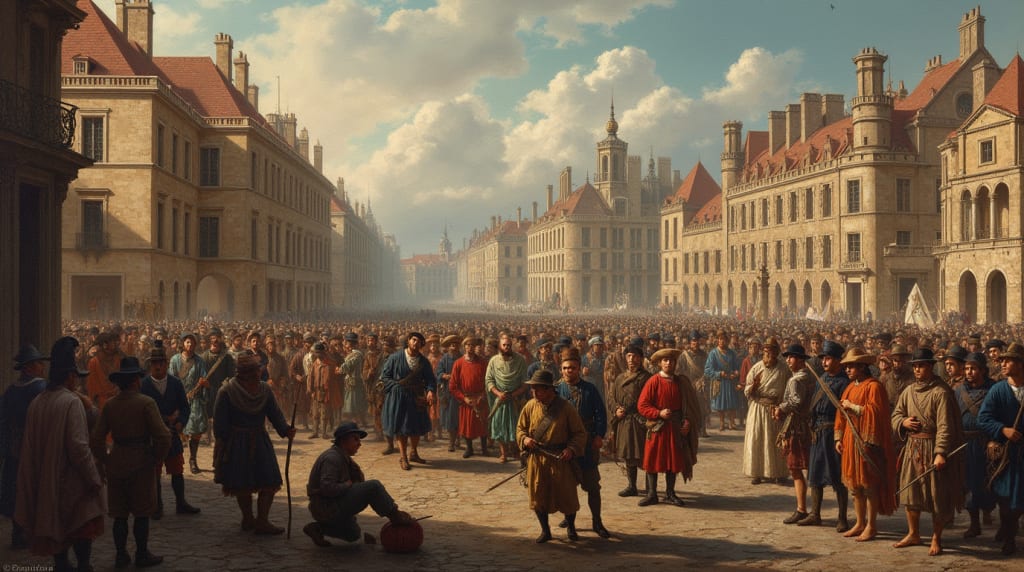
On the dawn of August 24, 1572, one of the most horrific tragedies in French history unfolded: the St. Bartholomew's Day Massacre. This gruesome event witnessed the killing of thousands of French Protestants, known as the Huguenots, under orders from the Catholic authorities. The massacre was part of a long-standing religious and political conflict between Catholics and Protestants and had a profound impact on France's political and social landscape.
Underlying Causes of the Massacre
1. Religious and Political Tensions
Since the mid-16th century, France had been engulfed in violent conflicts between Catholics and Protestants. The latter was a reformist movement aiming to liberate religion from the authority of the Catholic Church.
2. The Royal Marriage and Political Intrigue
In an attempt to establish peace between the two factions, the French king arranged a marriage between Margaret of Valois, a Catholic, and Henry of Navarre, a Protestant. However, what was meant to unify France ultimately led to disaster.
Details of the Night of the Massacre
1. The Sudden Onset
The massacre began just days after an assassination attempt on Protestant leader Admiral Gaspard de Coligny. The failed attempt heightened tensions. On the night of August 24, during the feast of St. Bartholomew, orders were given to kill Protestant leaders gathered in Paris.
2. Spread Across France
The massacre was not confined to Paris; it spread to other cities like Lyon, Toulouse, and Bordeaux. The killings continued for weeks, leading to the deaths of tens of thousands.
Key Events of the Massacre
1. Assassination of Protestant Leaders
The initial targets were prominent Protestant leaders. Admiral Coligny was brutally murdered, and his body was mutilated.
2. Widespread Violence
The killings were not limited to political and religious elites; ordinary Protestant civilians were also targeted in widespread violence.
Immediate Consequences of the Massacre
1. European Shock
The massacre provoked widespread outrage across Europe, especially in Protestant countries like England and the Netherlands.
2. Deepened Sectarian Hatred
The event further entrenched the divide between Catholics and Protestants in France, making reconciliation even more difficult.
3. Impact on the Reformation
The massacre became a symbol of religious oppression and spurred resistance to Catholic dominance in Europe.
Long-Term Effects on France
1. Exacerbation of Religious Wars
Rather than ending the conflict, the massacre intensified the French Wars of Religion, which continued for another two decades.
2. Protestant Exodus
The massacre prompted many Protestants to flee France, spreading their influence to countries like England and the Netherlands.
3. Paving the Way for the Edict of Nantes
In 1598, King Henry IV, a former Protestant, issued the Edict of Nantes, granting Protestants religious freedom in an effort to end the religious wars.
Lessons Learned from the Massacre
1. The Importance of Religious Tolerance
The St. Bartholomew's Day Massacre demonstrated the catastrophic consequences of religious intolerance.
2. The Dangers of Mixing Religion and Politics
The massacre highlighted the risks of intertwining religion with political agendas.
3. The Value of Dialogue and Peace
The tragedy proved that violence is not a sustainable solution to sectarian and political conflicts.
Conclusion: The Legacy of the St. Bartholomew's Day Massacre
The St. Bartholomew's Day Massacre remains one of the darkest chapters in French history. It showcased the horrors of sectarian violence and its devastating consequences. While it was a human tragedy, it also marked a turning point in French history, pushing the country towards seeking peaceful resolutions and enshrining religious tolerance. This event serves as a poignant reminder that dialogue is the only path to overcoming religious and political divisions.
About the Creator
💓 Pulse of Stories 💓
The world of short and inspiring stories! Here you will find stories that touch hearts, ignite the imagination, and take you on quick yet deep journeys.
Keep reading
More stories from 💓 Pulse of Stories 💓 and writers in Fiction and other communities.
Shadow of the Past: An Unfinished Story
Shadow of the Past: An Unfinished Story In a world filled with memories and unfulfilled dreams, there are stories that leave a profound impact on our souls. Shadow of the Past is the title of a story that carries many lessons and morals within its folds—a story that remains unfinished but continues to live in the hearts of those who lived it or heard about it. In this article, we will delve into the details of this captivating story and explore the various dimensions that make it a tale worth reading and reflecting upon.
By 💓 Pulse of Stories 💓about a year ago in Fiction
The Solitude of The Chupacabra
Many say that the Chupacabra is a rather recent and modern tale, a mangy coyote or rabied dog. Some point out that it’s just twisted evolution. But very few know the true backstory of the shapeshifter that led to the bloodsucking legend. And perhaps once you will come to know and understand more, you might “forget” a few cattle out to wander.
By Oneg In The Arctic3 days ago in Fiction
The Story Beneath The Story
People call me Bigfoot and other names and say that I smell horribly. They are afraid of me because I’m not human and have fur. I live where few people do, and the scent I give off is from my rich diet. We live in the wilderness, hiding from humans, and smell like the earth and trees. We rub the raw elk onto our fur and sometimes have nests with carcasses and excrement. Humans don’t find traces of our bodies because, when near death, our fur sheds and eagles take it away. We only die in the spring when wolf and bear cubs are emerging, and our bodies feed their young, while their parents consume our bones. There aren’t many of us left. We think humans stink, and we know when they are near. Human females smell better than males, but sometimes their acrid odor makes me sneeze; it seems to happen once every moon.
By Andrea Corwin 3 days ago in Fiction
The Forsyth House Fire
Since 1851, Forsyth House has stood on the corner of Union Street and Gordon Street in the heart of Glasgow. Its iconic, or was... because on Sunday 8th of March, 2026, a fire broke out in a small, seemingly un-named shop in the building and tore all that history down. As I write, the rubble is still unsettled and the street is still blocked off. Central Station is quiet on the upper level, and around 30 small businesses have quite literally gone up in smoke.
By S. A. Crawford3 days ago in The Swamp



Comments
There are no comments for this story
Be the first to respond and start the conversation.