
SpaceX Launch Creates Mesmerizing 'Nebula' in Sky: April 21, 2025, Space Picture of the Day
A Stunning Atmospheric Display as SpaceX’s Falcon 9 Rocket Paints the Sky with Light During Its Return to Earth

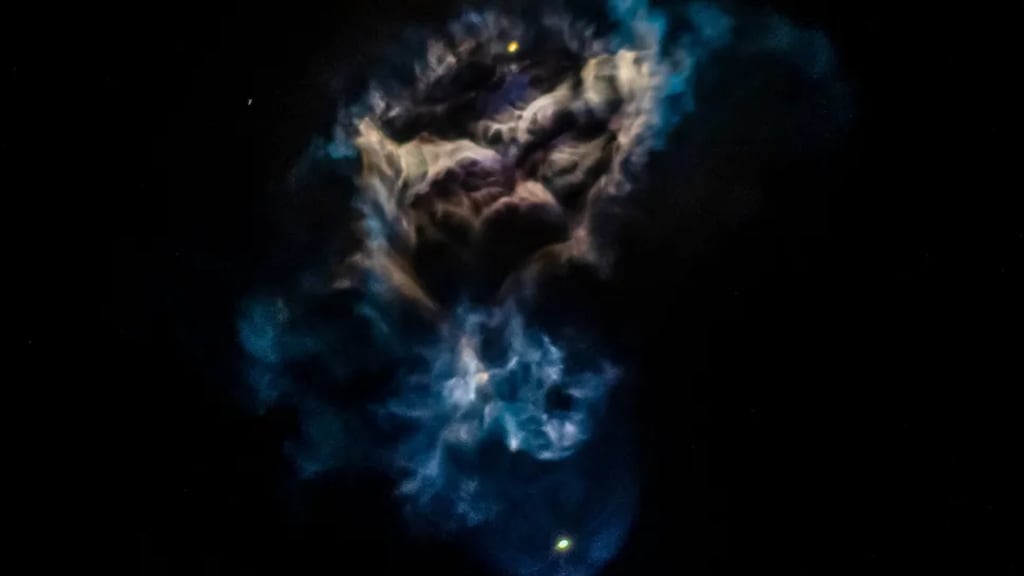
In a dazzling demonstration of technology meeting natural beauty, a recent SpaceX rocket launch painted an awe-inspiring image in the early morning skies, resembling the brilliant, swirling colors of a deep-space nebula. This captivating spectacle occurred during the company’s 32nd commercial resupply mission (CRS-32) to the International Space Station (ISS), solidifying SpaceX’s place not only as a trailblazer in aerospace technology but also as an unintentional artist of the cosmos.
What Happened?
On April 21, 2025, in the calm stillness of early morning, SpaceX launched its uncrewed Dragon spacecraft from Launch Complex 39A at NASA’s Kennedy Space Center in Florida. The mission, part of NASA’s Commercial Resupply Services program, aimed to deliver critical cargo, scientific instruments, and supplies to astronauts aboard the ISS. This was the 32nd such mission undertaken by SpaceX, showcasing the company’s consistent ability to support international space research and collaboration.
The Falcon 9 rocket, which has become a workhorse for SpaceX, was tasked with carrying the Dragon capsule into orbit. As part of the mission’s flight profile, the Falcon 9’s first stage separated from the second stage shortly after liftoff. While the second stage continued propelling the Dragon toward orbit, the first stage began its return journey to Earth — a feat of engineering and precision that has become a hallmark of SpaceX launches.

The Ethereal Glow: A 'Nebula' Born in Earth's Atmosphere
What caught the attention of skywatchers, photographers, and scientists alike was the breathtaking light show created during the rocket’s "boostback burn." This maneuver, which occurs high in the Earth’s atmosphere, involves relighting a subset of the first stage’s engines to adjust the trajectory for a return to the launch site rather than letting it fall into the ocean. During this burn, the rocket expelled exhaust gases that illuminated the sky, forming a glowing cloud-like formation that mirrored the shape and luminescence of a cosmic nebula.
Although these so-called "rocket-induced nebulae" have been witnessed before, each instance is unique due to the variability in atmospheric conditions, lighting, altitude, and timing. The April 21 event stood out for the clarity and vivid coloration of the phenomenon. The exhaust particles reflected sunlight in a way that diffused through the thin upper atmosphere, scattering light and creating what appeared to be a floating, radiant structure in space.
For a few magical moments, this human-made phenomenon bridged the gap between Earth and space, showcasing how advanced propulsion technology can give rise to scenes reminiscent of deep-space astronomy images captured by telescopes such as Hubble or the James Webb Space Telescope.
Where Did It Happen?
The event took place in the skies over Florida, beginning at Kennedy Space Center and culminating at Cape Canaveral Space Force Station, where the Falcon 9’s first stage successfully landed. The boostback burn responsible for the glowing visual occurred high in the upper atmosphere, where conditions are just right for sunlight to interact with rocket exhaust in extraordinary ways.
Launch Complex 39A, the site of liftoff, has a storied history in human spaceflight. It was the launchpad for historic missions like Apollo 11 and the final Space Shuttle launches. Now repurposed and modernized by SpaceX, it serves as a hub for both cargo missions to the ISS and upcoming crewed missions aboard the company’s Crew Dragon spacecraft.
After stage separation, the first stage navigated through a controlled descent trajectory, using grid fins for steering and onboard sensors for precise landing calculations. The boostback burn changed the rocket's course back toward land rather than following a ballistic path into the Atlantic Ocean. The visual spectacle was produced during this burn, roughly a few minutes into the mission, capturing the attention of onlookers both on the ground and across social media platforms.
Why Is It Amazing?
Rocket launches inherently represent the pinnacle of engineering, physics, and international cooperation. However, phenomena like the April 21 "rocket nebula" reveal an artistic dimension to these otherwise technical endeavors. The blend of light, gas, and motion creates a natural display that transcends mere utility and enters the realm of wonder.
Each rocket-induced nebula is a confluence of timing, angle of sunlight, and altitude. These conditions are typically met during twilight launches, where the rocket ascends into sunlight while the ground remains in darkness. The backlit exhaust particles scatter and refract light, creating ethereal halos, luminous spirals, or in this case, a full-blown nebula effect.
To the untrained eye, it might seem like an alien event or some form of atmospheric anomaly. In reality, it is a perfectly explainable yet profoundly beautiful consequence of orbital mechanics and propulsion science. The fact that such beauty arises from a calculated technical process makes it all the more inspiring.
Furthermore, the April 21 event serves as a reminder of how deeply interconnected technology and nature can be. Here, a rocket designed for logistical support to a space station inadvertently produced an image that could be found in the pages of an astronomy textbook or an art exhibit. It prompts us to reflect on the unexpected ways science enriches our visual and emotional experience of the world.
The Broader Implications
This event is more than just an eye-catching image. It speaks volumes about the progress of reusable rocket technology. Each time a Falcon 9 first stage successfully returns to Earth and lands, it validates the model of sustainable spaceflight. These reusable rockets are helping reduce the cost of access to space, making it feasible for more frequent missions and broader participation in space exploration and science.
Moreover, the CRS-32 mission itself underscores the importance of continuous support for the ISS. The cargo delivered includes food, research materials, equipment, and scientific experiments that contribute to a growing body of knowledge about long-term space habitation and microgravity’s effects on biological and mechanical systems.
Capturing the Moment
Photographers and amateur astronomers who witnessed the event captured stunning images of the 'nebula' in the sky. These visuals quickly went viral, with viewers comparing them to deep space structures such as the Eagle Nebula or the Carina Nebula. Social media channels were flooded with questions, awe-struck reactions, and praise for SpaceX and its role in turning an ordinary launch into a cosmic light show.
Experts in atmospheric science and rocket propulsion also weighed in, explaining how such visuals occur and why they are more visible under specific conditions. Their insights helped demystify the process while highlighting its uniqueness. Educators used the opportunity to discuss basic principles of light scattering, propulsion, and orbital dynamics, transforming a beautiful image into a teachable moment.
A Glimpse Into the Future
As we look ahead, events like the April 21 launch will likely become more common as the cadence of commercial space missions increases. With companies like SpaceX, Blue Origin, and Rocket Lab conducting frequent launches, the chances of witnessing rocket-induced sky phenomena will rise accordingly.
These events also serve as a gentle nudge for the public to remain curious and informed about space activities. They show that spaceflight isn’t confined to astronauts and scientists but touches everyone, even those simply glancing upward during their morning walk or capturing a moment on their smartphone.
Conclusion
The "nebula" created during SpaceX’s April 21, 2025 launch is a testament to the beauty that can emerge when advanced engineering intersects with the natural world. While the CRS-32 mission was focused on delivering supplies to the ISS, it also delivered something much more intangible but equally valuable: a sense of awe and a reminder that science and art often go hand in hand. In the age of reusable rockets and interplanetary dreams, even a routine supply mission can become a moment of cosmic wonder.
Writen by Sakibul Islam Sakib
About the Creator
Sakibul Islam Sakib
If you want to be happy, then always try to be alone, be strong, and be a humble person.
Keep reading
More stories from Sakibul Islam Sakib and writers in Fiction and other communities.
OpenAI Flex API in 2025: A Game-Changer for Budget-Friendly AI Usage
If you’ve been looking for ways to reduce your AI infrastructure costs without sacrificing too much performance, you’ll want to pay attention to OpenAI’s latest breakthrough in 2025—the Flex API. Designed for low-priority, high-volume AI tasks, this flexible pricing tier is ushering in a new era of smart, cost-efficient model deployment.
By Sakibul Islam Sakib9 months ago in Fiction
How to fill a hot water bottle. (Or, How to get through the night.)
1. Go to the cupboard where you keep all the towels and sheets. It's at the top of the stairs. Take a deep breath and roll your shoulders back. For this will take some effort. Reach up and dig into the mountain of materials. Past the scratchy towels, the creased sheets, the mismatched pillowcases, the marooned sock. Keep feeling until you find something somewhat soft. There might be a bit of matting from lack of use. With a slight hardness underneath. Grab onto it. Firmly. Begin to start pulling it out of its hole. Like a game of Jenga, don't let the mountain get on top of you. It helps to use one hand for steadying the mountain and the other hand for gripping on to the hot water bottle. Carefully slide it out. Take your time.
By Sarah O'Grady2 days ago in Fiction
Wild Card Weekend Recap: What Happens Now?
I think I figured out why I love Wild Card Weekend so much. It's because it's the first playoff anything of the calendar year. The NFL season starts in the fall, and once upon a time, the champion was crowned either on or slightly before New Year's. The evolution of the NFL schedule has resulted in the playoffs starting just into the New Year, and currently, the final week of the season falls on the first weekend of the New Year, with Wild Card Weekend coming a week after that. So yes, chronologically, the NFL's Wild Card Weekend serves as the first playoff anything of the calendar year.
By Clyde E. Dawkins6 days ago in Unbalanced




Comments
There are no comments for this story
Be the first to respond and start the conversation.