

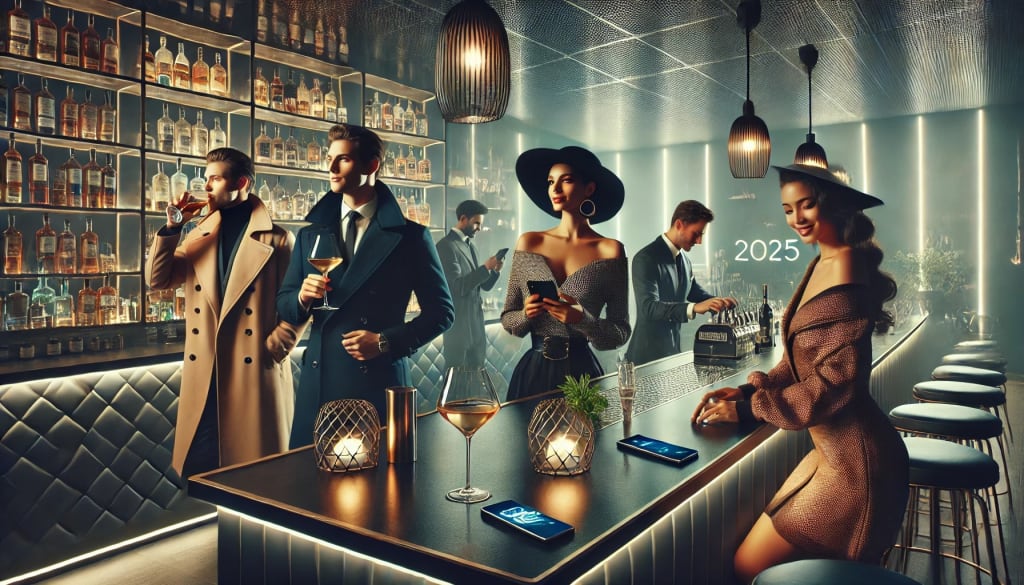
As I sit here in November 2025, I could never have imagined, when I first met Tassy, that she would lead me to moments of pure ecstasy—and to the depths of unfathomable darkness.
You’ll meet Tassy later. Not in this instalment. But believe me, she’s worth meeting and worth waiting for.
Let’s start at the beginning. December 6, 2024. 2:00 PM. I’m about to receive an award from the local Chamber of Commerce. My best friend, Samir—Sam—is seconds away from standing before a distinguished crowd to tell them all about me. You should hear what he has to say.
Maybe you’ll find it boring. Maybe you’ll think this is just an exercise in vanity. Fine. Put the book down. Walk away.
But if you do, you might never learn about the greatest existential threat humanity has ever faced. And is facing. And it’s at your doorstep.
The choice is yours.
Samir rose to speak.
"Good afternoon, everyone.
“How do I sum up Charles Blake? Hell, if I know—I’ll give it a shot, though, since I’m Samir Hamish McCloud, his best mate, business partner, and the poor sod tasked with introducing him at this Chamber of Commerce shindig.
“Charles came screaming into the world in London, 1989, born to a Russian father and a French mother—explains the accent he’ll deny he has—vodka flirting with wine.
“A precocious little bugger, he’d torn through Europe’s literary giants by twelve, decided philosophy and history were his bag, yet somehow ended up hooked on the pulpy thrills of Dennis Wheatley, Ian Fleming, Raymond Chandler, Conan Doyle, John Buchan and dozens of others. He’s been to bed with them all. At 39, he’d rather crack open a battered Bond paperback than wrestle with Dickens or Dostoyevsky.
“Charles is a walking contradiction, a rationalist with a capital R, built on the bedrock of cold, hard facts and cause-and-effect. His favourite phrase is: ‘I need to explain it.’ His second favourite phrase is: ‘I worship at the sacred altar of rationalism.’
“He’ll tell you the world’s a machine—gears grinding, no ghosts in the works. Yet, he’s got this weary glint in his eye, like he’s seen too much to dismiss the shadows outright. ‘Today’s supernatural,’ he’ll mutter over a few whiskies, ‘is just tomorrow’s science.’
“When you think about it, he’s got a point. If something happens, it must be possible for us to explain it. If an explanation is impossible; the phenomenon is impossible. Reasoning like that kinda loused up his love life but got him published in peer-reviewed journals.
“Oxford spat him out with a History and Philosophy degree before he hit 20, then he kicked up a storm with a doctoral thesis at 23—some brain-bending trip into nineteenth-century German mysticism and how it fuelled the Nazi nightmare.
It was called—I kid you not—A Comprehensive Exegesis of Teutonic Mythopoetic Traditions and Their Protracted Socio-Historical Influence on the Eschatological and Ideational Foundations of Nazism in the Twentieth Century. Snappy title, Charles. I understand it was big in academic circles. I mean, come on, dip me in melted chocolate, it’d choke a bloody blue whale.
“He snagged a professorial chair at 26, only to ditch it two years later for the real game: buying and selling businesses, bricks-and-mortar or digital ones, turning chaos into profit with a flick of his laconic wrist.
“He’s not just a suit, though. Charles moonlights as a novelist—fifteen books under his belt, starring Damion Stranger, a paranormal detective who’s half him, half James Randi, and all piss-and-vinegar. His nom-de-plume is Lucien Drake. It’s not sexy, I know. I suggested Dirk Puttyshaft or Thrusten Moistland, but for some reason he didn’t go for those.
“Stranger’s a bulldog, debunking spooky nonsense with a smirk, and the books sell enough to keep Charles in whisky even without his empire. He still haunts universities as a visiting prof, dropping three or four lectures a year like bombs—dry, sharp, and leaving the room anaesthetised.
“Don’t let the dour face fool you; he’s got a sense of humour buried under that world-weary scowl. It’s a rare beast—dark and biting one minute, schoolboy pratfalls the next. You won’t spot it at first; he’s too taciturn, too guarded. But stick around, earn his trust, and it’ll shoot out like a Champagne cork—caustic quips, sly jabs, maybe a slapstick stumble just to mess with you. Sophisticated one second, juvenile the next. That’s Charles.
“He’s got a Rolodex of acquaintances but a tight circle of friends (yes, he does still have a Rolodex). I’m proud to say I’m one of his friends, his brother-from-another-mother, confidant, and the guy who keeps him from disappearing into his own head.
He loves life, in his quiet way—loves a good meal, a sharp deal, a rare laugh—but he’s always half-braced for the seedy rot underneath. Seen too much of it, I reckon, in boardrooms and back alleys alike. That’s Charles Blake: a man who’d rather dissect the world than hug it, but damn if he doesn’t make you want to stick around for the show."
When the ceremony was over and all the backslapping was through, Sam and I began our short walk to our office. I had a deal to tie up and Sam had a few dozen emails to attend to. A bus pulled up and its doors yawned open. Two people got off and yawned. It was one of those afternoons perfect for yawning.
“Mate,” said Sam, “what’s with all the yawning? The fetid-fetish-fascist Margaret challenging your vanilla lifestyle again?”
“She’s not fetid.”
“Lucky you. Mate, if I were you, I’d either give in to her kinky desires or walk away. You can’t keep saying no every time she says, ‘Let’s try it with mouldy Frankfurter.’”
“Sam, you don’t need to be me to give in to a woman’s kinks. You do it frequently.”
“Charles, I’d suggest you live life on the edge for a while, but you’re so far from the bloody edge you’ll need a long-haul trip to get there. You need a bit of excitement. And I mean something more thrilling than halving the amount of water in your whisky.”
“Business is my drug of choice, you know that.”
“I do. But I don’t think you’re quite getting the high you used to from it.”
Sam and I had a large property where we lived and worked. On the ground floor we had offices. My rooms were on the second floor and Sam’s were on the third. We walked through the entrance of the building.
“Catch you later, Sam. And thanks for the character assassination.”
I walked into the boardroom, housed in what was once a stately Victorian townhouse. I loved the place—its elegance, its history, the way it cradled our business ventures. Sam and I knew that this place impressed people. And it was a good investment. We owned the place. No mortgage on it. We bought it about ten years ago. A central London location. Sam was right, though: today, I didn’t quite get my usual buzz when I walked in.
I can’t quite put my finger on why I was bored. Another deal was going through. A good one. One I’d been working on a while. Five years ago, I’d be excited right now. Trembling. Business excited me, then. But today, I just didn’t feel it. Today’s deal felt about as exciting as watching Monopoly as a spectator sport. When I think about it, I’ve been feeling this for a while.
I guess if you do anything for long enough, there is a danger of boredom setting in. Familiarity doesn’t just breed contempt, it breeds apathy. Contempt and apathy are cousins. They both come from the family of indifference.
The boardroom was a shrine to mahogany and masculine authority. Sam and I made no apology for that. It was all gleaming wood, blue leather chairs, and oppressive symmetry. The boardroom table dominated like a Roman altar. The air smelled of polish, old money, and arguments never truly finished. Even the fruit painting on the wall seemed vaguely judgemental.
My guests were shown in. Tea and coffee were waiting for them. “Gentlemen, please, do take a seat. Help yourselves,” I pointed at the refreshments on display and did my best to keep the boredom out of my voice.
The meeting was pure choreography—nods exchanged with mechanical precision; handshakes executed like military drills. I didn’t really need to be there, but I always thought it important that my business deals were conducted by me.
At the head of the table, its edges carved with subtle acanthus leaves, I played my part—nodding on cue, a lazy smile plastered on like a well-drilled spaniel. One chap coughed, a dry little bark; another tossed out a limp quip about my track record.
“Groundhog Day with better lighting,” I drawled under my breath as the meeting fizzled out.
The room emptied fast, all rustling coats and clicking briefcases, a symphony of forced grins and backslaps ringing hollow. A third suit lobbed congratulations my way, his enthusiasm as convincing as a used car salesman’s handshake.
“Another victory, Charles! You’ll be buying and selling companies till they put you in the ground.” The way he said it, it sounded like both a compliment and a death sentence. I nodded along, mustering just enough polite laughter to avoid hurting feelings.
“I don’t think they allow hostile takeovers in the afterlife,” I replied, watching him blink like an owl with cataracts.
“I sense a new Damion Stranger novel,” the man remarked with a knowing nod.
I smiled, barely stifling yet another yawn.
“Tomorrow, and tomorrow and tomorrow,” I whispered under my breath. I was more than just physically tired. And I realised I was more than just bored. I’d felt like this for a while. Perhaps this was my existential vacuum.
I’d never fully understood the meaning of ennui. I had that problem sometimes with abstract things, which is a strange thing for an academic—or ex-academic. When you spoke about something concrete, you knew what it meant. You’d never mistake a bird for a dog, or a bridge for a house. But when it came to feelings or emotions, you couldn’t just point to something and say that’s happiness or that’s anger.
Of course, I understood the description of ennui, but could I be sure at what point mere boredom became ennui? Consequently, could I be sure that I was feeling ennui? The problem seemed greater with ennui than other feelings because it was so much more layered.
I needed some air. I walked outside. The December evening had set in. There was a chill in the air. I could hear something that I can only describe as exotic, fruity, creamy.
I’m mildly synaesthetic, and occasionally something like this happens. My senses get mixed up. I taste sounds or hear scent.
What I heard was the sound of a piano. Notes falling with a beautiful melancholy; a smiling tear; a comforting ache. A story told in a brief glance across a room.
I heard jasmine. I heard Shostakovich. The Second Piano Concerto, second movement.
My ennui flatlined. I felt a mild thrill, a pleasant unease, a desire to submit to something. But to what?
I looked across the road and saw a woman. The afternoon was dark, and she was in dark clothing. Momentarily, I had a bitter, metallic taste in my mouth. She wobbled. It looked like she’d caught her heel in a crack in the pavement. I had the strange sensation that I knew she was going to stumble.
My ennui returned. I went back into the building and into my office. A space of elegance and history, adorned with intricate wood panelling and the charm of a bygone era. I let the heavy oak door swing shut behind me and stood at the tall, arched window, looking out at one of London’s most elegant squares.
Across from the enormous bay window, my desk waited, cluttered with a precision that only seemed accidental, nestled amidst the rich variety and ornate mouldings of the Victorian townhouse.
A tidy stack of books sat where I’d left them, lined up like soldiers on parade. Topping the pile was my Ph.D. thesis—yes, the same one Sam mentioned. Don’t ask me why I’d found it out that morning.
Shit, that title was pretentious. I had to admit that it was a bloated slog through obscure German lore that even academics found arid. “Dry as a bloody rattlesnake’s cough,” I’d quipped when I completed it. Next to it, my fifteenth Damion Stranger novel sprawled like a cheeky gate crasher, all mismatched flair and devil-may-care grin—same pen, different soul.
I’d once bet academic scribbling would earn me gravitas. It didn’t. Fiction, though? That paid the bills and kept me sane—modest sales, sure, but I wasn’t chasing Stephen King’s crown. My Damion Stranger novels were well-researched and well-written. They may not quite be literary fiction, but they were good fiction without literary pretensions.
I sank into my chair and turned on my computer. The screen blinked like a faithful Labrador stirring from a nap. I needed to add a little colour to my sepia world. And here it was. I hunted down a website I’d been tipped off about—an anonymous nudge that piqued my curiosity. Occult Odds and Ends: A Journey into the Arcane Abyss. The name itself screamed the commercialisation of the supernatural.
I occasionally flipped websites, and this one snagged my attention like a burr on a coat. I hunched over the desk, sifting through a motley digital haul—skull pendants, swords with flimsy tales of barbarian glory, a lock of hair from some obscure ghost of the past. It looked much like most websites of this type. Perhaps there wasn’t much to get excited about.
I’d become interested in the occult when I was about ten. My dad had come home with a pile of old paperbacks that one of the local libraries was throwing out. One of those books was by Dennis Wheatley, The Devil Rides Out. I read it almost in one sitting. I was gripped. After that, I read widely on the occult—fact and fiction. Even at age ten, my developing rationalist mind dismissed it. But I had to admit, the Devil had the best tunes, and the occult had the best stories.
"Total bollocks," I declared, more for what I thought was the empty room than anyone else. I hit "print screen" and listened to the gentle whirr of the printer as it obliged me. By the time I stood up to collect the evidence, I was smiling. Just a little. Just enough for it to be noticed by Sam.
“Fuck it, Sam, do you never knock?”
"What's total bollocks?" he asked, hovering at the door with his usual polite insistence. Sam was about my age—half cowboy, half entrepreneur, and all dangerous charm. He was my partner and best friend.
"The latest potential conquest," I said with a sly grin, waving the printout at him as if it were a prize trophy. It flapped triumphantly in the air, evidence of my latest peculiar target.
I handed him the paper, watching his expression shift from curiosity to amusement as he scanned the list of items I'd unearthed from the digital abyss. It was a collection bizarre enough to perplex anyone who didn't believe in the supernatural—and even some who did. The paper rustled in his hands as he held it up for a closer look, like an archaeologist studying the remnants of a forgotten civilisation's most dubious artefacts.
"Occult Odds and Ends?" He sounded out the name with an exaggerated flourish, raising an eyebrow as he caught sight of some of the more outlandish listings. "A journey into the arcane abyss?" His bemused tone made it sound like the tagline to a B-movie.
"Quite the expedition," I replied, leaning back in my chair and putting my feet up on the desk, the very picture of someone who'd already made the voyage and returned with a story to tell. "Complete with relics of mass delusion."
"What are you planning to do with all this shit?" he asked, still clearly entertained by the sheet's contents. He lowered the paper and looked at me, eyes twinkling.
“Grind it up, slap a ‘buyer beware’ on it, and ship it out,” I said, giving Sam’s grin a deadpan glance. “Keeps the lights on and the fools from falling too hard. Or at least giving them a chance to think rationally about what they’re doing.”
He laughed, a genuine, hearty sound that filled the room and put the cold elegance of the place to shame.
"Some of this is fascinating," he said, pointing at the printed page, "you might have to start taking these things seriously."
"Ha! What's next? I'll be trading stocks in astrology? Writing horoscopes instead of novels?" I shook my head, still amused by the sheer absurdity of it all.
Samir let out a hearty chuckle, his usual soundtrack.
“Fuck me, Charles, I could’ve used this last night,” he said, jabbing a finger at the printout. “Pills to turn your woman into a sex slave—where was this when I needed it?”
I arched an eyebrow, voice flat. “Turned down again, Sam?”
He grinned, unfazed. “Nah, Cordelia’s after commitment. These might’ve kept her too busy to think about that nonsense.”
“Cordelia? I thought you were out with Yasmina?”
“I was. And with Francesca.”
“You talk bollocks and live in a soap opera,” I replied, watching his eyes flick over the paper.
"Where did you dig this one up?” Sam asked.
He pulled up a chair and sat back, crossing his arms in a relaxed pose that said he was ready to hear more. His expression was one of genuine interest, but I could see the spark of playful scepticism in his eyes, the kind that beguiled investors and friends alike. His cowboy charm had turned many a doubtful situation into an opportunity.
"Where did I dig it up?" I echoed, leaning forward. "Anonymous text. Just a note suggesting that I take a look at the site. I know, I know—sounds a bit dodgy, doesn't it?"
Sam raised an eyebrow, his expression somewhere between impressed and amused.
"So, you bit." He looked at me with mock accusation. "Shit, Charles, someone sends you a text that says, ‘look at me I’m for sale, wanna buy me, sucker,’ and you can’t resist. You’re going to get a reputation for buying crap websites.”
"What can I say?”
"You're doing your fucking conscience cleanse bit again, aren’t you?" Sam shrugged, tossing the page back onto my desk. "Assuaging your guilt for things not your fault."
"It's business," I replied.
“No, it’s your personal crusade. And I approve, by the way.”
I went to another page—the auction page. The last line of the auction's home page promised a mysterious package for every buyer.
“Fuck me,” said Sam. “Let’s buy something and see if we get a Shaman in a bottle or a pixie on a stick.”
“Shit, Sam, I was meant to meet Margaret, twenty minutes ago.”
“Ah, fetish-fascist Margaret,” mused Sam. “From occult oddities to odd difficulties
About the Creator
Edward Lock
Edward Locke writes absurd mysteries about rational men in irrational worlds. Creator of Charles Blake, Damion Stranger, and other unfortunate souls tangled in logic, love, and the occult. Expect wit, whiskey, and the odd exorcism.
Keep reading
More stories from Edward Lock and writers in Fiction and other communities.
The Summer I Was Chosen by a Northern Mockingbird
During the long, suspended days of the pandemic, a wild mockingbird began visiting my driveway and chose me, again and again. What started as a strange encounter became a brief, meaningful connection that I still carry with me.
By Erica Roberts 4 days ago in Petlife


Comments
There are no comments for this story
Be the first to respond and start the conversation.