
Something Alive at the Bottom of the Dead Sea
An Essay
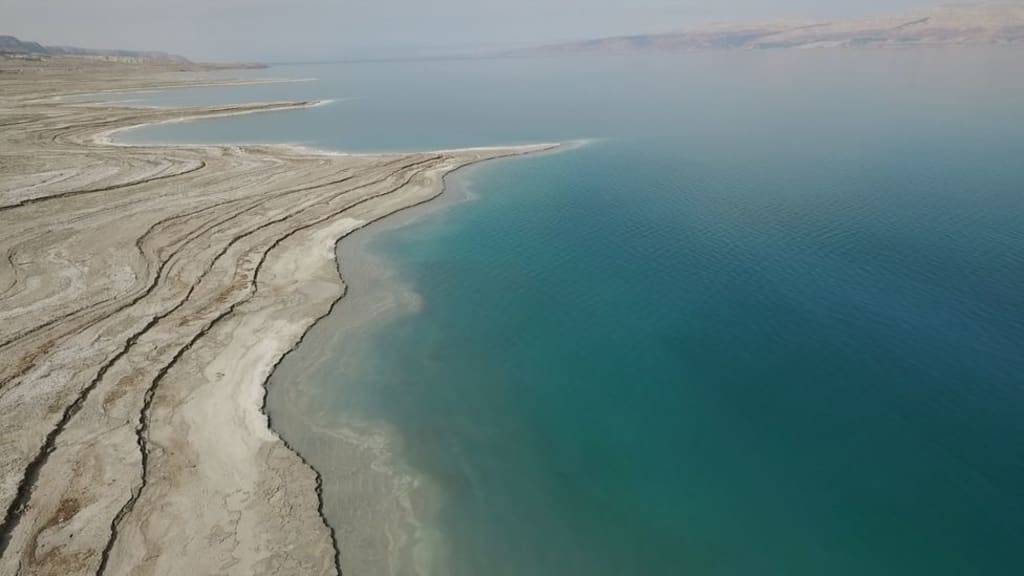
Something Alive at the Bottom of the Dead Sea
Magnesium, sodium, calcium, potassium; silicon dioxide, aluminum oxide, magnesium oxide, iron (III) oxide, sodium oxide, potassium oxide, titanium (IV) oxide, sulfur trioxide, phosphorous pentoxide; chloride, bromide: the composition of one of earth’s largest and most potent mineral cocktails. Such a spontaneous organic phenomenon as that occurring within the Dead Sea has been scrutinized, questioned, and observed, as well as—something we humans excel at—commodified, extracted and diluted from the poisonous to the palatable in the form of rows upon rows of high-end beauty supplies. And, though I shake my head in retrospective shame, in this despicable custom I gleefully took part.
The only relic I sustained from my visit to the Dead Sea is a small glass dropper bottle printed with a flashy line of gilded text: AHAVA. I scoff now thinking about the clean, air-conditioned stores with white tiles and walls, about the silky “mud” facials in small, neatly packaged jars lined along the shelves displaying the same word: AHAVA. I can recall gazing out of the bus’s windows, which were caked in a thin film of dust, at the flashy billboards of women running their hands sensually along their smooth, tanned skin, smiling directly at me and repeating one word: AHAVA, a seductive and deceptive promise. I am not necessarily anti-materialistic; I don’t find myself lamenting advertisement or mass-production, and I certainly don’t give a damn about a beauty company capitalizing on the environmental anomaly that is the Dead Sea. But, when I remember viewing these billboards set up along the road to the cobalt Sea, I sense in my stomach the same feeling I bore when I saw Serrano’s “Piss Christ” for the first time.
While sitting on the bus at the time of my own visit, however, lumbering along the road from Galilee to Jordan, I did not experience this nausea. I passively inhaled the promise I was given, as would most American visitors in a hopelessly foreign land. For me, AHAVA constructed the illusion of a Dead Sea that was built considerately around my desires, and, not knowing how else to react, I accepted this industrialized false prophet. Yet as the bus plunged further away from the familiar lushness of Galilee, taking a descent of over two-thousand feet within a twenty-mile span of Jordanian desert into the lowest bowels of earth, the very air began to change; the sensation has been compared to “that of landing in an airplane, ears stopped and voices muffled.” This became disagreeably apparent as the oxygen surrounding the bus flexed with the dramatic shift in pressure. The adjustment in air was the first in a series of rapid changes. As we barreled onward, the terrain soon looked nearly Martian, protruding with massive, rust-colored cliffs brazen against the muggy sky. AHAVA’s gaudy billboards were suddenly out-of-place and forced, like a bad joke; the familiar became strange, and the strange became entirely encompassing. And when I finally saw the oval diamond of water, I was suddenly abnormally anxious at the thought of submerging myself in its depths.
I have read from an American writer that the Dead Sea was perceived by her as “something large and somber and almost unearthly: a remote place of silence and strangeness,” and a similar observation hit me with profound unease as I watched the Sea approach like a wavering mirage. I felt a tourist’s relief when our bus pulled in front of the high-rise hotel, and I largely ignored how bizarre the building appeared within its landscape, like a familiar object that fell from earth onto another planet and was marked with a message: Marriott. Stepping out of the bus, I sensed that the atmosphere was congested, as though on the brink of a sneeze, and I could already taste salt in the acrid hot air. I hurried to grab my belongings and shuffle indoors with the rest of my sweaty group. The air-conditioned Marriott, much like the AHAVA stores, was a cool and domestic relief, and my nervousness was replaced once more by eagerness for AHAVA’s sacred assurance that the Sea’s “mineral catalyst” will render my skin—by then scrubbed raw by cheap, lemon-scented bar soaps from a hotel in Tiberias—“deeper than beautiful.” We piled into the elevators, nodding and smiling assuredly with the hotel’s clientele of sunburnt Euro-centric individuals in damp tankinis. My room of the hotel, with its neat beds and faux-marble bathroom furnishings, appeared to adequately provide the website’s promise of “unparalleled comfort” ; that is, excepting the quiet, still, and distinctly alien Sea, looming outside the floor-to-ceiling windows, a dusky painting. I resolved to go for a swim.
Leaving the perfect 68-degree air of the Marriott and returning to the thick heat of the desert, time suddenly began to lull. The pressing air smothered sound and suppressed movement. I had stepped into an entrapping slow-motion film. The sun was more than bright; it was glaring, and I felt trapped, exposed, bare in my swimsuit, and as I began my walk along the dirt path to the Sea, my vague excitement at a novel experience began to, just slightly, twist. I became noticeably uncomfortable, and the world around me dissipated into the bizarre and surreal. I was surrounded on all sides by towering cliffs, but even they were hazy and unreal. The terrain was entirely windless; everything around me seemed to be preserved in hot formaldehyde. The atmosphere, which began as feeling slow and heavy, was suddenly suffocating and oppressive. Even though the sun was high and the sky was clear, nothing looked in-focus. All was blurry, like the periphery of a dream. And I marched onwards, towards the plane of cloudy water.
The Dead Sea is utterly toxic, and there are risks of swimming in an environment that is poisonous to our sensitive insides. Resting in the water for fewer than twenty minutes is entirely acceptable so long as no water is ingested, but a period longer than twenty minutes sucks the body of necessary enzymes and could spur fainting spells, which has been the primary cause of tourist Dead Sea drownings. When I heard this information spoken lightly—almost jokingly—from our tour guide, I felt betrayed by the beckoning women from the billboards promising spa-tier comforts, but it was not until I was walking along the pathway to the Sea that my true doubts about AHAVA-nism began. I was oddly offended at being sold the Dead Sea in a dropper bottle that was plush against my skin while the real Sea in front of me was so imposing and the atmosphere felt so awful. There was a small inlet of Dead Sea water astride with the gravel pathway I walked, and I began to notice what appeared to be sculptures of ice but were actually lumps of driftwood or abandoned objects—a sandal, a beach umbrella, a towel—encased in glistering salt. Of course, I understand that the Dead Sea is salty because it is an endorheic basin; the stifling heat evaporates the water yet leaves behind the salt like an environmental sieve, sucking the Sea dry. But in that moment—and to this day—I had difficulty correlating the driftwood geodes with anything other than the alkaline terror of Lot’s wife as she turned to face the condemned pair of cities; a crystalline Eurydice.
Before arriving to the Dead Sea, I was morbidly fascinated to discover its close proximity to the site of the destroyed Sodom and Gomorrah, in the same way one would be fascinated by the occurrence of a past murder in a hotel where one happens to be staying. However, when the image shot through my mind of Lot’s wife, thick with salt, an awareness of destruction slowly and unknowingly seeped into my consciousness until it was permeated with substantial dread. Dread of what? I shook my head clear of this unprecedented terror, refusing to think about the people of Sodom and Gomorrah who were “eating and drinking, buying and selling, planting and building” until “it rained fire and sulfur from heaven and destroyed all of them”; I was refusing to accept the ominous warning, “It will be like that on the day that the Son of Man is revealed,” taking this premonition and angrily forcing it away, away, away.
Fully ingratiated once again in the present, I was aware that the sand was relentlessly hot on my bare feet when I slipped out of my sandals. The beach was fairly occupied, and as I observed the people shuffling around me, a strange trend I had only noticed earlier in passing cemented itself in my mind as verity: the site was occupied primarily by the infirm. Apparently, as I did not read until far later, “sufferers from chronic skin diseases, such as psoriasis and eczema, routinely make pilgrimages, attracted by the bone-dry climate, oxygen-rich atmosphere and—some claim—the sea’s miraculous healing properties.” My instantaneous mental comparison of the hotel’s weary travelers to AHAVA’s lithe ladies with porcelain skin, rubbing themselves with product, was nearly laughable; the individuals shuffling along the pathways to the beach were bloated people, with scabbed or spotted or reddened skin stretched taut over their aged girth. They tottered along with downturned heads throughout the hotel, but when they eased themselves into the water their entire weight was suspended, and they were held floating upright like fleshy buoys, grasping the notion of a miraculous healing. I felt sort of a pitying reverence for them; I was viscerally repulsed by their age and size and skin yet drawn to their earnest, hunched trekking along the hot hot hot sand. I grew to admire them more as I watched their grimacing expressions as their skin, already marred by infection or disease, was scorched by the unforgiving water of the Sea, and childlike joy flashed onto their ruddy, sweaty faces when the Sea held them entirely, welcoming their wonder and frank belief with a scalding embrace. I would have enjoyed the Sea much more if I too made the pilgrimage to the Sea like the ill to Jesus Christ, but I arrived like a gambler to Vegas, preoccupied by AHAVA’s white-toothed smiling promise.
Watching these ugly pilgrims, I began to step uncertainly towards the shore, feeling as though I was intruding onto a ritual with my clear young skin that I desperately wanted to be “deeper than beautiful.” The waterline was, like everything else, encrusted in salt, and I was shocked to find that the salt seared the soles of my feet. I yelped and did a small surprised dance on the shore in reaction to the sudden pain before stumbling ankle-deep into the water. It felt for a moment just viscous and warm, but immediately commenced to burn my feet and ankles. I waded deeper, but my steps looked more like awkward jumps and jives as I cringed at the small spikes of pain in my calves, knees, thighs. The Dead Sea dwellers around me glared as I disturbed their water, but I ignorantly pressed deeper, gritting my teeth as the water stung my flexed back. Sweat began to leak from my hairline and I mistook it for the Sea, attacking me from the top down, and when I frantically swiped at my forehead I was successful only in splashing myself with actual seawater, which itched and prickled my face and soon turned sticky. I remembered the warning we were given by the tour guide against getting the water in our eyes, and in an irrational fear of blindness I leapt towards the shore in bounds, panting, and cut across the sand to the outdoor showers. When I tugged the pulley, cool tap water drenched my body in a blissful shower, and I scrubbed my skin of the Sea’s clinging remnants. I spent the rest of the evening skulking in the nearby swimming pool.
…
While lying in bed that night, body wrapped in hotel sheets and air conditioning and face smeared in AHAVA’s Dead Sea Crystal Osmoter X6 Facial Serum (which is supposed to result in “glowing, radiant skin” ), I knew that there was a prospect that crouched in the corners of my consciousness that had been preventing since my walk to the water; in fact, perhaps I ignored such a specter even before I panicked at the sight of the natural salt statues. But it could hide no longer, which happens to most thoughts that are potent enough to keep one awake during the night. And, in that moment, I allowed myself finally to open my mind to the terrible, the downpour of decimation, the awful wrath from heaven, the wails, the divine judgment and apocalypse, and I supplicated to the dark Sea which was watching through my window, Why? Why did it hurt? Why had dread been boiling inside me, and why did I fear it? Why do I find myself embroiled in Armageddon, nearly waiting for the End to sweep out the earth? Why did I feel a sickened connection between the 420-meter depth of the waiting, watching water and the number 42, the number of the endtimes, the number of the Beast? I could hear the words, fateful and damning: Truly I tell you, it will be more tolerable for the land of Sodom and Gomorrah on the day of judgment than for that town. I felt direct fear, a swarm of fiery arrows, aimed at me, and I felt the End. I felt it in a gasp, or a sob, and in my later reading it returned as a horrible judgement that became clear to me: I was not looking towards our past but towards our future, when Sodom and Gomorrah will be “universalize[d] in scope to encompass the entire cosmos…coming suddenly and in spectacular fashion…utterly devastating…perpetual in nature.” That night in Jordan in my bed, I clenched my eyes, feeling hopelessly foolish, feeling as though in that moment I took on the foolishness of all humanity because I felt a hideous certainty that this place was trying to speak, crying out, sending us its Scrolls that calculate the End to its very date and forming us a Sea that reeks hotly of Sulphur, a Sea that forges sparkling reminders of the wife of Lot by its mere organic existence. And we, in our vanity, we can look at the Sea only when it is thoroughly manufactured and whipped and rubbed on the legs of a female while the real Sea is crumbling beneath the weight of our commodification, dipping and dropping into sinkholes, signaling at last the end of the world in compassionate, righteous fury!
I was trembling and clammy in my sheets, staring wide-eyed at the hotel ceiling and feeling immensely small and immensely alone. In that moment, yearning for my loneliness to be broken and hoping for someone who understands, I began to think of the people I saw rubbing and chafing in their diseased skin, and in my mind’s eye I saw their faces, contorted in pain, release as they settled into the hold of the water. I could sense them, around me, sleeping like innocent children in their respective rooms and dreaming, hoping of another baptism in the Sea tomorrow that will finally wash them. This was the thought I clung to as I closed my eyes and fell asleep.
…
I awoke to my bedsheets awash in a dull violet light. The sky behind the window was a spill of dark blue and purple. I sat up in a groggy haze and observed it with sleepy eyes before decisively swinging my legs over the side of the bed. I shivered while slipping out of my pajamas warmed by sleep and into my bathing suit, which was still damp from yesterday and smelled strongly of chlorine. The click of my door’s lock and ding of the elevator were both muffled by the carpeted emptiness of the corridor, and my sandals squeaked noisily on the marble tile of the lobby. Upon pushing through the revolving entry door and stepping onto the driveway, I was immersed in the expectant hush of morning. No birds warbled and no breezes whispered; all was enveloped in a reverent silence.
The salt structures jutting from the inlet reflected the colors of the sky, which were beginning to dissolve into a bluish mauve. In the sunlessness of the morning, the air was no longer stifling and cruel. It was anticipative, and the air’s emotion seemed to seep through my pores. I hiked along the trail until the stretch of Sea came into view, nearly matte in its density. I approached the water timidly, vulnerably, almost apologetically, and the Sea accepted my steps with readiness. I ignored the slight stabs on my legs and waded slowly, allowing my skin to adjust. Soon my entire body was crouched in the water, and I coalesced to its careful hold.
…
I had recurring dreams after returning home from Israel of something alive at the bottom of the Dead Sea that trembled and breathed below the clay of the seafloor. It was something faraway yet familiar. It was something ancient and still yet something (horribly, hopefully) awakening.
About the Creator
Sydney Bulthuis
Recent college graduate. BA in English and Philosophy.
Keep reading
More stories from Sydney Bulthuis and writers in Fiction and other communities.
Flint
Flint I, Flynn Mawr pronounced maw-er but called Flint because they find it real lenun and laugh away at it, I found the little puella the same day I burned down the poor-people project. I couldn’t soph if she had lived there or not. Either way, I was real shocked to vid her nudging the rubble with her right foot while that stinking pile was still smoldering away. The air was so thick and smelled so deus-awful that I thought the gasoline smoke was just clogging up my mind and making me see fax that wasn’t there; but there she stood, small puella-hands all gray with soot and her eyes all solemn-like and dark as two pebbles. I swore, snatched her filthy hand, and dragged her to Martin Hazard’s house because I was supposed to be there ages ago, hoping all the while he wouldn’t be too bothered to vid me no longer in-soul like I was supposed to be.
By Sydney Bulthuis4 years ago in Fiction
🅼🅸🅳🅽🅸🅶🅷🆃 🆂🅽🅰🅲🅺🆂
"It's 10 in Tuscon! We all know what that means... It's Time for Midnight Snacks with your man, Gerald Gee! Ready to spend the night together? Me too! I'm full of snacks and can't wait to regurgitate them all back into your hungry ears. Crack a brew! Pop some corn! Anything to get ready for one hell of a show where the talk maybe cheap but the words cut deep...
By Lamar Wiggins6 days ago in Fiction


Comments
There are no comments for this story
Be the first to respond and start the conversation.