
Snowfall
A man follows the pull of winter into the darkest version of himself.
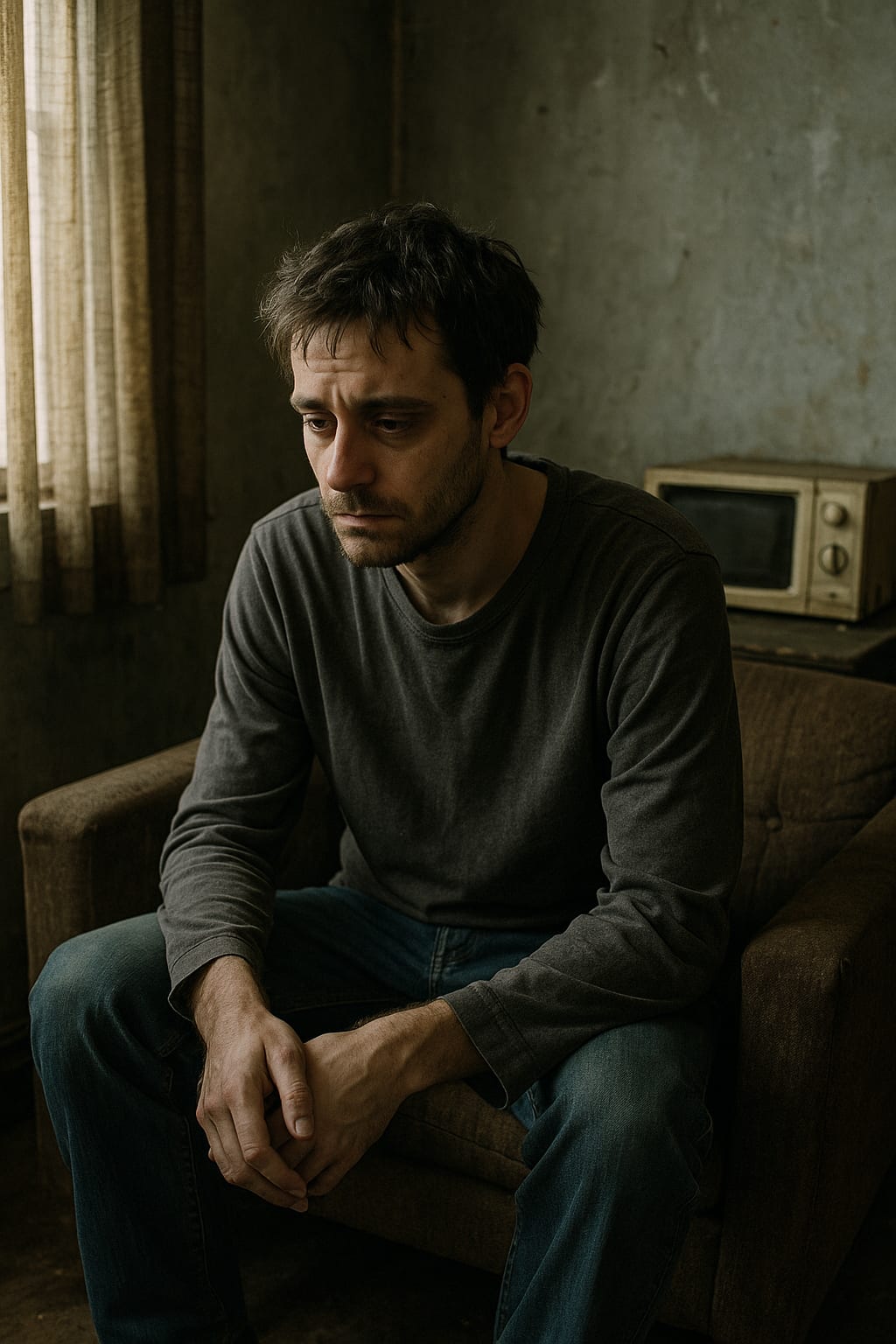
Ben has had enough.
He sat at the edge of a stained mattress on the floor. The air in his apartment felt stale, like it hadn’t moved in days. Or maybe that was just him.
Every day felt like a punishment. Not dramatic, not even loud—just a dull, endless ache, like a tooth rotting slowly in the back of your mouth. A suffering too boring to talk about. Waking up was the worst part: the moment his mind reassembled itself and remembered it still existed. That he still had a name. That he was still Ben. That he was still tethered to this goddamn world by rent, obligation, and the meat sack he couldn’t crawl out of.
He didn’t cry. Not anymore. Crying meant you still hoped someone might hear you. Now, all he wanted was for the noise to stop. The noise of people—their mouths always moving, always needing, always performing. The noise of society telling him he had to get better when nothing made sense anymore. The noise of his own thoughts looping in perfect, suffocating circles, like carts moving along a track. He longed for darkness. In fact, his heart warmed every time he thought about it. No community. Blackness. Coldness. Aloneness. Silence. Peace.
Ben didn’t believe in love. Or therapy. Or second chances. At least not since she left. He believed in rot. In entropy. In the slow unraveling of all things. Humanity, he thought, was just mold growing over a dying planet. Everything people built turned to shit eventually—relationships, families, governments, promises. The shadow of the axe loomed over every joy. Even the sun would die someday, and that was the only thing that had ever done its job properly.
His state of mind couldn’t be described as suicidal. It was just… gravity. The slow pull downward. Lately, Ben could feel something pulling harder than usual. Today was the day. The pull was at its apex. He could sink no lower.
Today was the day. Ben has had enough—and he had a plan.
❧
As Ben pulled out of his parking space at his empty apartment, he recalled the two weeks leading up to this moment. Selling everything hadn’t been difficult—he didn’t own much. Facebook Marketplace, Craigslist, even pawn shops had been willing to take the trinkets and odds and ends he had accrued over his thirty-four years.
Relics. None of it had any attachment to him. He was indifferent to it all. They might as well have been ancient Egyptian artifacts—important to someone, but to him they were just things filling the spaces between waking and sleeping. He had had enough of possession as a concept. His life was a fire sale. Everything must—and did—go.
He put his shitty car in gear and pulled away. Thoughts of the weeks and months leading up to this day crowded his mind. This moment. It was exhausting, but he had a forty-minute drive ahead. The radio was off—always off. Silence felt cleaner, if not merciful.
As he maneuvered through the narrow streets of town, pale sunlight slanted low through a web of telephone wires and skeletal trees. The air, heavy with late summer humidity, pressed against him.
Up until today, his plan had always been the same: complicated, yet simple. Step one: sell his earthly possessions. Check. Step two: take the money to Vegas and live out every fantasy he had ever imagined. Step three: return to his empty apartment. With the last of his dollars, he would make his final purchase—sleeping pills from the corner drugstore, any brand would do.
Once the pills reached his stomach, entered his bloodstream—then, and only then—would he call the paramedics to report a suicide.
By the time they arrived, he would have shuffled off this mortal coil. No mess, no fuss, no note. The act itself was the note: a man with an empty bottle of pills, barely cold on the floor. They could have it cleaned up in ten minutes. No muss, no fuss. They could even toss the pill bottle in the dumpster outside if they wanted. It didn’t matter. Not to him. Nothing did. That was the point.
The relief of it all would be lying on that slab, a single sheet covering his face. No name. No identity. Just a number. Printed on a small cardstock tag tied to his big toe: “Deceased.” Filed away into the drawers meant for people—but for him, the proverbial “Junk Drawer.” A place where things without meaning or purpose go.
He used to think about rolling around in an actual junk drawer—with pens, batteries, rolls of tape and string. It brought him comfort, knowing he’d be forgotten. Unseen. Unperceived. Being nothing for longer than he had been something.
He knew that, ultimately, his remaining family would want him buried. As per their wishes. He would have preferred the circular file. They were going to pay extraordinary amounts of money for a box, a suit, a hole to be dug. They would insist that some hungover medical examiner—or someone like one—be hunched over his husk, removing organs, draining fluids, sewing his mouth shut, and gluing his eyes to ensure he looked real enough for the “viewing” but not real enough to scare anyone.
The truth was, if there were a way to show people at funerals what a person was really like on the inside, the whole practice would be abolished, like human sacrifice. People in far-off times would hear of it and think it barbaric and wasteful—As it was. He also knew that once the family turned his death into a spectacle, as if he were a celebrity, someone to be revered, they would plant him—lowering him into the ground, covering him, and marking the spot with a ten-thousand-dollar rock adorning his name.
This was the only part he wanted. If he could have a say, this would be where the paramedics brought him after they found him: right to the ground.
He began to feel something as he stopped at the first stoplight. What was it? Sadness? Comfort? Excitement? He wasn’t sure. Today was the big day. And although the plan had changed, the result would be the same: sightless eyes brought to a world without windows. His entire life reduced to the size of a printed, laminated mass card: “In Memoriam.”
The light turned green, and he continued.
He signaled out of habit as he gently turned onto the on-ramp for the final time, heading out of town toward his destination. He still had another thirty minutes to get there. The phone buzzed in the cup holder. Lighting up inside its dark purple phone case. He ignored it. A few moments later, it buzzed again. He held the power button on the side of the phone to turn it off completely—a symbolic gesture. This would be the last time it was ever on.
❧
He thought about how he had gotten here. What kind of life could a man like Ben have lived to lead him to this point? Drugs? Alcohol? Abuse? Tragedy? No. None of the above. On the surface, his life seemed fine to the outside observer.
He was born in the winter of ’91. Bleak, cold, and void. He used to love his birthday—the gifts, the cake, and the attention were nice. But it was the season he loved the most: winter. His favorite.
He loved winter because it finally let the world look the way he felt inside. Like a silent mirror in an empty white room. The gray skies echoed his muted emotions, and the snow covered everything in silence like a soft shroud. For once, the world seemed to move at his tempo. The bare trees stood stripped of their illusions, the ground lay quiet under a sheet of white, and no one questioned why a man would rather stay indoors. In summer, his silence was suspect. In winter, it was natural. In that silence, he found a strange kinship—as if the earth itself understood the weight he carried and agreed to rest with him until spring.
Paradoxically, winter highlights small warmths—a cup of tea, the glow of a lamp, the closeness of a blanket. For someone starved of hope, these small mercies glow brighter against the dark. The season teaches us to notice rare moments of comfort. As he sits in the driver’s seat, he can feel that those comforts have faded. There is nothing left. The tea is scalding and bland, the lamplight blinding, burning holes through all his blankets.
He had been tormented, day in and day out, year after year, by endless summer. Society constantly emphasized activity, brightness, and socialization—while making stillness and withdrawal socially unacceptable. Winter promotes staying inside, being quiet, moving slower, and being left alone—normalcy instead of illness.
The sun never seemed to set on his days spent running like a rodent on a wheel. Running, consuming, rending food with teeth. Then defecating. The heat was unbearable. He craved the soothing minimalism that didn’t overwhelm his fragile nervous system.
As he merged lanes, he remembered being twelve or thirteen, sometime in February—his birth month. Standing in a lonely field near his New England home, walking back from school, a latchkey kid who didn’t get picked up. Which was fine by him; he didn’t live far and enjoyed the solitude. His CD player’s headphones pressed against his ears, he listened to a song by Metallica, an instrumental track written in honor of their fallen bassist, Cliff Burton. The song was entitled “To Live is to Die.”
He remembered distinctly, standing in that field—snow up to his shins, music playing, the crescendo of that particular song merging with the winter landscape. The combination culminated in a flood of emotions he had never felt before, and had not felt since. In that field, on that day, he wept. Openly. For a long time. Frozen tears stung his cheeks.
It was the first sign to him that maybe he wasn’t an alien sent here to be tormented by humans. That maybe he was like them. That maybe he was the same as them. To this day, he had tried to recreate that moment, and he never could. A fleeting gesture he knew—but one he felt had been worth making.
He once had something to look forward to.
Snow.
To him, snowfall felt like erasure—covering the clutter and chaos of life, leaving behind a pure, blank surface. Winter’s blankness gave him the illusion of release. And today, in early September—for Ben—it would snow. Forever.
Twenty minutes to go.
❧
He moved along at the speed limit, in no hurry, staying in the right lane. The world around him raced at sixty-plus miles per hour, competing to reach what they hated most, fastest. With twenty minutes left in his journey, and after recalling his once-great love of the cold, he remembered when he had found warmth for the first time—the thing some people in the program would call “a monkey on his back.”
He was only nine when he discovered something that could turn the gray static in his head into a rushing current. Other kids had basketball games, friends, and hobbies. He had this. His brain, already wired for sadness, clung to that warmth like a drowning boy clings to driftwood. By the time he was grown, it wasn’t a choice anymore—it was circuitry. Every synapse had learned the same lesson: when the dark came, sex was the only light.
It was an accident. A simple, overlooked moment—like leaving a phone unmuted while insulting someone. During summer vacation, Ben didn’t have a set bedtime. Anything went. Stay up late, sleep in late. He was alone most of the day while his parents worked. Responsible, obedient, clean. A “good boy.” Knowing this, his parents rewarded him with freedoms similar to an adult’s—access to whatever was in the house. This was the mistake. The accident.
Anyone over thirty remembers cable. Just the word sparks memories: A boxing match, stand-up comedy specials, and movies with all the swears left in.
One evening, tired from the day’s work, Ben’s parents left him downstairs to watch TV. And then it happened, precisely at 10pm, a warning would scroll across the bottom of the screen. “It’s 10pm, do you know where your children are?” It would ask. At this moment, Ben’s parents knew exactly where he was. He was downstairs watching a movie, like a good boy. What they didn’t know was the movie he had been watching switched over to the “adults only” channel. This switch was both physical and psychological—what Ben’s parents didn’t know, was that he was downstairs, watching a full figured blonde woman, wearing nothing but a red lipsticked smile and dark heels, playing pool. A cue stick in hand, aiming precariously at the glossy colored balls. She stared at the camera, smiled and winked. Then he felt it—that warmth, that invisible blanket sliding over his nerves.
He stared at it, transfixed, his eyes glazed over.
An outside observer might have noticed early markers of depression in Ben: persistent sadness, lethargy, difficulty finding joy in play. His brain was already primed toward heaviness, meaning his reward pathways required far more stimulation to feel the same effect as his peers.
Unlike other boys, who might chuckle and change the channel, Ben’s brain ignited. He had never experienced this type of stimulus before. It was like a lit match dropped into a powder keg.
For the first time, the surge of dopamine felt like relief from his baseline despair.
This neurological imprint formed almost instantaneously. Whatever peace had existed inside him was gone. At nine years old, his innocence died.
It became an endless pursuit— to feel more.
As puberty arrived, other teens might find reward in sports, friendships, or school success. Ben did not. That slow burn in his veins became his reliable hit. His prefrontal cortex—still immature and responsible for impulse control—could not regulate it. That burn.—Thus, he could not regulate it.
Over time, loneliness, sadness, and boredom—all of which he had in spades—pointed to the same ritual.
By the time Ben turned eighteen, his prefrontal cortex had matured enough to recognize consequences, but it struggled against years of conditioning. His brain’s natural reward system had been hijacked: ordinary pleasures—friendship, accomplishment, art—felt muted, while sex lit up his neurons like fireworks. He didn’t stand a chance.
By now, the pathways were deeply grooved. Sex wasn’t just escape—it was medication. Where others might reach for comfort in distraction or the bottle, he reached for intimacy, or the illusion of it.
Layered on top of this, his hollow feelings persisted. Each “release”—whether a girl at a party or alone in his room—was a fleeting reprieve, a microdose of meaning followed by shame and emptiness that reinforced the cycle.
He had become a man for whom pleasure was not celebration, but anesthesia.
To him, it was a prescription, another drug, keeping alive the only thing he could truly feel.
His life was a pendulum, swinging between numbness and intoxication, never finding balance.
Until he met her.
❧
He met her not in a blaze of fireworks, but in a quiet moment—at a diner, where he sat bleary-eyed and withdrawn, scrolling through his phone. He sat at a booth by himself. The place had giant windows that lined the front, facing the parking lot. The entrance was across the lot, coming directly off the highway. The diner had served as a rest-stop for long haul truckers and happy families on road-trips. It also served as her job, and the very spot where Ben’s life would change once again.
He was twenty-four—hollowed out by his own habits, chasing the next faceless encounter, his body exhausted, his spirit numb. His days were mechanical: work, release, shame, repeat.
She asked if the coffee he was drinking was ready for a refill. Her voice was ordinary, yet carried a warmth. He looked up, expecting nothing—and instead found her eyes: not just beautiful, but attentive, as if she actually saw him.
For the first time in years, the rush he was familiar with didn’t come from lust. It came from the way she smiled at his clumsy joke, the way she touched his arm, as if he mattered. His brain, long-starved of genuine human connection, mistook the sensation for salvation. He convinced himself she was the answer.
They fell into a rhythm. She softened his edges, coaxed him into small joys he’d long forgotten—movies at midnight, cooking together in a cramped kitchen, the slow ritual of building a home from mismatched furniture and shared laughter.
He loved her fiercely, almost desperately. And for a while, it felt like enough. He thought he was cured. The cravings dulled when she was near; the hollow spaces filled with her voice.
But addiction doesn’t vanish—it waits. When she was gone, when depression’s weight pressed back in, the old circuitry lit up. He would sneak away into his rituals, convincing himself it was harmless, just an outlet. But lies have gravity. They accumulate.
Being with her had been like stepping into sunlight after years underground. For a time, he believed she could burn away the shadows that clung to him. But he hadn’t told her about the cage he carried inside. When the bars finally showed—when she saw the truth of his need—she left. Her leaving wasn’t just an ending. It was proof. Proof that he was every dark thing he had known about himself. Proof that even love couldn’t fix him.
One night, she discovered him: an open tab on his laptop, a text from someone who was not her. The look on her face was worse than rage. It was recognition. She had given him her trust, her faith, her future, and he had traded it for a fleeting chemical relief.
She left. Not instantly, but inevitably. And he watched the light walk out of his life, carrying with it every fragile thread that had held him together.
And so the cycle deepened. Where once sex had been an escape from loneliness, it had become punishment—a way to drown the shame she left behind. Each encounter wasn’t just compulsion—it was self-destruction, a reenactment of loss.
Her absence didn’t just break him—it confirmed every cruel whisper depression had fed him since childhood:
“You are unworthy.”
“You are broken.”
“You will ruin everything you touch.”
Now, at 34, he wasn’t living—just existing in an empty room that had once held a shared sense of peace. It had been a year since she moved out, a year of regret and grief, followed by the inevitable numbness. Nothing surprised him anymore.
What did surprise him was what happened a month after she left. He found himself at a bar at midnight.
❧
He spotted her accidentally. Her. The bar was dim, music thrumming through the floorboards like a pulse, and for a fleeting second, he thought he hadn’t actually seen her. But there she was—half-dressed, laughing, leaning close to men he didn’t know, gestures loose, unguarded, alive in a way that made his chest tighten and his stomach churn. She didn’t see him, and that only sharpened the sting.
A heat rose through him, sudden and unwelcome, crawling along his arms and down his spine. His hands curled into fists before he realized it. The warmth became fire, and his heart hammered as though trying to escape his ribs. Each laugh she tossed into the room felt like a blade sliding against bone. Each tilt of her head, each careless flick of hair, each shared smile with another man was a silent declaration: she had moved on. She had chosen the world over him.
Jealousy twisted into something darker, sharper. It coiled in his gut, tightening with every heartbeat. He could feel the pull of every memory they had shared, every touch, every whisper, folding over itself into a weight that pressed on his chest. Her presence, so casually luminous, felt like a violation of the quiet, controlled world he had tried to build for himself. It was unfair, infuriating, and yet, impossibly compelling.
His mind raced— a jumble of flashes: her face in his apartment, her laughter echoing down the empty streets, her hand brushing his, and now, her freedom—the careless freedom he couldn’t bear. Every instinct screamed at him to vanish, to lash out, to reclaim something he could no longer name. He felt small, impotent, enraged, and unreasonably alive all at once.
He watched her from across the bar, the low hum of conversation and clinking glasses folding around his attention like a cage. Her laughter cut through the haze of his thoughts, bright and careless. He imagined every step she took, every gesture, every sip, and in the mapping of her movements, clarity bloomed like a black flower—its petals falling to the cracked, arid soil of his world.
A spark ignited—he could see it. The way she reached for her drink, the tilt of her head, the brief glance at her phone. Each motion became a marker, a signal, a step in the sequence. The old plan, to end himself, no longer sufficed. Now, a new plan took shape: precise, inescapable. Every element in his mindlined up perfectly, and he smiled—small, tight, satisfied by inevitability.
He imagined the coming months, how she would never see it coming. The world had always moved too fast, too loud, too ignorant of the darkness lingering in quiet places—
Ten minutes to go.
❧
Ten minutes.
The glow of the dashboard clock held his eyes for a beat too long before he blinked back to the road. He adjusted the rearview mirror, though there was nothing behind him but dark. His fingers drummed against the steering wheel, steady and rhythmic—like a heartbeat counting down.
He thought of the plan, the old plan: pills, silence, a slab, a tag tied to his toe. Easy. Clean. A winter of stillness with no thaw. But then he saw her at the bar—laughing, breathing, living—and something broke loose inside him. Pills weren’t enough anymore. Neither was death. In his troubled mind, the world had to see what they made of him.
Nine minutes.
He took a sip of the lukewarm coffee from his travel mug, the bitter taste grounding him, reminding him how ordinary this all was. Just another man on another highway, anonymous taillights streaking ahead. No one glances twice. No one ever does.
“It’s not her fault, she can’t see me,” he muttered, voice flat, almost conversational. No one did. He’d been a ghost his entire life. A body people brush past without noticing. Invisible. His jaw tightened. His mind landing on a single conclusion—“She just confirmed it.”
He remembered the years of addiction, crawling back again and again to the same empty comfort. Women as pills, encounters as anesthesia. He’d burned bridges until there was only her left—and then he burned her too. The shame festered, grew teeth. Tonight, those teeth had finally found something to bite.
Eight minutes.
The hum of the tires, the occasional hiss of wind sneaking through the cracked window, filled the car. His world was stripped bare, reduced to motion and intent.
Winter had always been honest with him—its silence, its shroud of white. Summer demanded smiles and activity; winter let him rot without apology. He thought of that field when he was thirteen, snow stinging his shins, music bleeding through his headphones, and the first time his body knew how to weep. He wanted that silence back. The snow. The clean erasure. The only exception was that now he believed the silence would be better if shared—with her.
Seven minutes.
His thoughts flickered like headlights on wet pavement. It’s not about her. It’s about all of them—the laughing, the forgetting, the moving on. He tightened his grip on the wheel until his knuckles bleached. “They’ll see me now.” he thought to himself. “They’ll all see.”
For years he had begged for something to still his mind, to soothe the static. Addiction filled the gap, briefly. She had filled it longer. But in the end, nothing held. Nothing stayed.
Six minutes.
He scratched his chin absently and glanced at the fuel gauge. Half a tank. More than enough. The triviality of it almost made him laugh—how, even now, he still noted fuel levels like any commuter.
The world had reduced him to habits: checking gauges, paying bills, showing up on time for a job that drained him. He had been nothing but a function, a cog. She was the only one who had made him feel human—and when she left, he realized he was less than that. A ghost wearing a man’s skin.
Five minutes.
The road narrowed; streetlights breaking the darkness in clean intervals like the tick of a metronome. Each pool of light washed him briefly into existence before returning him to shadow.
Her laughter at the bar replayed in his skull, cutting him raw. She was alive in a way he could never be. She wasn’t a ghost; she wasn’t trapped in a cage of shame and circuitry. She had escaped. He would never forgive her for that.
Four minutes.
He thought of her behind the counter at the diner—apron tied loose, hair pulled back, hands passing coffee cups to strangers who never knew what she was worth. She gave them smiles that he once thought were his. His stomach coiled. “She’ll understand in the end. I’ll take her someplace clean and cold—like the field. The slab. The drawer.”
He tapped the steering wheel in rhythm with the thought, each beat a hammer driving the nail deeper. Addiction. Depression. Love. Betrayal. All threads led here, weaving him into a single act of clarity.
Three minutes.
He signaled out of habit, merging into the right lane. The click-click-click of the blinker echoed in the cabin, absurdly loud. A turn, an exit ramp. The neon sign of the diner would be visible any moment.
His father once told him life was about “moving forward.” But what if forward led nowhere? What if it was repetition until you rotted? He had moved forward for thirty-four years—and now he would end it. Forward was death, and that was fitting.
Two minutes.
His chest ached, but it wasn’t fear. It was anticipation. Soon, it will all fade to white.
The thought calmed him: not the fire, not the laughter in her throat, not the men circling her like moths—but the snow. The silence. The erasure. The junk drawer closing forever.
One minute.
He rolled his shoulders as though settling in for a long drive, though there was hardly any road left. He took the off-ramp leading to the diner entrance. Instead of slowing, he moved forward—faster, and faster. Like his father told him. The engine roared beneath him. The diner lights flickered into view, warm against the night.
She finally saw him; standing at their old booth, pouring coffee for strangers who were happier in that brief moment than he’ll ever be.
As the windows rushed up to meet him, he drew a small, tight smile and whispered, “I love you.”
❧
End.
About the Creator
Keep reading
More stories from writers in Fiction and other communities.
The Devil's Cut
“Comrade, finally you’re awake.” The voice was smooth, sensual. A flickering incandescent bar was all that lit the white, sterile room. All Vladimir remembered was everything going black. He tried to move his arms and found them strapped to the gurney.
By Matthew J. Fromm4 days ago in Fiction


Comments
There are no comments for this story
Be the first to respond and start the conversation.