
Small Repairs
A shop that trades what weighs you down for what you thought you lost

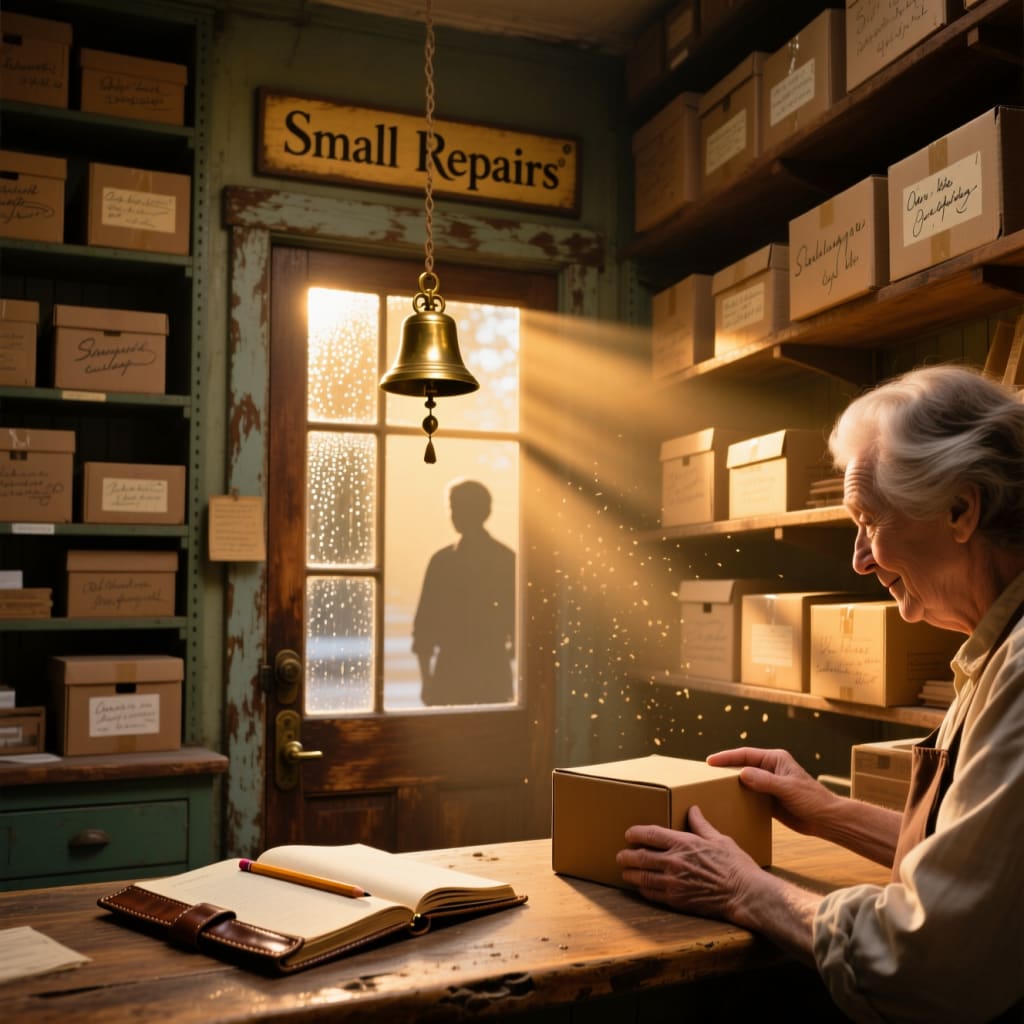
**We fix the things people don’t know how to name.**
On my second day, a man set a shoebox on the counter like it might go off. On the lid he had written The Dream About Running Away And Finally Making It Out West. He slid over a heavier box too, The Weight Of Having Stayed. He walked out empty-handed and lighter by an inch. The bell hummed.
Inez owns the shop. She asked him what he brought to trade. That is our rule. **Nothing leaves without something you are ready to leave behind.**
The shop hides on a side street no one looks for. In the window there is a varsity pin missing a letter, a melted birthday candle, a napkin with a smudged number. People don’t come because they see the sign. They come because they are ready.
Shelves reach the ceiling. Every shelf is boxes with hand labels that read like truths people finally said out loud. The Way The House Smelled When You Got Off The Bus. Courage, Enough For Watching. Your First Apartment’s Window Light At 5:17 P.M. The Correct Comeback, Three Weeks Late. That Laugh Your Uncle Had Before The Divorce. The Sound Of The Ocean You Think Is Cheesy But It Isn’t.
I work the counter. I dust. I write soft pencil receipts in a fat ledger. It lists what you take, what you leave, and where to find both if you forget again. In the margins, someone long gone left rules in a smaller hand. Take with water. Do not fix this for someone who did not ask. You will want to stop. You cannot.
We have regulars. A grandmother borrows The Exact Wrong Time To Use Humor and returns it with a look that makes me laugh. A teacher touches Your Name Spoken Without A Phone In Someone’s Hand and always hesitates. A teenager in a thin jacket buys The Nerve To Apologize and leaves The Reasons He Should Apologize First. A woman presses Socks Without The Bit Of Pebble That Makes You Angry to her chest, then trades The Part Of Me That Likes Being Mean.
People ask where the boxes come from. No one asks where their unrest goes. **The exchange isn’t magic. It is practical.** You bend. You set down something heavy. You pick up what you dropped when you were carrying too much. Same arms. Same back. Different load.
**In March, my mother stopped saying my name.** I wrote it in the ledger to watch a pencil make it hold, then erased it so Inez would not ask if I wanted a receipt. The first time Mama looked through me like I was a window that would not shut, a bird took off inside my chest and could not land.
There is an M shelf I straighten too often. Your Mother’s Meatloaf You Pretend You Don’t Miss. Knowing Your Mother Was Doing Her Best Even When She Wasn’t. The Face Your Mother Made When She Tried Not To Cry. I never open a box until it is leaving. Some hum like a phone on a wooden table. Some sit quiet and heavy as snow.
Tucked between them is a box I did not shelve. My handwriting I did not write. The Exact Way Your Mother Said Your Name. Inez saw me looking. “If it is yours, you will know. If it is hers, you will know. If it is neither, it will not open,” she said. “If it is for you, you will ask the price.”
A kid came in with a busted skateboard and two friends who guarded him with their posture. He hovered by a box that read The Feeling You Used To Get When You Were Good At Something. “Would it be enough if I left The Part Of Me That Laughs With Them When They Bully? I don’t want it. It makes me sick,” he asked. I wrote the receipt. He did not cry. Two of us did.
The next morning I unlocked early and turned on one lamp. The shop felt like a throat clearing. I set my hand on the lid of the box with my mother’s voice. It felt like the couch in our first apartment. It felt like a steady hand on rattling bowls. It felt like being called into a room by a voice you did not know you were waiting for.
“What will it cost?” I asked the ledger. A faint note in the margin answered. If you have to ask, you have already started paying.
Inez came in with coffee and warm bread. “We can do it now. Or later. Or not at all,” she said. “What are you done carrying?”
On bad nights I play a voicemail. Mama in the car. The turn signal ticks. “Don’t forget the spinach,” she says, then my name, bright as found keys. I scrolled to it. I listened. I deleted it. It felt like snipping a thread so short it might not hold. My stomach dropped. Then it landed. I wrote another thing on a card and left it too. The Need To Be Right About Reality.
The box lifted as if it had been waiting. Inside there was only air that smelled like hallway laundry and a radio in the kitchen and shampoo on a wire rack. I carried it on the bus. A little girl slept open-mouthed on her dad’s lap. He touched her head like a shelter. He nodded as if he knew I was carrying something breakable.
The care home smelled of lemons trying too hard. A woman at the puzzle table put all the blue pieces in a bowl like they were water. Mama watched a squirrel as if it owed her rent. I set the box on my lap. I slid my hand inside. I did not force it into a shape it was not.
We waited. Sun slid across the carpet. The squirrel found something else to bother. Mama watched my hands.
She made a small sound. Then she said my name.
**She tried my name. It fit.** She said it like an answer and a question and an I love you she did not know how to keep.
We stacked small sentences. We talked about pink streamers on a first bike and shoes that were not fast enough and running anyway. I told her there is a shop that fixes what you cannot hold. She laughed in the right places and a few wrong ones. It was not a miracle. It was warm bread with butter. It was enough for an afternoon.
Back at the shop I kept the box under my arm too long. Inez said I could keep it. I set it down. “I want it to be true because it happened, not because I can make it repeat,” I said. She nodded. I wrote one more thing for the ledger. The Long Story About How I Don’t Need Anything Because I’ve Already Done The Hard Part.
We shelved the box under C for Community. That shelf holds things one person starts and others finish. The Ability To Stand In Line Without Thinking You’re Wasting Your Life. A Good Knife Sharpener. Somebody’s Patience, Borrowed.
In the afternoon a boy came with his father. The boy had salt water eyes. The father talked to fill the air but he was watching his son. “He misses the house,” he said. “There is an echo now.”
The boy read labels with the care of a scientist. He stopped at The Sound Of Winter Mornings In Your Old Kitchen. Something in him clicked. He looked at me like a door he was not sure he should open. “What do I leave?” he asked. His father reached for his wallet. Inez said it was not that kind of paying. The boy thought. “Saying Sorry For Being Here,” he said at last. I nodded. He took the box. The echo stayed with me while I swept.
We close when the street wants us to. I flip the sign. I check the ledger. I square a box that will not sit straight. When I lock up, the bell says you did enough. I carry home the bit of quiet people leave behind when they take what they were missing. I heat soup. It tastes like a person cooked it. In my kitchen I say my name once. No one answers. That is all right.
Small Repairs does not promise miracles. We fix what we can. **You can do a lot with what you can.**
About the Creator
Our Song
Evening has given way to night. Gently, I settle next to you on the comfortable, old love seat and reach for your hand. You snatch it away, again. It cuts me to the quick, but I hide the pain, understanding that the reaction is but part of your demented state. Since the accident, your presence here in our cozy home has been clouded by a haze I can't see. Nevertheless, I feel the frigidity of your expressions and it serves as an excruciating reminder of the immeasurable distance between us.
By Dana Crandell4 days ago in Fiction
The Train Ride That Changed Everything
It was an unusually warm autumn morning when Sophie boarded the train to the city. She had her headphones in, a notebook on her lap, and a long day of work ahead. The train was crowded, people jostling for space, yet somehow, in the chaos, she noticed him. He was sitting across from her, sketching in a small notebook, completely absorbed in his work. Something about the focus in his eyes and the calm expression on his face drew her attention. She caught herself staring and quickly looked away, embarrassed, but her curiosity lingered.
By Sudais Zakwan3 days ago in Fiction
The Angry Man in Your House
"If you grow up with an angry man in your house, there will always be an angry man in your house" This statement has caused plenty of controversy online, people say its a statement that blames victims while also undermining those who break traumatic cycles to form health relationships... but if I'm honest now that I'm in my 30s it makes more sense to me than ever, and I'd argue that its not just about fathers and uncles.
By S. A. Crawforda day ago in Humans




Comments
There are no comments for this story
Be the first to respond and start the conversation.