

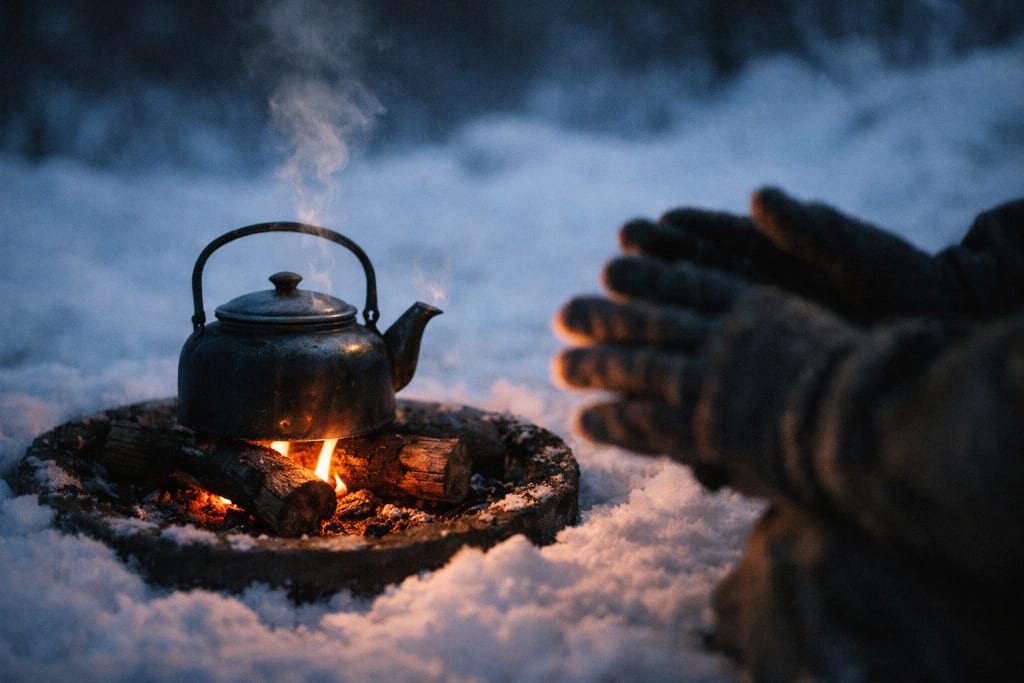
The fire was tiny enough to disbelieve.
Two slender pieces of wood sat under the kettle, slanted just so, their edges already burned. The flame between them didn’t rise or roar. It remained low, almost bashful, like it wasn’t sure it deserved to be there. Snow encircled everything—on the ground, on the lip of the fire pit, packed tight and quiet. The cold seemed older than me, older than my thoughts, like it had always been waiting.
I squatted near the fire and extended my gloved hands out, palms wide. The warmth reached me in brief, irregular pulses. Not enough to soothe. Just enough to remind me that heat still existed.
I pondered adding extra wood. I had a few pieces left in my knapsack. Thicker ones. Safer ones. But I hesitated. Big flames require attention. They eat quicker. They offer strength and then dissipate just as fast.
Tonight, I didn’t need a promise.
I required modest heat.
The kettle sat there silently, metal scarred and dull from usage. It had cooked water a hundred times before this moment, possibly in nicer settings, under friendlier skies. Now it waited, patient, as if it realized that survival isn’t always imperative. Sometimes it’s slow.
Out here, the stillness is not empty. It pushes in. Every sound becomes personal—the subtle snap of wood, the murmur of steam starting to develop, my own breathing under the hood of my jacket. With nothing to distract me, my mind did what it usually does when it detects stillness: it drifted backward.
I thought about how frequently I’ve delayed action because circumstances weren’t right. How many times I promised myself I’d begin once things were clearer, warmer, and easier. I thought of ideas abandoned not because they were unattainable, but because they were too tiny to be significant.
The flame flickered, unimpressed by my reflection.
Steam ascended gently from the kettle’s spout, feeble at first, then steady. It didn’t hurry. It didn’t struggle. It just emerged, as if to say, "This is what happens when you remain."
I adjusted one piece of wood gently, cautious not to upset the equilibrium. Fires like these don’t tolerate impatience. Push too hard and you snuff them out. Ignore them and they fade. They require presence, not force.
That felt familiar.
So many things in life function the same way. Habits. Relationships. Confidence. You don’t construct them with sudden vigor. You develop them by returning, again and again, even when the effort seems trivial.
The kettle started to hum—a deep, assured sound piercing through the calm. I poured the water gently into my cup, watching steam curl upward and fade into the darkness. I didn’t hurry. Waste seems heavier when resources are scarce.
As I sipped, the warmth flowed within. It didn’t blast through me. It didn’t cure anything. It just settled. My fingers relaxed somewhat. My shoulders sank. The cold didn’t flee, but it ceased feeling aggressive.
That was when it struck me.
We’re trained to revere great occasions. Turning points. Breakthroughs. The evenings when everything shifts at once. But such times are uncommon, and they typically occur unexpectedly. Most of life is molded by quieter decisions—the ones no one sees, the ones that don’t seem significant enough to celebrate.
Like opting to build a tiny fire instead of waiting for a better one.
The snow remained undisturbed beyond the fire pit. The darkness continued deep and unrelenting. Nothing about the surroundings altered. But I did. Slightly. Enough to matter.
I saw the flame dwindle as the wood succumbed to ash. I didn’t panic. I didn’t scramble for extra gasoline. I had taken what I needed. Survival doesn’t need excess. It demands time.
Tomorrow would offer its own issues. More chilly. More options. More chances to hesitate. But tonight had taught me something basic and stubborn: you don’t need to overcome your circumstances to survive them.
Sometimes, you only need to remain present long enough for tiny heat to do its job.
When the fire eventually died out, the darkness came in softly, not viciously. I packed everything gently, the kettle still warm in my palms. As I rose and turned away, I didn’t feel victorious.
I felt stable.
And that, I discovered, is frequently enough.
About the Creator
abualyaanart
I write thoughtful, experience-driven stories about technology, digital life, and how modern tools quietly shape the way we think, work, and live.
I believe good technology should support life
Abualyaanart
Keep reading
More stories from abualyaanart and writers in Fiction and other communities.
23 Actually Free Things
The broke-city weekend guide no one puts on Instagram—but everyone quietly uses to stay sane There was a Saturday last summer when I stared at my bank app, did the math twice, and realized something brutal: if I bought one more $19 cocktail, I was going to have to pick which bill didn’t get paid that month.
By abualyaanart12 days ago in Fiction
Tatt~Master
— Assembly Line Tatt Machine ~ Impressions to Impress — As I begin to understand more about the Tattoo Phenomenon. I've written silly, yet verbatim, dating site anecdotes in 'Frazzled.' So let me ask you: Would you be More attracted to someone slathered with tattoos, or Less?
By Jay Kantor6 days ago in Humor



Comments
There are no comments for this story
Be the first to respond and start the conversation.