
Sleepless Nights
Traditions are not to be forced, but given the room to breathe.


Right in the thick of the ballade, I forgot what came next and my fingers fumbled into a wild disaster of discordant notes. The left arpeggio clashed with the chords on the right. I paused. I lifted my hands and tried to revisit the measure, but I crashed into the same problem. I paused again, pretending to extend out a rubato from the last note played. Which major am I on? My eyes flared in the mad query for answers. Okay, the E flat chord goes here… but what’s the next arpeggio? How does the rest of the melody fall into place? The left-hand F goes with the right-hand G… no, E flat, right? I definitely knew how the next part should sound, I played it a million times. Yet, I didn’t have the time to be making crucial guesses. My mind ran a blank, as if a vacuum sucked out the painstaking years of practice into the trash.
All those years were supposed to amount to greatness in the eyes of my parents. They were meant to be destined for something. But what really separates the difference between those years of practice to only one hour of performance? Could they ever know the life of an estranged student that is pigeonholed into the role of a first-born pianist?
I finally stopped trying to play, and I glared into the dark abyss that is the Steinway piano. With my hands frozen in place, twenty whole seconds of gaping silence filled the void in the recital hall. Then thirty. Forty.
Every second harped on me in shivers, as small tears sprinkled onto the keys. These were whole seconds that I could never take back again, even though they only came about from a minor lapse of judgment. So minor. Musical errors made in passing are easily adjustable, correctable, so long as too much attention isn’t brought to the mishap. In theory, they shouldn’t devolve into a nervous meltdown. You can always tether a couple strings of notes to hold up a fallen harmony together, just as you can sew a patch of fabric over an overlooked hole in your jeans. They are easy fixes, and if the whole piece still feels and sounds wonderful, no one would bat an eye to say that you did terrible. Maybe no one would have the ear to tell the difference. Or in ideal scenarios, the error could be elevated to the level of classical improv novelty.
Unfortunately, I didn’t have an elegant way to mimetically fashion music out of an abrupt and unknown pause. I’m not John Cage. Nor was today one of those simple, practice-heavy days where occasionally forgetting an entire page could be excused on a whim and you could start again from the top.
I knew that I was mindlessly spent, drained of sanity, playing past an expiration date. It wasn’t like I was born to play for a lifetime. Playing songs is supposed to elicit an innermost freedom, not the burden of an irritating chore. Regardless, I was forced to perform out of rote learning, to beat out of me the senseless repetition and mechanics of memorizing piece after piece, to trudge along and do what I was told to do. And inevitably, the strain of meeting elite standards caught up to me. It was only a matter of time that I would cave under the pressure and eventually collapse like a house of cards, at the worst moment possible.
I considered the thought of starting over, believing that everyone including me deserves a second chance. Second chances always seemed better than the first. But I recanted. There was no point to this. No point in bowing and walking off in embarrassment either. I simply remained still, seated under the stage lights, dead-center, as cold as stone. My hands were drenched in sorrow. I wanted to pretend that I was alone. I wanted to feel alone, to be one with the silence, so that I could finally rest in the ease of not caring about the world and let my parents dissolve into the background.
A minute or two had already passed by, and yet, no one dared to rise out of their seats and take the silence away from me. Even if they were going to, I wouldn’t let them overshadow the rest of my recital. I had to prove that my silence is still worth listening to.
*********************************
When I was younger, my parents taught Sunny, my younger sister, and me to be golden little perfectionists of the family. They weren’t irrationally cruel. They were nothing like the stereotypical notions that my schoolmates would flaunt around in my face about how poor Chinese children are forced to study until sundown, locked in their rooms, day-in, day-out. I did have to intensely study for exams on some occasions, but that was on my own accord. My parents had little to do with my drive to succeed beyond my peers. What they did try to squeeze out of us, though, was to find talent that they considerably lacked. It didn’t matter where the talent came from, so long as we had it at their disposal. They would throw as much money into the wind to mold us into shining heirlooms.
Was this born out of a wretched tradition? Where was the honor? I never asked them, not that I could be given an opportunity to do so. I don’t like being amenable under my father’s control. I wasn’t offered the right nor space to debate and explain myself because that’s just the way tradition can feel sometimes. Like an awkward confrontation at the principal's office, where a heaviness would shift in the air, and the words you prepared to say could suddenly be used against you. There was no escaping the dilemma. You lose either way because your reasons are deemed invalid. Talking your way through the conflict would only raise more feelings of disappointment. All acts of rebellion—pouting, bickering, complaining—are still seen as an admission of guilt. To save face, you just had to nod, understand, and quietly face the music in the end.
What I could say about my parents is that making us conform to their will must surely make them feel invincible and powerful. God did make us in their image after all, but apparently not enough where we refused to inherit their fallible ways of teaching. They only knew how to engineer and live as engineers, it seemed.
While Sunny stretched herself thin through art and dancing, I emiserated myself within the world of classical music. At the ripe age of five, I had to be held equivalent to Mozart because how else am I going to live? When I would slip up on my scales, my mother would fly out of her chair, scowl, and then berate me for making childish mistakes, as if I wasn’t a child then. She would hover over my shoulder like a detective, pushing her square glasses against her nose, examining whether I was on beat and making the right hand formations. Yet, she stood just enough behind me that I couldn’t play and notice her at the same time. Her nagging presence loved to dance on the edge of my awareness, just enough to remind me that I’m not going to be alone with the family piano. Practice is officially over when she decides to leave the living room.
The reasons for her involvement seemed silly: every session became a lesson, readily free of charge, totally homegrown. After the first consultation with my first piano teacher, the scales fell from her eyes. She became an expert on piano performance overnight.
“Andrew, you are going to practice six hours everyday,” she once told me.
“But why?”
“That’s what Lang Lang did, so that’s what you’re going to do too.”
I know of Mozart, but who’s Lang Lang?
I didn’t know what made him special then, but I knew that my mother idolized him more than caring about what interested me. A Chinese pianist of international renown, he’s famously known for having picked up piano when he was two and gave a public recital when he was five. He was and still is a prodigy, like Mozart. Still, I had to match up somehow, even when I clearly wasn’t a prodigy. I didn’t have high dreams of being a concert pianist, but she remained unfazed about this. It’s the reputation that counts, and a legacy of success and prestige must be imprinted in me as early as possible. Yet what more did I have to go on? Both my parents foisted this ideal upon me, even when I resisted, but there was no other choice around it. I had to give in and let it become a part of me, as an ideal that I would hope to achieve on my own.
*********************************
After a couple more minutes passed, Ms. Williams briskly skipped onto the stage from the first row. Her sparkly silver dress still felt intimidating, but her gentle eyes reassured me. She knelt beside me at the foot of the bench, as I quickly tried to wipe the tears off the piano with my handkerchief.
“Hey, it’s okay. It’s okay. It’s not the end of the world. We all make mistakes like this,” she said.
I looked down at the bronze pedals. “Yeah, I know.” I couldn’t muster the courage to face her, and incidentally, the audience behind her.
“What do you think went wrong?”
“I don’t know. I’m not sure…”
She continued inquiring, “Were you too nervous?”
“I guess so.”
“Oh, that’s normal. It’s normal. Well, why not give yourself a breather, and we can come back with a fresh start, and you can replay our Chopin series. How about that?”
I squirmed in my seat. “Uh…”
I knew exactly what I wanted to do, but I wasn’t sure what I should say. All my friends, family, extended family, came here for a reason. They were given an entire itinerary on how the evening should go. The orchids and roses laid at the edge of the stage would go to waste. The decorative ribbons circling between the rows of chairs would need to be cut down. The snacks, appetizers, and drinks were not complimentary. People changed plans, took flights to see me here. The recital hall was rented out for the evening, solely for me and the good pleasure of watching me play—not for a mere twenty minutes but for the entire hour, and then some.
My piano teacher waited patiently for me to give an answer while intermittently glancing down at her watch. Then, she tried going about asking me from a different angle.
“Well, we don’t have much time. What would you want to do? Please let me know.”
This is now or never. If I don’t say what I want to say now, I don’t think I ever would find another moment to make things right.
“I think… I’m done.”
Her brown eyes slightly perked up ith excitement. “Oh, done with the piece? If that’s the case, we could move onto the—”
I quickly shook my head. “No. I’m done. Not just with the recital. I’m done. I don’t want to play anymore.”
“Oh… is that so?” she quietly muttered.
“Yeah. If that’s okay. I just want to be alone.”
“Well… if that’s what you want. I’ll let everyone know then.”
I finally tur to face her, mess and all. “Thank you, Ms. Williams.”
“Of course,” she said as she squeezed my hand.
As she got up to turn and address the audience about the unexpected change in plans, I stormed off and slipped behind the curtains. I couldn’t be bothered to be seen again, even when I was already seen and recorded for the day. Through the hallway, I slunk down against some pale bricks, between the dim ceiling lights, and cried some more until I couldn’t anymore.
During the ride, I could hear distant voices speaking, people moving about, but no one in particular was brought to my full attention. I felt that I was zipping past as many cars as if we were rushing to get off the highway. My parents didn’t bother to speak beside me. Sunny was off looking somewhere I think, clutching some flowers close to her chest, while I laid flat, zoning in and out of sleep, until I closed my eyes.
*********************************
At some point, I found myself thrown into the center of a whirlwind, strapped to my seat, as sand buffeted against my face, piling up to my knees through the windows. Screaming at the top of my lungs had no effect, not when more sand poured through the cracks of my parched lips. However, the sediment rolling within my mouth lacked the crunch and rocky depth that grinded up particles usually have. The sand stopped right at the base of my neck, smoothly covering me at an even height. As the wind died down, I felt at peace, like an open face in the air, as one pleasant mound upon other mounds.
Without warning, the ceiling of the van then flung open, trailing out of view, whisked away into the menacing and strangely violet sky. Glancing upwards, a black mass partially eclipsed the white sun. Even so, its beaming rays struck me hot and comforted me, as an unfamiliar warmth permeated the sand around me, and then my heart.
Far off in the horizon, three gigantic creatures rose up from three separate corners and gradually approached me. They glided across the sand in effortless sweeps. Their figures blocked out the sky, and their shadows jointly casted over the entire scope of the desert. Upon reaching the van, I could see them clearly for what they were. They represented three different types of owls, and they loomed over me, standing proud and tall in their distinct plumage, as high as skyscrapers. On my right was a majestic snowy owl; on my left, the shortest one was a black owl; and in front was a barn owl that appeared stockier than the rest.
While the two other owls continued peering down at me, the black owl gave a short hoot and turned away to face the sky. The duo looked at each other and nodded in agreement, spreading both their wings across the expanse. Then they hunched over to cover me until I was engulfed in darkness.
*********************************
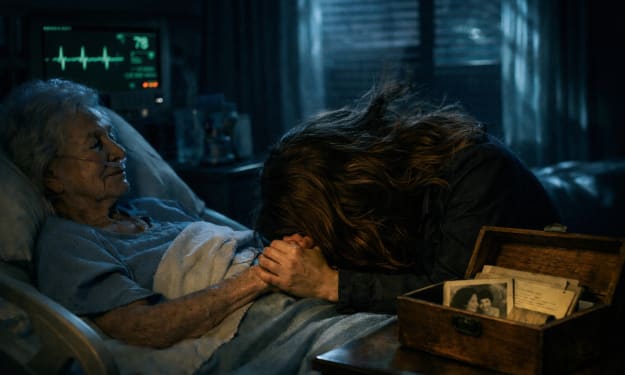
When I opened my eyes, I looked around and found my parents watching over me at my bedside. How did I end up here? Wasn’t I just in the van? Weren’t we driving home? Feeling groggy and lightheaded, I raised myself up against the pillow.
My left arm was hooked up to an IV bag while a heart monitor displayed my vital signs. A list of medical staff, along with my name, was written on a whiteboard next to the door. It was bright out the window.
“Um… what happened?”
“You must’ve been very tired,” my mother replied.
“What do you mean?”
She simply shook her head and wept quietly. Alongside her, my father remained silent on his knees, tightly gripping my hand.
About the Creator
Jesse Chen
Lifelong poet, writer, singer, student of philosophy. Existentialist. Graduate student of Counseling Psychology.
Instagram: https://www.instagram.com/jchen_love/
Keep reading
More stories from Jesse Chen and writers in Fiction and other communities.
Last in Line
There was a distant line of onlookers, huddling close with their hands tied behind their backs against the brick wall. They were not sorry for how heretical they may have felt, in how they opposed religiosity and the terrible tragedies that they've come to find revolting by association. Not a shred of regret came over their faces beneath the dark plank ceiling. They knew what had to be done. There was no going back now.
By Jesse Chen4 years ago in Fiction
Bomb Scare
It was 2027, and the world never thought it would happen. A missle hit the United States, but it wasn't where they had anticipated. A little town in the northeast was hit by a missile strike, they didn't know why, and they didn't know exactly where it hit, but they did know it was a coastal community, somewhere between Maine and Delaware.
By Gregory Payton7 days ago in Fiction



Comments
There are no comments for this story
Be the first to respond and start the conversation.