

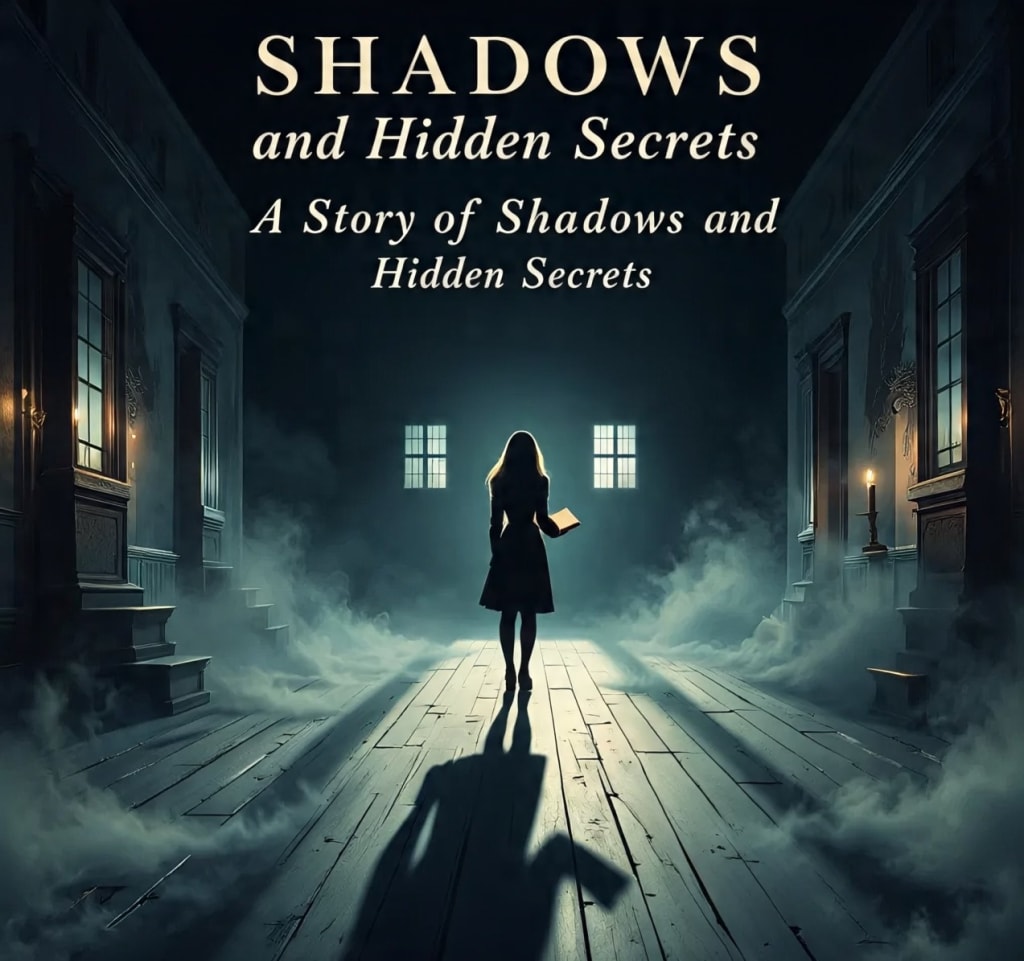
The first time Clara noticed the shadows moving on their own, it was dusk. She had been sitting in her grandmother’s old house, a place that smelled of cedar and memories, tucked into the folds of a small New England town. Her grandmother had passed away two weeks prior, leaving Clara as the sole heir to the house. It wasn’t much by modern standards—creaking floors, a roof that leaked in autumn storms, and drafty windows that whined at night—but it had history, a kind of pulse that felt alive.
Clara was used to silence. Her work as a freelance illustrator kept her indoors most days, sketching portraits for people she had never met. The house, though lonely, seemed to welcome her in a way city apartments never had. But it wasn’t the silence she had grown accustomed to. This silence was heavier, thicker, as though the walls themselves were holding their breath.
She had unpacked only the essentials—her sketchbook, a set of pencils, a kettle for tea. That evening she sat at the oak desk by the window, sketching the outline of a raven she had seen earlier perched on the garden wall. The dying sunlight stretched long across the wooden floors, painting the room in gold and shadow. That was when she noticed it.
The shadow of the raven on her paper moved.
Not a flicker of candlelight, not the shift of her hand. It shifted—wings spreading wider, head tilting—as though alive. Clara froze. Her pulse skipped, then hammered in her throat. She lifted her eyes slowly toward the garden wall outside. The raven was gone. Only its shadow remained.
She told herself she was tired, that grief was making her imagine things. She put down her pencil and stepped back. The shadow, however, remained fixed to the paper—silent, but wrong.
The following days blurred together. Clara explored the house room by room, cataloging her grandmother’s belongings. There were shelves of dusty books, porcelain figurines, and cabinets locked with keys that seemed lost to time. She felt her grandmother everywhere—the faint lavender perfume on scarves, the indent of her body in the armchair.
But the shadows… they never left her.
At first, it was only out of the corner of her eye. A figure standing at the end of the hallway, gone when she turned. The silhouette of someone seated at the kitchen table though the chair was empty. At night, her bedroom walls seemed to breathe, shadows stretching and retracting as if they had lungs.
Clara tried not to draw them, but her hands betrayed her. Every sketch she made twisted into something she hadn’t intended: faceless figures cloaked in darkness, doorways leading into nothing, eyes that gleamed from pits of shadow. The drawings filled her desk, piling like evidence of something she could not explain.
One night, unable to sleep, Clara wandered into the attic. It was a narrow space filled with boxes and moth-eaten drapes. Moonlight poured through a small round window, spilling pale silver over the floor. She noticed a trunk tucked beneath the beams, its lid half-open as though waiting for her.
Inside were letters. Dozens of them, yellowed with age, bound together with brittle ribbon. They were addressed to her grandmother, written in sharp, hurried script. Clara unfolded one and read:
You said you could silence them. You said the ritual worked. But the shadows follow me still. They whisper at night. They know my name. Please—tell me what else I must do before they consume me.
Her skin prickled. She tore through letter after letter, each more frantic than the last. The shadows were always mentioned—silent, watching, feeding. Her grandmother’s name was never written, only “You.”
At the bottom of the trunk lay a leather-bound journal. The cover bore a sigil Clara didn’t recognize, etched into the leather as if burned there. She opened it and her heart lurched. The pages were filled with sketches eerily similar to her own—faceless beings, endless corridors, hands reaching from blackness. The handwriting belonged unmistakably to her grandmother.
Clara stumbled back, the journal clutched to her chest. The attic shadows seemed to swell, reaching toward her with grasping arms. She slammed the trunk shut and fled downstairs, her breath ragged.
Sleep became impossible. Every corner of the house felt alive, the silence suffocating, heavy with unseen eyes. Clara began leaving lamps on in every room, though the light only seemed to stretch the shadows longer.
One evening, rain lashed the windows as thunder rolled overhead. Clara sat in the parlor with the journal spread open, determined to understand. Between the drawings were passages written in desperate scrawl:
They are bound to silence. They thrive in what is unsaid, what is hidden. They are not ghosts but echoes of things we bury.
To confront them is to give them voice.
Clara read the words again and again. Echoes of things we bury. What had her grandmother buried? And why did Clara now see them?
The lamp beside her flickered. She stiffened. Across the room, the shadow of a figure stretched along the wall. It stood tall, featureless, its head cocked in an unnatural tilt.
Clara’s throat went dry. She forced her voice to work. “Who are you?”
The silence broke like glass. The figure’s head snapped toward her, and though it had no face, Clara felt it smile. The house groaned as if relieved of its breath. The shadows quivered, rippling outward.
“You hear us now,” a voice whispered—not from the figure, but from everywhere at once.
Clara dropped the journal. Her knees weakened. “What do you want from me?”
“To be remembered.”
The words vibrated in her bones. Images flooded her mind—her grandmother as a young woman, seated before the same journal, chanting words she did not understand; a man collapsing in the hallway clutching his chest; a child crying in the night, unseen hands reaching from corners. Generations of secrets, of things unspoken, feeding the shadows.
Her grandmother had tried to silence them. Clara had given them a voice.
From that night on, the house was never quiet. Whispers slithered through the walls, sometimes in words she knew, sometimes in languages lost to time. When Clara sketched now, the figures no longer twisted into horror—they stepped from the page, standing silent until she acknowledged them. They were echoes of grief, of anger, of guilt too heavy to name.
Clara understood at last: the shadows were not her enemies. They were her inheritance. Her grandmother had borne them in silence. Clara’s task was to give them form, to let them be seen.
Weeks passed. Her illustrations changed in tone—no longer grotesque, but hauntingly beautiful. Publishers took notice, calling her work “visionary” and “otherworldly.” Readers claimed her drawings stirred memories they thought long forgotten.
At night, the shadows still lingered. Some sat by her bed, others walked the hallways. But they were quiet now, no longer suffocating. She had given them voice, and in doing so, they had given her purpose.
Still, sometimes, in the deepest hours of night, Clara would wake to find one shadow larger than the rest, standing at her window. It never spoke. It only watched.
And though she never admitted it aloud, she feared the day that particular shadow decided to break its silence.
About the Creator
Muhammad Ilyas
Writer of words, seeker of stories. Here to share moments that matter and spark a little light along the way.
Keep reading
More stories from Muhammad Ilyas and writers in Fiction and other communities.
Lightning Never Strikes Twice
The distant rumble, the sudden deluge, the crescendo of sound, the flash of light, the explosive energy — it never gets old. I became an amateur storm chaser about two years ago. My wife, Cindy suggested it. Sort of. She said, "Alex, you know this cancer is killing me. I've come to terms with that, but you're smothering me. Go join a band, write a book, or become a storm chaser, for all I care. I love you, but you need a hobby."
By Julie Lacksonen4 days ago in Fiction
Spring Sacrifice
The woods of Hollow Glen were quiet, save for the crunch of dead leaves underfoot. The air was thick with the scent of pine and damp earth, and the last rays of sunlight filtered through the canopy, casting long, eerie shadows. The group of teenagers—Ellie, Jake, Sarah, and Ryan—had ventured there on a dare. Rumors of strange happenings in the forest around Easter had been passed down for years, but none of them believed in ghost stories.
By V-Ink Stories7 days ago in Fiction
Review of 'Man on the Run'
My wife and I saw Man on the Run, a nearly 2-hour documentary on Amazon Prime, about Wings, Paul McCartney's group that flew around the world from shortly after The Beatles broke up in early 1970 to shortly after John Lennon was murdered at the end of 1980, making a Beatles reunion forever impossible.
By Paul Levinson3 days ago in Beat


Comments
There are no comments for this story
Be the first to respond and start the conversation.