
She Was the First in Her Village to Touch the Stars
When dreams are passed down like lullabies, someone has to be brave enough to follow them all the way up.
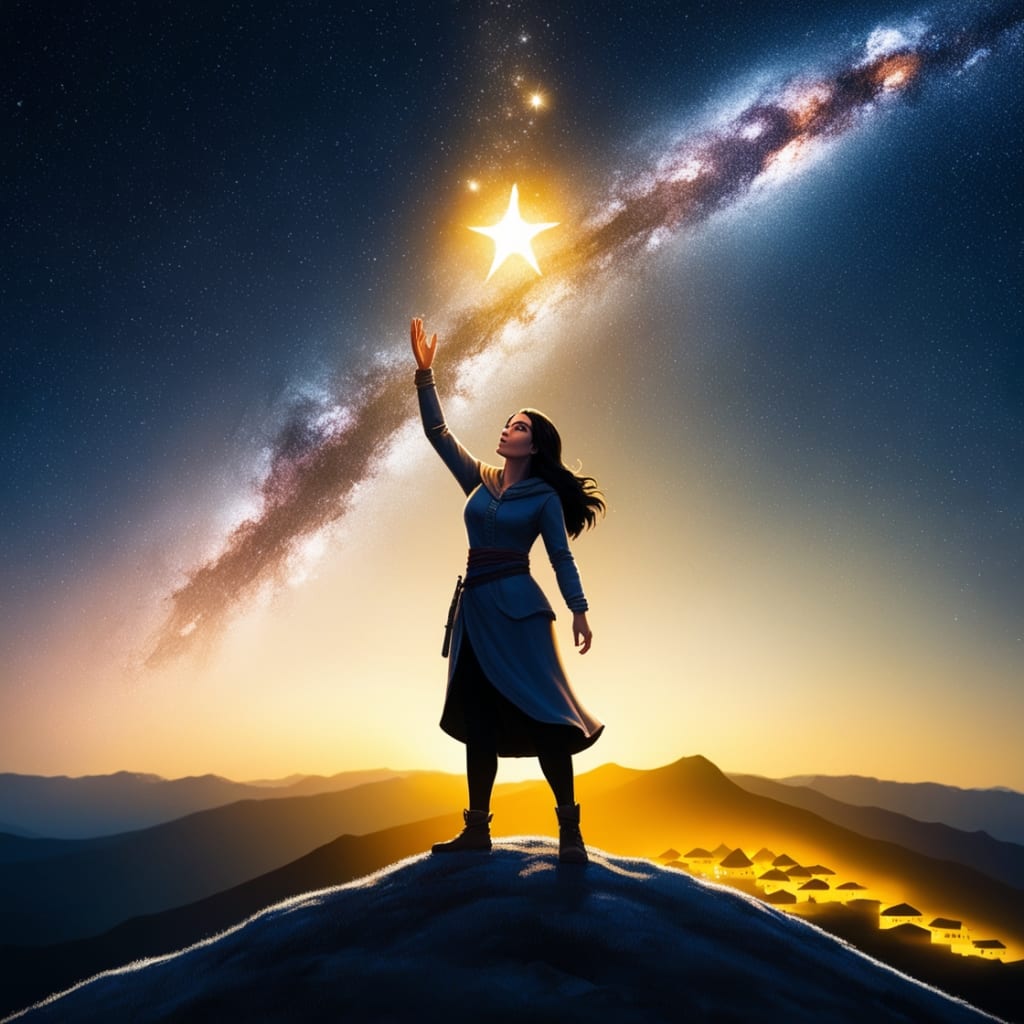
They said the stars were not for touching.
The elders in the village of Olya repeated it like a bedtime prayer. “The sky belongs to the gods,” they’d say, “and the stars are their lanterns. Look, but do not reach.”
But Noor was born with her fingers curled upward, grasping at nothing. Her mother used to joke, “She came into this world already trying to climb out of it.”
By the time she was seven, Noor knew the names of every constellation above her village. Not the names from the old stories, but her own—ones she whispered into the cool grass at night while everyone else slept.
She named the three stars in the hunter’s belt “Brother, Sister, Me.”
She named the brightest one “Belonging.”
She called the cluster above the well “The Place I’ll Go.”
Olya was a quiet village tucked into the side of a mountain, where time moved like honey in winter—slow and golden, but never changing.
People lived and died in the same stone homes. They baked bread in ovens passed down generations. They sang the same harvest songs and repeated the same warnings.
The sky was vast above them, but the rules were small.
Noor didn’t mean to break them.
She just couldn’t help asking:
“What if the stars are calling us?”
At twelve, she began climbing trees taller than the temple spires.
At fifteen, she built a wooden ladder that reached halfway to the clouds.
At seventeen, she found the cave.
It wasn’t marked on any village map. It hid behind a curtain of ivy, high above the goat trails. Inside, the walls shimmered. Not with water, but with something else—mineral veins that glowed faintly in the dark.
She spent days there, sketching and dreaming, building blueprints out of candle wax and paper scraps. No one knew.
They found out the night the fireball crossed the sky.
A meteor—or something like it—streaked across Olya with a roar that shook the mountains. It landed far beyond the northern ridge, in the forbidden zone they called The Sky’s Graveyard.
The elders forbid any search.
But Noor didn’t ask.
She left before dawn with a satchel, a compass, and boots worn thin by wonder.
The journey was cruel. Her hands bled. Her throat blistered. She nearly turned back twice.
But the stars kept blinking at her like eyes that had waited a long, long time.
When she finally reached the crater, her breath left her like a secret.
There, nestled in molten glass and silver ash, was not just a meteor—but a vessel.
Not of wood. Not of metal.
Of something Noor couldn’t name.
And inside it, a shard. No bigger than her palm. Humming like a heartbeat.
She took it.
Not out of greed, but longing.
The moment her fingers wrapped around it, she felt everything shift.
The stars whispered louder.
She returned to Olya a stranger.
The shard had changed her. Not her face, or body—but her eyes. They now shimmered with silver streaks that frightened the old and mesmerized the young.
She stopped needing sleep. Her dreams came awake with her.
She stopped aging. Or perhaps time paused around her.
She built something in secret.
Not a ladder. Not a kite.
A vessel.
With curved wings made of harvested wind.
A seat carved from starlight glass.
A shell reinforced with the shard’s impossible glow.
They gathered in the village square the night she launched.
Not to cheer—
but to stop her.
“You will anger the sky,” the priest cried.
“You will fall like Icarus!” shouted the baker.
“You will die,” whispered her mother.
But Noor only smiled.
“I would rather fall than never try.”
And she pulled the lever.
The sky opened.
Not like a door.
Like a memory being remembered.
Her vessel lifted, trembling like a prayer that doubted itself. But the shard pulsed. And the wind obeyed.
Olya gasped.
She rose.
Above the chapel.
Above the trees.
Above the highest ridge.
The stars waited.
Not cold. Not distant.
They opened to her like arms.
Noor didn’t just fly.
She danced.
She spun past Saturn’s rings and caught comet tails in her braid.
She learned the language of light.
She sang in the dark places between galaxies, and the dark sang back.
Years passed.
Or seconds.
Time stopped counting when it lost track of her.
The people of Olya still speak her name—softly, reverently.
Some say she died in the clouds.
Others say she became one of the stars she loved.
But the children—the ones who now climb too high and ask too many questions?
They believe something else entirely.
They believe Noor is watching.
That every falling star is her waving hello.
And that the sky no longer belongs only to the gods.
About the Creator
Keep reading
More stories from Abuzar khan and writers in Fiction and other communities.
Late-Night Confessions Over Cold Coffee
The bell above the door didn’t ring—it coughed. That old diner on 9th and Rosewood had stopped trying to be anything other than what it was: tired linoleum floors, booths with torn red vinyl, and a jukebox that only played silence. The only thing still working was the neon sign in the window. It sputtered COFFEE into the dark like a promise that nobody asked for.
By Abuzar khan8 months ago in Fiction
Pandora’s Burden
“My brother warned me to not accept gifts from the one who commissioned you,” said Epimetheus to the woman clad in silvery raiments standing at the entrance to the temple. Her silver tiara and the silver rings on her fingers and toes glinted in the firelight cast by torches set on either side of the doorway. Lingering in the shadows, beyond the reach of the flames as she was, he could not tell what she held in her hands. At first what appeared to be a box was perhaps a funerary urn, or maybe merely an apple.
By J. Otis Haas3 days ago in Fiction


Comments
There are no comments for this story
Be the first to respond and start the conversation.