
Shanghai Currency
Surviving the Hidden Economy of a City of Contrasts

In the bustling heart of Shanghai, a streamer navigated through a sprawling shopping mall, the kind that screamed luxury from every polished marble floor to every glimmering glass storefront. The mall was a paradise for the wealthy, where the world's most prestigious brands and high-end restaurants lined the corridors, each more opulent than the last.
The streamer held up his phone, the camera capturing the sleek, modern aesthetics around him. "Guys, check this out," he said, panning over a display of dried beef at an upscale delicatessen. "This little package here? Forty yuan. And it's barely enough for a snack."
His chat exploded with comments, the tone a mix of shock and humor. "Forty yuan? Is that made of gold?" one user quipped. "Shanghai currency, man. Might as well be paying in US dollars," another commented, triggering a wave of laughing emojis.
The streamer continued his journey through the mall, his disbelief growing with each new discovery. "Here's a small bowl of Japanese ramen," he said, zooming in on a pristine, minimalist bowl with a few delicate slices of pork and a perfectly cooked egg floating in the broth. "Sixty yuan for this? I could eat for a week in some places with that money."
As he wandered deeper into the mall, the prices only seemed to climb. A simple lunch here could easily set someone back hundreds of yuan, and for what? A meal that barely filled the stomach. "This city, man. It's only for the rich," he muttered, half to himself, half to the thousands of viewers watching his stream. The comments section filled with more jabs at the absurdity of it all, the term "Shanghai currency" quickly becoming a running joke. But beneath the humor, there was a somber recognition: in a city this grand, there were many who could only dream of affording such luxuries.
Just a short walk away from the gleaming towers of the shopping mall, the atmosphere changed entirely. The streamer stepped out of the air-conditioned bubble of luxury and into the reality that most of the city's inhabitants knew. The streets were narrower here, lined with older buildings that had seen better days but still carried the weight of history and countless stories.
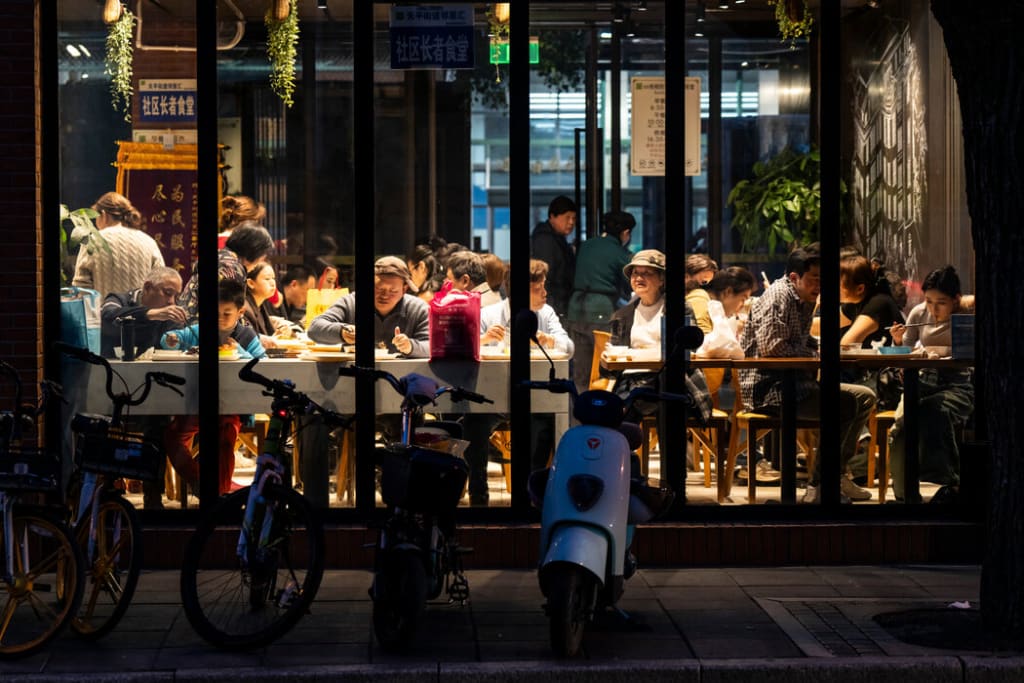
On one of these streets stood a community cafeteria. The place was a far cry from the restaurants in the mall—humble, with simple wooden tables and plastic chairs that had been worn smooth by years of use. But it was clean, and the air was filled with the comforting aroma of home-cooked food. The cafeteria operated on a self-service basis, much like a school canteen. The streamer picked up a tray and began to survey the options. Here, the prices were written in chalk on a blackboard above the counter: fried eggs with tomatoes for eight yuan, stir-fried potatoes for six, even boiled meat and shrimp dishes for just under ten yuan each. The rice and soup were free, a small gesture of kindness in a city that often seemed to forget its poorer residents. The streamer filled his tray with food, paying less for a full meal than he would have for a single dish in the mall. "Now this," he said, taking a bite of the fried eggs, "this is what real people eat." His viewers watched as he sampled each dish, the contrast between this simple meal and the extravagant offerings of the mall stark in their minds.
Later, as the sun dipped below the horizon, the streamer took to the streets again, this time in search of the other side of Shanghai's food scene—the late-night bargains. He found himself in a convenience store, where the unsold boxed meals were marked down for quick sale. It was nearing 9 PM, the golden hour for bargain hunters. He picked up a boxed meal that contained a generous portion of rice, a crispy chicken cutlet, and a drink, all for just ten yuan. "If you're smart, you can survive here without spending a fortune," he said to the camera. "But it's not an easy life. You have to know where to look." The food in these discounted boxes was far from perfect; the vegetables were sparse, and the freshness was questionable. But for those who couldn't afford anything better, it was enough. The streamer advised his viewers to stock up on vitamin supplements if they planned to live off these meals for too long. “Don’t buy the branded vitamin recommended by the staffs at drug stores. They are completely scams. These unbranded white bottles hidden in the corners of pharmacy shelves are nowhere less effective.”
In the quiet hours of the night, the streamer explored the options for housing in this massive city. Owning a home was out of the question for most—an impossible dream that seemed more like a cruel joke in a place where property prices soared into the stratosphere. But there were still ways to find shelter. He passed by shared dormitories, simple rooms with just a bed and a study desk, often occupied by students or young professionals who had come to Shanghai with dreams of making it big. The rent was around a thousand yuan a month—still big city standard, but manageable. For those who needed a place to stay just for a night or two, there were low-budget inns and all-night Internet bars where one could sleep in a recliner for a fraction of the cost. But even these options were beyond reach for the most desperate. The streamer spoke of a hidden truth, whispered among those clinging to the fringes of Shanghai's vastness—sleeping in the public bed spaces of airports or train stations. These spots were meant for weary travelers catching early flights or late-night trains, but for those with nowhere else to turn, they became a refuge, a place to rest their heads, if only for a few fleeting hours. The public bathrooms in the city, some equipped with card-operated bathing stalls, became a lifeline for those living on the edge. Despite their utilitarian purpose, these bathrooms were remarkably clean.
Shanghai, like many of the world's great cities, is a place of stark contrasts. The glitzy shopping malls and luxury apartments are the symbols of its prosperity, but beneath the surface lies another world—one where many struggle to make a life, day by day, meal by meal. Though it may seem like a city only for the wealthy, Shanghai holds a place for everyone, regardless of their means. From bustling cafeterias to hidden rest spots in train stations, it's a city of survival and resilience, where dreams are both made and broken. Here, countless stories begin—stories lived, if not always told.
About the Creator
Harry Haller
Words often distort thoughts, revealing that what is wisdom to one might seem foolish to another—yet this difference in understanding adds richness to our shared experiences.
Keep reading
More stories from Harry Haller and writers in Fiction and other communities.
The Internet Bar Chronicles: A Life Lived in the Present
I knew Wei back in middle school in Xi’an, China. He was the kind of guy who seemed almost invisible at school, always on the fringes, and often a target for the meaner kids. Perhaps out of pity or something else, I took him under my wing. On Friday nights, we’d sneak out to the Internet bar in the "village inside the city"— a dense, chaotic maze of narrow streets and old brick buildings hidden within the city’s modern exterior. The village was alive with activity, neon lights from restaurants and street stalls painting the night in vibrant colors. We’d stay there until midnight on Friday and Saturday nights, lost in the glow of the computer screens in the Internet bar, playing games until our eyes were heavy with sleep. But after middle school, our paths diverged. I went to a different high school, then abroad for college. We lost touch, and I wasn’t even sure which high school he attended—perhaps he didn’t make it to a regular one, likely ending up in a trade school instead. It was only earlier this year, on a whim, that I wished him a happy birthday. To my surprise, we ended up exchanging messages, and through these conversations, I learned more about his life over the past years.
By Harry Hallerabout a year ago in Fiction




Comments
There are no comments for this story
Be the first to respond and start the conversation.