
Seven Steps to Death: A Love That Defied Honor in Balochistan
A Tragic Tale of Two Lovers Who Paid the Ultimate Price for Choosing Love

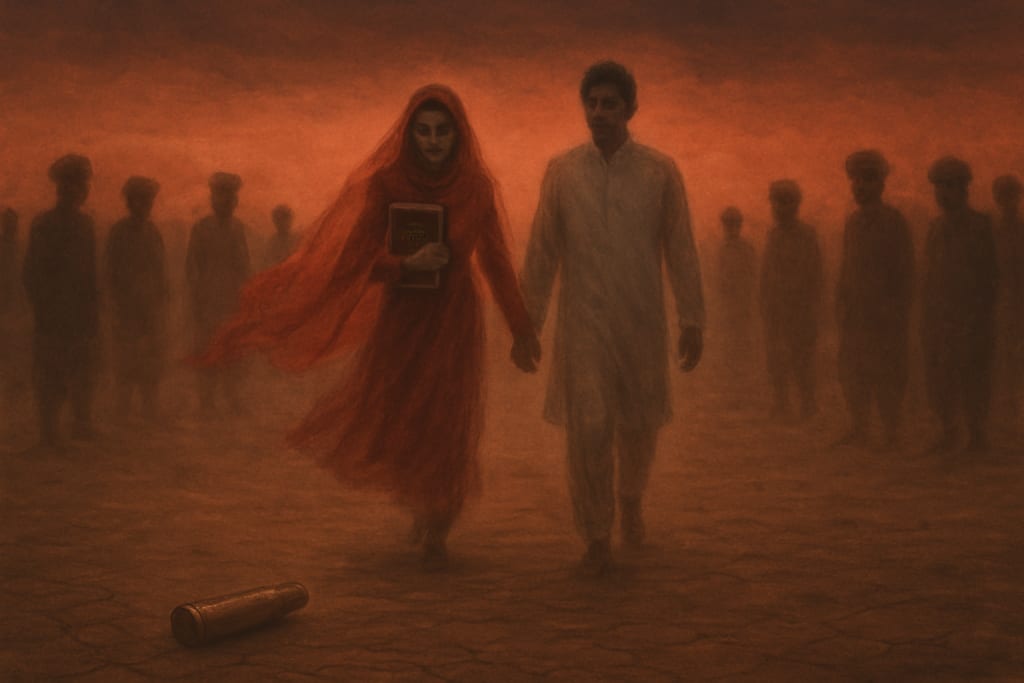
Part One: The Desert Pact
They were supposed to begin a new life together. A life they had envisioned far from the burning gaze of disapproving eyes and tribal customs that choke love before it can bloom. But for the young couple from Balochistan—names still withheld for security and legal reasons—their first steps as husband and wife would also be their last.
In a now-viral video, the woman clutches the Quran to her chest, standing shoulder to shoulder with the man she chose to marry. She turns to the men who had summoned them—the self-proclaimed custodians of tribal honor. The dry, barren land is still; the only sound is her voice breaking the silence: "Walk seven steps with me, then you may shoot."
The couple walks forward, hand in hand, into what they must have known was a death sentence. The woman in red. The man calm, resigned. After the seventh step, gunshots ring out. First her, then him. Each life extinguished with clinical precision. Their crime? Love.
Part Two: In the Name of Honor
Honor killings are not new in South Asia, and Balochistan—a region marred by insurgency, patriarchal dominance, and tribal rigidity—is no stranger to them. Yet, this case pierced the national conscience like few others. Why? Because it was recorded, circulated, and witnessed in real time. There was no denying it. No brushing it under the rug.
The footage was disturbing, but it was also undeniable truth. The killers didn’t even bother to mask their faces. Their sense of righteousness was so deeply entrenched that they stood by their actions proudly, believing they had cleansed the family’s name.
But what name was left to protect after such brutality?
These murders were not spontaneous crimes of passion. They were organized. Calculated. A convoy of vehicles, nineteen men, five loaded guns. They called the couple to a fake "feast," a false reconciliation—only to trap them in the wide-open silence of Chittail Maidan, a field that now whispers stories of love and bullets.
Part Three: State Response and Outrage
The public outcry was immediate and thunderous. Human rights organizations, journalists, celebrities, and citizens flooded social media with demands for justice. The Chief Minister of Balochistan, Sarfraz Bugti, labeled the act as terrorism and vowed accountability. Within days, eleven suspects were arrested, and a case was filed by the state, not by the family—who were complicit in the murder.
In a rare move, authorities signaled their intent to try the case in anti-terrorism courts, setting an example against the normalization of such killings.
But for activists, it wasn’t enough. Honor killings are deeply embedded in the societal psyche. In 2024 alone, Pakistan recorded over 400 honor killings. Most go unpunished, or the killers are forgiven via "razinamas"—legal pardons given by families of the victims. But in this case, the family was the killer.
"If this case fails, it will tell every tribal father and brother that they, too, can kill in the name of 'honor' and walk free," said a lawyer from the Human Rights Commission of Pakistan
Part Four: The Final Walk
What did she feel, holding the Quran, walking into her own execution?
Witnesses say her face held no fear—just a quiet, unwavering resolve. The same resolve that had led her to reject a forced engagement. That had compelled her to marry Zarak—an orphaned cousin with no tribal standing but her whole heart. That had pushed her to believe that love was worth the cost.
She had hoped that the Quran, as a holy symbol, might stop the bullets. She had hoped that someone in that convoy of relatives would see the humanity in her, in him. She was wrong.
Zarak never looked away. Not when she was shot. Not when he was told to kneel. He died with his eyes open.
Part Five: The Religious Argument
What makes this case even more horrifying is the religious hypocrisy embedded in it. The killers justified their actions as preserving family honor—yet ignored Islamic teachings that explicitly forbid forced marriages and honor-based violence.
Surah An-Nisa (4:25) states:
"Do not prevent them (women) from marrying their husbands when they mutually agree in a lawful manner."
This verse underscores the woman’s right to choose her partner. Scholars across sects agree: Islam promotes consent in marriage and condemns injustice. So how can a book that begins with "In the name of God, the Most Merciful, the Most Compassionate" be held in the hands of a girl while her relatives aim guns at her chest?
They killed her holding the Quran. What honor remains in that
Part Six: The Symbolism of Red
She wore red to her wedding. She wore red when she died. Red—the color of celebration, of brides, of martyrdom. Her blood, when it spilled, turned the red of joy into the red of mourning.
Zarak, too, wore a simple white shalwar kameez. His hands trembled not from fear, but from the weight of love betrayed by family. It is said that he muttered a prayer seconds before death. That his final words were her name.
In a society where the man is often spared, he chose to die with her. That choice—like their marriage—was made together.
Part Seven: A Field of Ghosts
Chittail Maidan, once a grazing field, is now a memorial no one dares to visit. Locals speak of it in hushed tones. Children are warned to stay away. But at night, some say, they see two shadows walking—holding hands, walking seven steps, vanishing into the moonlight.
The site is not marked, but it is remembered. Not officially, not with plaques or monuments—but in the trembling voices of girls planning to run away. In the silent tears of mothers who once were brides. In the eyes of brothers who watched and did nothing.
Part Eight: What Justice Looks Likes
Justice for the couple is not just about convictions. It’s about systemic reform:
1. Legal Prosecution: Their killers must face life imprisonment without parole. No razinama. No out-of-court settlement
2. Education Campaigns: Schools in tribal areas must teach girls and boys their rights under Islamic and national law.
3. Religious Reconciliation: Mosques must speak out—clearly and loudly—against the false equivalence of honor and murder.
4. Media Advocacy: This story should be told in newspapers, films, classrooms—not just Twitter feeds.
5. Support Networks: Helplines, shelters, and anonymous legal aid must be expanded across rural Pakistan.
Part Nine: An Unfinished Love Letter
They had written letters to each other. In one, she wrote:
"If they find us, I won’t cry. But I hope the world sees this as love, not rebellion. We didn’t ask to be famous. We just asked to be together."
They weren’t revolutionaries. They didn’t protest. They didn’t demand to rewrite law. They only wanted to be together.
But in their quiet love, they have shaken the pillars of a society built on fear.
Part Ten: A Future Worth Building
Somewhere in Balochistan, another girl is in love. Somewhere else, a young man is planning to marry without permission. What legacy will they inherit?
Will they see the couple in red and white as martyrs or as warnings?
That answer depends on us—on lawmakers, on religious scholars, on educators, on every parent who claims to love their child. If we don’t act now, we’re complicit in the next killing.
We must build a future where marriage by choice is not a death sentence. Where the Quran protects—not accompanies—a girl to her grave.
Love should never cost your life. But if it does, let it at least shake the conscience of the living.
Let it start a revolution in red
Thank for reading 😘:)
About the Creator
Muhammad Abbas khan
Writer....
Keep reading
More stories from Muhammad Abbas khan and writers in Fiction and other communities.
Echoes of a Forgotten Code: When AI Redeems Human Memory
Chapter 1: The Leak Cameron Malik thought this would be just another gig: investigate the rumored leak from AetherTech’s closed AI initiative, Project Mnemosyne. The internal memo hinted an internal beta had “begun recalling user-specific data it was never trained on.” The source was anonymous, but the claim was earth‑shaking: an AI with emergent memory. On a rainy Islamabad afternoon, the forwarded PDF sat waiting. Cameron’s pulse raced. This would be career territory—or a career‑ending rumor. They arranged a clandestine meeting for proof.
By Muhammad Abbas khan8 months ago in Fiction
“I Found a Phone in the Forest — It Started Receiving Messages From 2045”
The forest behind my town wasn’t famous. It didn’t have a name on any map, and tourists never came. To most people it was just a patch of old trees, tangled paths, and the occasional deer. But to me, it was where I went whenever life felt too loud.
By Maavia tahir4 days ago in Fiction


Comments
There are no comments for this story
Be the first to respond and start the conversation.