

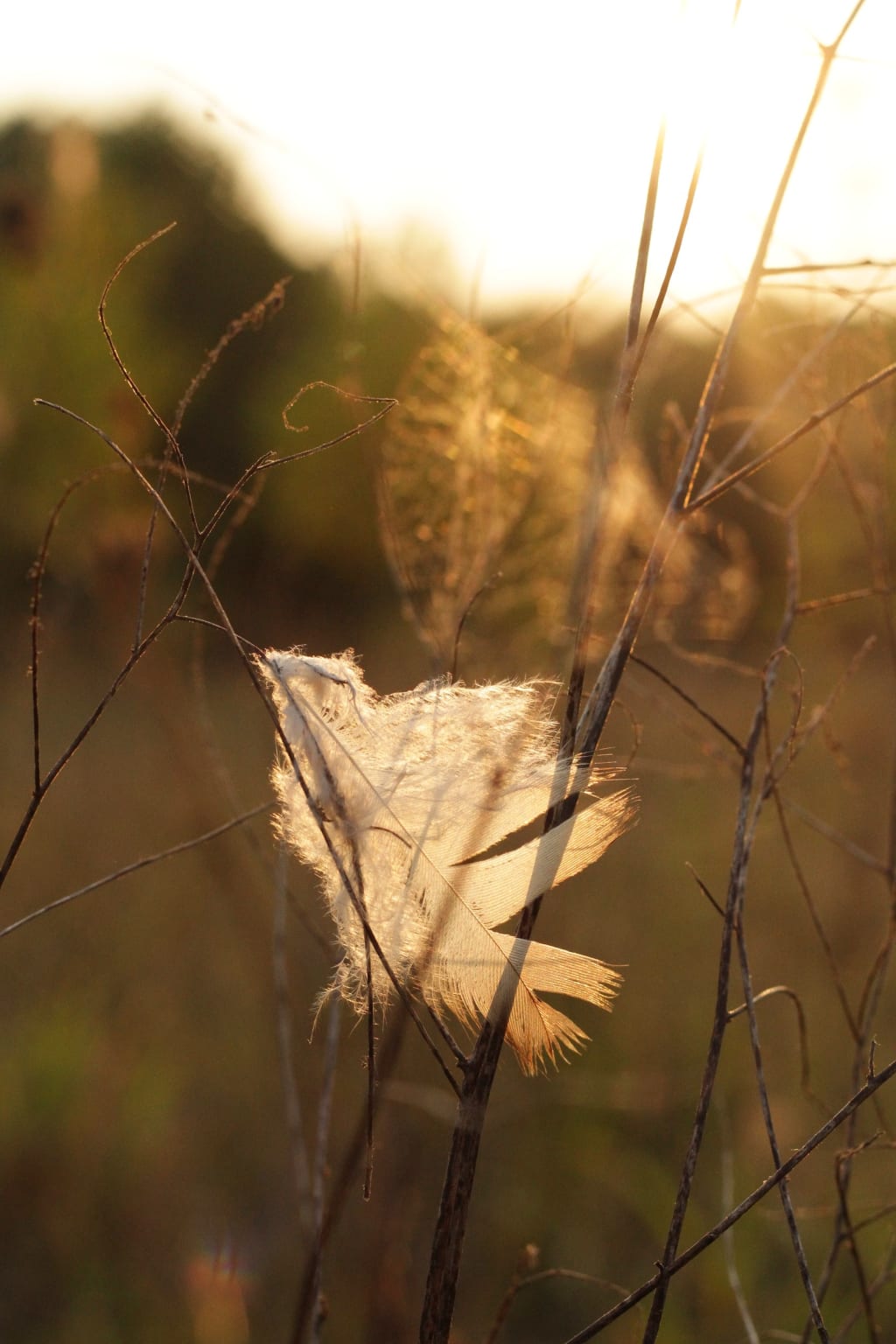
The woman approaches the barn with a weary heart. It has been years since she last crossed these fields of golden-green grass, and she was decidedly smaller the last time. She is so much changed, in fact, that the barn barely recognizes her.
Her hair, once short, now falls around her shoulders in great brown waves. Her limbs, too, have lengthened and she strides easily through the sea of grass she once waded through. Her face is less soft, less round, and her summer freckles are not so prominent as they once were. These things barely matter to the barn, though, who does not see her so much as feel her. It is her insides that feel so different now.
Still, the barn would not forget the girl who gave it life, and it stands ready to welcome her back. She approaches, and with gentle fingers she runs a hand over its great hide. The wood is weathered and sun-bleached, but she seems not to mind. A small smile crosses her face, barely crinkling the corner of her sad mouth.
“Hello, barn.” She whispers.
It has been so long since anyone has said hello to the barn. It feels for a moment as though the sun has broken through the clouds, warming its roof slats and the earth beneath its foundations. Hello, little one. The barn replies, though it has never been sure if she can hear.
In years past the girl would spend time poking through the grass around the barn’s sides for hidden treasures. Often she would find them, too, gifts from the ravens who the barn allowed to nest in its rafters; scavenged keys and silver trinkets, beautiful pebbles, sometimes even small weather-worn bones to line the girl’s pockets.
Today though the gray afternoon promises a mid-summer rain, the wind pulling insistently at her clothes, and the woman ducks quickly through the barn’s wide doors.
The barn spares a thought for its own insides, and with a pang of regret realises that the woman is not the only one who is different. There is no more warm, sweet-smelling hay for her to climb over top of and nest in; instead, there is old unused equipment haunting an empty space. The boards of the loft have cracked and splintered, and the roof dribbles in water when it rains. The barn is no longer the warm fortress it once was.
The barns worries this is why the woman’s eyes are so sad as she enters. Surely she was seeking refuge, as she so often did as a child, and has found a great creaking, leaking husk instead. Suddenly the barn wishes that she would leave. Something in it, analogous to a heart, perhaps, aches fiercely as the woman quietly wanders around the old plows and combines.
I’m sorry, it thinks. The woman blows the dust off the seat of a tall tractor and climbs up into it. She leans back and tips her head up to the ceiling, eyes gently closed.
“I’m sorry it’s been so long.” She says. Her voice fills the space, soft and warm and just as honest as it always was. The barn imagines it can feel some of the cobwebs clearing out of it’s corners at the sound.
You had to leave. It tells her. I always knew that.
“Sometimes I think I never should have left here.” She says, and the barn couldn’t say if she was responding to it or simply continuing her own thoughts. It waits for her to speak again.
“The forests in Texas are nothing like they are here, all spindly and short and sharp. I can’t even walk barefoot down there, the grass is too pointy and dry.” The woman laughs as though it’s a joke, but the barn feels the unhappiness underneath her words. It can't fully comprehend the idea of short trees; the only ones it has ever known tower above its peaked roof. It remembers then how much she loved to climb them and sit high in their branches.
“I don’t mean to sound ungrateful, you know. The city has been good for me in a lot of ways, it’s just...” She trails off, letting out a heavy sigh.
Just what? The barn asks. You can tell me. You can always tell me.
“I’m never really happy anymore.” She confesses, her voice barely a whisper. She says it like some great secret, but the barn can already feel just how deep the well of her sadness runs.
It’s hard to reconcile the joyous girl of it’s memory with this woman. There is the same warmth, the same love, perhaps even a hint of the same playfulness, but something new drowns them all out. It is not the small fears of her childhood, or the anxieties of teenagedom. The barn remembers those well, has warm memories of sheltering her through those squalls and storms.
This is different. This feels like an ocean, an expanse of emotion so vast the barn can hardly feel its edges. It is ripe and thick with pain, a deeper and purer pain than the structure has ever encountered. Its boards creak with the weight of it.
What happened? It asks her.
Tears well in the woman's eyes and the barn is alarmed to see her bite down hard on her lip to stop them. She shakes her head sharply and hops down from the seat of the tractor. Always moving. At least that hasn’t changed, the barn thinks.
Its first memory is of the girl skipping through the field, on the way to say hello. She had been doing this every day for weeks, every time shouting “Hello, Barn!” at the top of her little lungs. The barn supposed it had become a bit more aware each time, until finally it was able to say hello back.
From that day, all through her childhood, the barn and the girl had been the best kind of friends. It watched over her as she gamboled through the fields, happily sheltered her from spring showers, listened to her chatter about whatever was on her mind. She, for her part, looked after the barn too. Whenever a board would come loose, or an uncomfortable nest of hornets settled into its side, the girl would run off to tell her father, and quickly it was fixed.
She often brought her toys with her and turned the inside of the barn into a great amphitheatre, staging great comedies and dramas with her stuffed animals and dolls. She practiced her cartwheels, hid from her parents, and played elaborate games of pretend. When she got older, she would bring books and sketchpads, and sit in the loft for hours.
And always, she talked to the barn. She told it everything; the rabbit she spotted in the woods, her terrible fourth-grade teacher Mrs. Howland, her parents fighting. There were no secrets between the two of them. She knew every secret nook and cubby of its vast structure, and the barn knew all the secrets of her little heart.
No more, though, it seems. The woman paces the length of the floor, examining the rusting tools hung from the walls. Have we both really changed so much? The barn rues to itself.
“Do you remember the family of mice that lived here when I was nine?” She asks, absentmindedly tracing the handle of a spade.
Of course. Your father wasn’t going to let you keep them, so I hid them for you.
“I named them all.” The woman says, voice full of nostalgia. “The mom was Pepper, and the babies were Cinnamon, Clover, Blue, and Maple.”
And Daffodil. The barns reminds her fondly.
“Oh! And Daffodil. I used to pronounce it Daffidoll.” The barn can feel the sadness lurking under the happy story, but the woman is stubbornly refusing to acknowledge it.
You always were stubborn, too. It says. The barn wishes she would just tell it what is making her so sad. The woman takes a deep breath in and sighs again.
“Well, I should probably get going. Looks like it’s going to rain.” She says reluctantly. To the barn’s dismay, she turns to go.
No! It shouts, certain that if she leaves now she will never come back.
The woman brushes her hand across it’s wooden side as she walks towards the door, and though it is reluctant to cause the woman any more pain, the barn jams a splinter into her finger.
“Hey!” She yelps in surprise.
Tell me what’s wrong. The barn demands.
“Oww, that hurts…” She whines, examining her finger. She removes the splinter easily, but as the sliver comes out she begins to bleed. The barn feels her tears begin to well up again, and this time she doesn’t stop them.
Tell me what’s wrong. Please. It still doesn’t know if she can hear.
The woman hiccups, the tears coming faster now as the stinging pain in her finger gives way to the tide of sadness held within her. She gives into it fully then, and begins to weep. Sobs wrench their way out of her, and the barn listens, and wraps its warm presence around her. When she’s ready, the woman speaks through her tears.
“He’s gone. I still can’t believe he’s gone.” She cries. “I don’t what to do without him, how to be without him. I keep waking up in our apartment and expecting him to be there, and every time he’s just not.” The words come fast, as though they’d been bottled up far too long.
“We buried him in a suit, which was stupid because he hated suits, but his mother wouldn’t listen to me. We were married for six years, but I still didn’t get a say in the funeral.
It was because there was no will. He was only 32, you know? Of course he hadn’t written a will. So she just bulldozed me the whole time, and we buried him in that horrible tacky suit.” The woman hiccups again.
“And I can’t afford our apartment by myself, especially not if lose my job, which I’m probably going to do because I keep crying on my lunch breaks and doing garbage work.
And all of my friends say that they miss him too, but it’s not the same. And I can tell they’re getting tired of me being sad all the time, but it’s only been a few months, and I thought we were going to be together forever, you know?”
And none of that matters at all, because I can’t think about anything other than how much I miss him.”
The barn and the woman sit in silence for a moment, listening to the gentle patter of the first few raindrops as they begin to fall on the roof.
“I’m sad I never got to bring him here.” She says after a moment. “You two would have gotten along famously.”
I’m sure he was wonderful. The barn says. It understands, now, that the ocean of sadness inside the woman is grief. It has had little enough contact with grief, but it hopes, for the woman’s sake, that grief passes the same way as other storms.
Just then a raindrop finds its way through a gap in the roof and splashes just on the tip of the woman’s nose. If the barn had a heart, it would have missed a beat, but the woman only looks up at the barn and smiles softly.
“I’ve been thinking about coming back up and staying with mom and dad for a while.” She says quietly. “I could always help dad patch you up while I’m here.”
I’d like that very much. The barn says, We could mend ourselves together.
The woman leans back against the wall of the barn and sighs, closing her eyes to listen to the rain. For the first time in a long time, both the girl and the barn feel something like hope.
About the Creator
Rebecca Sexton
Twenty-five year old artist and writer living in Austin, Texas.
Keep reading
More stories from Rebecca Sexton and writers in Fiction and other communities.
Goldblood
TW; Heavy Gore and Sexual Violence ………………………………....…........Chapter One……….....………………………………. It’s cold and pitch black here. The walls press in on me from both sides, the narrow never ending hallway stretching out further than even I can see. I keep walking. Further, and further, and deeper, and darker down into the black.
By Rebecca Sexton5 years ago in Fiction


Comments
There are no comments for this story
Be the first to respond and start the conversation.