

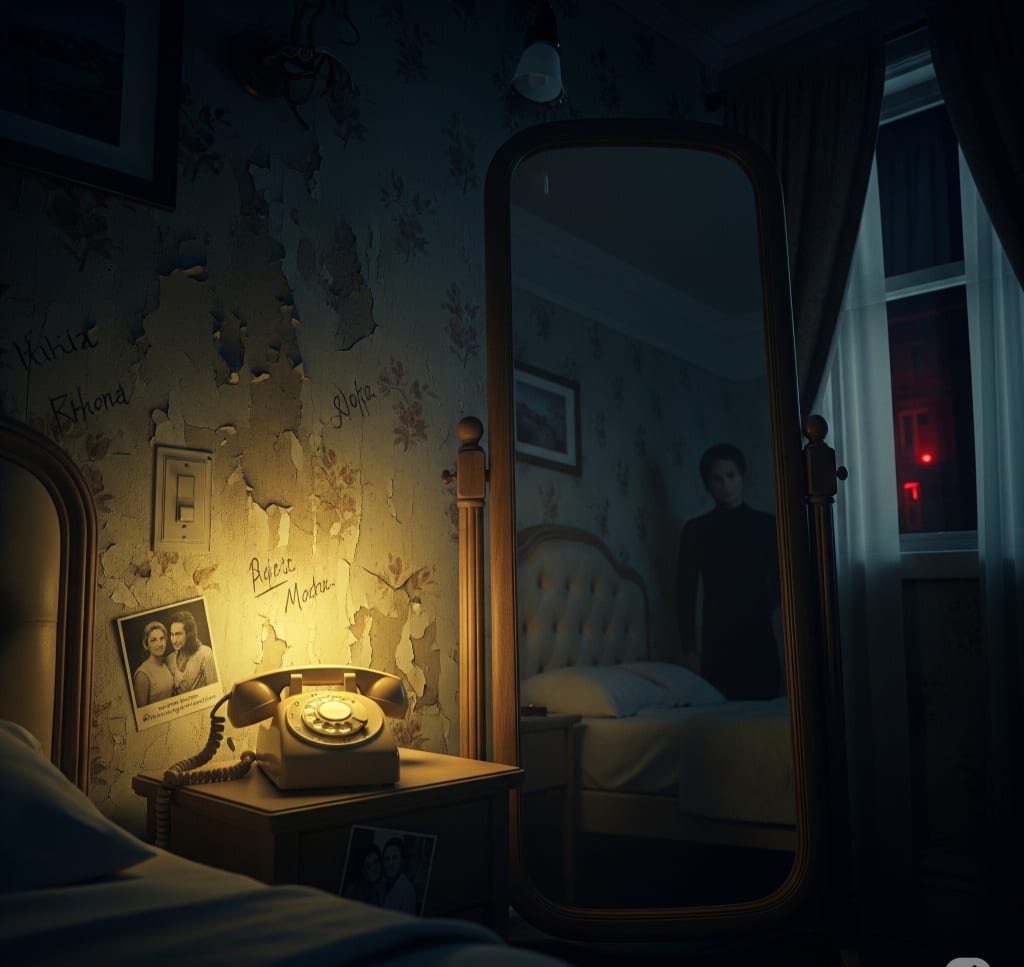
The phone in Room 313 rang exactly seven seconds after Julia unlocked the door—and no one was supposed to know she was there.
She froze.
The hotel was half-abandoned, operating on skeleton staff and flickering fluorescent lights. The carpets smelled like a forgotten decade, and the front desk clerk hadn't even looked up when she asked for the “cheapest room with the least light.”
That room was 313.
The phone rang again. Old, beige, rotary-style. The kind you couldn’t mute even if you tried.
Julia picked it up slowly, as if the air around it might burn her fingers.
“Hello?” she said, voice low.
Silence.
Then a whisper: “He knows you’re here.”
Her breath hitched. “Who is this?”
Click.
The line went dead.
Julia locked the door. Chained it. Bolted it. She checked the windows—sealed shut. She hadn't told anyone she was coming to this town. Not after what happened in the city. Not after finding the second envelope.
She pulled it from her coat pocket: the same off-white envelope, no stamp, just her name handwritten in faint graphite.
Inside: a photo of a door.
Room 313.
This room. This exact angle.
It had been slid under her apartment door two nights ago, just like the first envelope two weeks earlier—containing a photo of a stranger’s face. That man, she'd later learn, was found drowned in his bathtub. With no signs of trauma. Fully clothed. Smiling.
She hadn’t told the police.
She hadn’t told anyone.
Because deep down, she had a feeling someone was watching her reactions.
And now—this.
The room was dim. A single bedside lamp fought the shadows in vain. The wallpaper curled like old skin. On the nightstand, another phone sat—modern, black, out of place.
Not hers.
It vibrated once.
A new message.
LOOK IN THE MIRROR.
She turned her head slowly.
There was a full-length mirror beside the closet. But something was wrong. The reflection showed the room, but not her. Not her shadow. Not her shape. Nothing where she stood.
She moved.
The room in the mirror stayed still.
Then something did move—inside the reflection.
A figure stepped out from behind the bed in the mirrored version. Dressed in a dark coat. Head tilted. Watching her.
There was no one behind her in the real room.
Her phone buzzed again.
TURN AROUND.
“No,” she whispered. “No, no...”
Then a knock.
From inside the closet.
She opened it with trembling fingers.
Nothing. Just a wall. And a hole—carved into the back panel. A small crawlspace, like something from a maintenance duct. Cold air flowed out like breath.
Taped to the inside of the crawlspace was a photograph.
She pulled it out.
It was her.
Standing at the window.
But taken from behind, outside.
Suddenly, her phone buzzed one last time.
LOOK OUTSIDE.
Against every instinct, she stepped to the window and peeled back the curtain.
Directly across the street, in the building under renovation, a red light blinked.
A camera.
Pointed at her window.
She stumbled back.
That’s when she saw it—the wall under the peeling wallpaper, just behind the bed, had writing. Long faded, nearly invisible unless the lamplight hit it just right.
She leaned in.
It wasn’t just writing.
It was hundreds of names.
Each written over the other. Faded. Scratched. A list.
One name wasn’t faded.
It was fresh. Still drying.
Julia L. Mercer.
She stared in disbelief.
Her hands trembled.
Then, slowly, her reflection returned in the mirror.
Only now, she was smiling.
But she wasn’t.
The next morning, Room 313 was empty.
No signs of struggle. No fingerprints. Just a flickering lamp and a phone off the hook.
At the front desk, a man in a dark coat asked if the room was available.
The clerk glanced at the logbook, then nodded.
“Just had a cancellation,” he said. “Room 313’s open.”
The man smiled.
“I’ll take it.”
Ending line:
The room never waits long for its next name.
About the Creator
The Box
"I'm telling you, Man: it's real, and it's worth a fortune!" Duke had that look in his eyes again. Somewhere between a kid on Christmas morning, and a crackhead looking for his next fix. The last time Ronny had seen it, he spent two months in the hospital recovering from a weird, tropical fever nobody still could tell him the name of. The time before that, he'd spent three weeks rotting in a Mexican prison. Which he vowed never to speak of again.
By Natalie Gray3 days ago in Fiction



Comments
There are no comments for this story
Be the first to respond and start the conversation.