
Roman Rance: The Unyielding Storm
A Tale of Power, Loyalty, and Betrayal
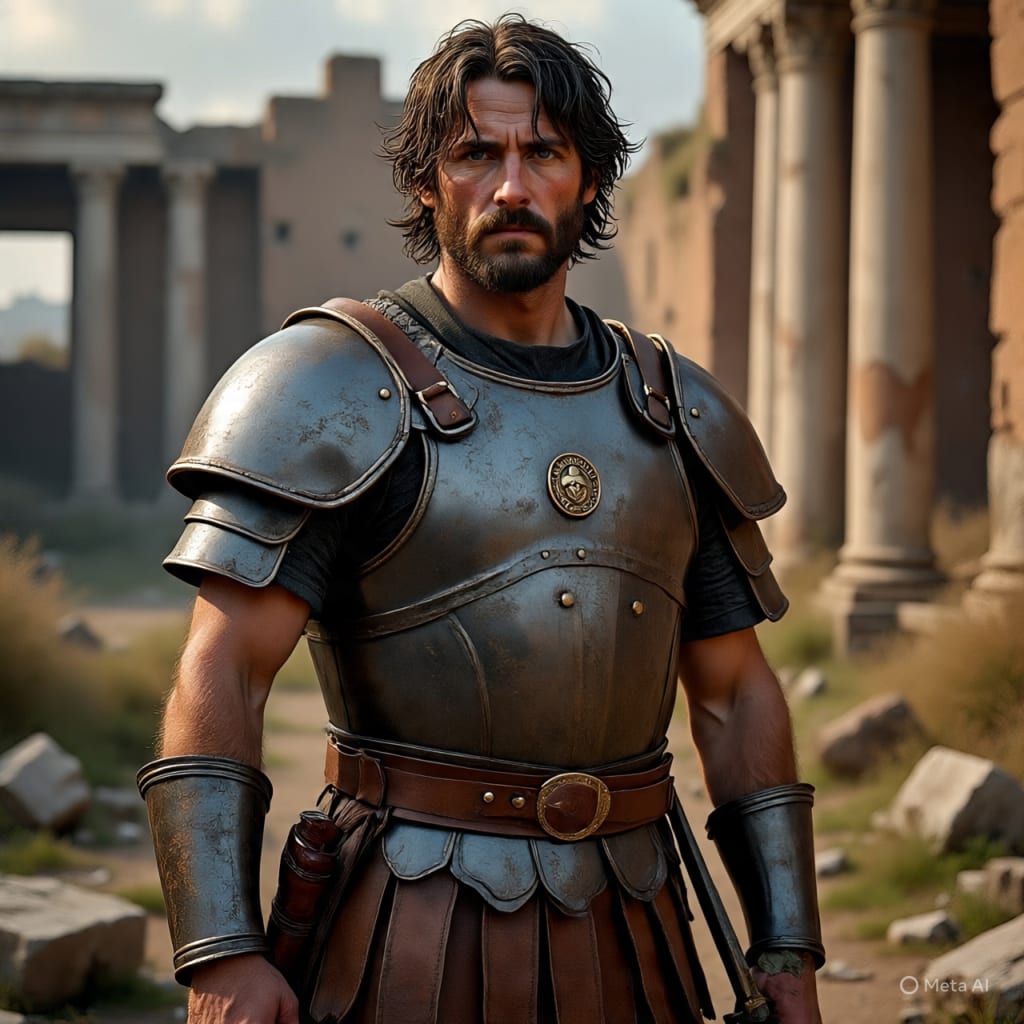
Roman Rance was born on the fringes of the Empire, in a small settlement where the stone walls of Rome’s power were more rumor than reality. His father was a soldier who never returned from campaign, and his mother a weaver who taught him the rhythm of patience, but it was in the wild fields and ruins near his home that Roman truly grew. He was a boy who fought the wind, shouted against storms, and swore that he would one day be more than just another forgotten name.
By the age of sixteen, Roman had already outpaced the other youths in both strength and cunning. He carried himself with an arrogance that others mistook for confidence. Yet beneath it lay a furnace of ambition—one that no victory in village contests could quench. When recruiters for the legions passed through his province, he enlisted without hesitation, hungry for the world beyond the horizon.
---
The legions taught him discipline, though not humility. Roman learned to march until his sandals split, to hold a shield until his arms screamed, and to obey orders with silence. But he also learned that not all commanders deserved obedience. He saw officers drunk on wine and power, gambling away lives for glory. Roman memorized every mistake, every weakness, storing it for the day he would rise above them.
His chance came during a campaign in the East. The legion had been sent to suppress a rebellion in a desert province, but the enemy proved elusive. Ambushes thinned their numbers, and morale fell like sand through an open hand. When his centurion hesitated, Roman acted. He led a counterattack through a narrow pass, guiding his cohort with boldness that seemed reckless yet somehow turned the tide. For the first time, he commanded men not by title but by fire of spirit. They followed him because they believed he could carve a path through chaos.
That night, as the desert stars blazed above, men whispered his name: Rance the Unyielding.
---
Promotion followed, and with it responsibility. Roman Rance became a centurion, then a tribune, his reputation spreading faster than news could travel. He was no longer just a soldier but a symbol—of ferocity, of unbreakable will, of ambition unchained. He never forgot the village where he began, the absent father, the thin meals by the hearth. Each victory was not just for Rome, but for Roman himself, a stone laid in the monument of his destiny.
Yet glory is never without shadow. Roman’s methods were ruthless. He drove his soldiers beyond endurance, demanded loyalty with an iron hand, and crushed dissent without mercy. He made enemies not only among rebels but within his own ranks. Senators in Rome muttered his name with both awe and unease, for men like Roman were as dangerous to empires as to enemies.
---
The defining moment came during the Siege of Veyra, a walled city defiant against Rome. Weeks dragged into months, supplies dwindled, and disease gnawed at the camp. Roman proposed a daring assault: tunneling beneath the walls while launching a feigned retreat to lure the defenders out. His superiors scoffed—too risky, too unconventional. But Roman, true to his nature, acted regardless.
The plan succeeded. The walls of Veyra fell, and with them the spirit of resistance in the region. Rome rejoiced, but Roman’s insubordination could not be ignored. He was summoned back to the capital, his future uncertain.
On the journey to Rome, he reflected on his path. He was no longer the boy who shouted at storms; he was the storm itself. He had carved his name into the annals of battle, yet he sensed that the Senate feared him more than they praised him. Power was a fragile thing in Rome—always shifting, always contested. And Roman Rance was too ambitious to rest satisfied as a tool of others.
---
When he stood before the Senate, garbed in the dust-stained armor of a conqueror, silence filled the chamber. Some expected him to beg for pardon, others to bow his head. Instead, he lifted his chin and declared:
“Rome does not need men who obey blindly. Rome needs men who win.”
His words echoed like thunder. Some senators applauded, some seethed. But one thing was certain: the name Roman Rance would not be forgotten. Whether he rose to consul or fell as a traitor remained uncertain, but history would carve him into its stone tablets as a man who dared to defy both enemies and masters alike.
About the Creator
Keep reading
More stories from Princess Ladly and writers in Fiction and other communities.
Imran Khan: The Lion Who Never Gave Up
In the bustling city of Lahore, in a family of scholars and strong traditions, a boy named Imran Khan was born in 1952. Unlike most children of his time, who dreamed of stable professions in medicine, law, or business, Imran carried a different vision. His heart belonged to cricket. From the narrow streets of Lahore to the manicured grounds of Aitchison College and later Oxford University, his bat and ball became his closest companions.
By Princess Ladly7 months ago in Fiction




Comments
There are no comments for this story
Be the first to respond and start the conversation.