
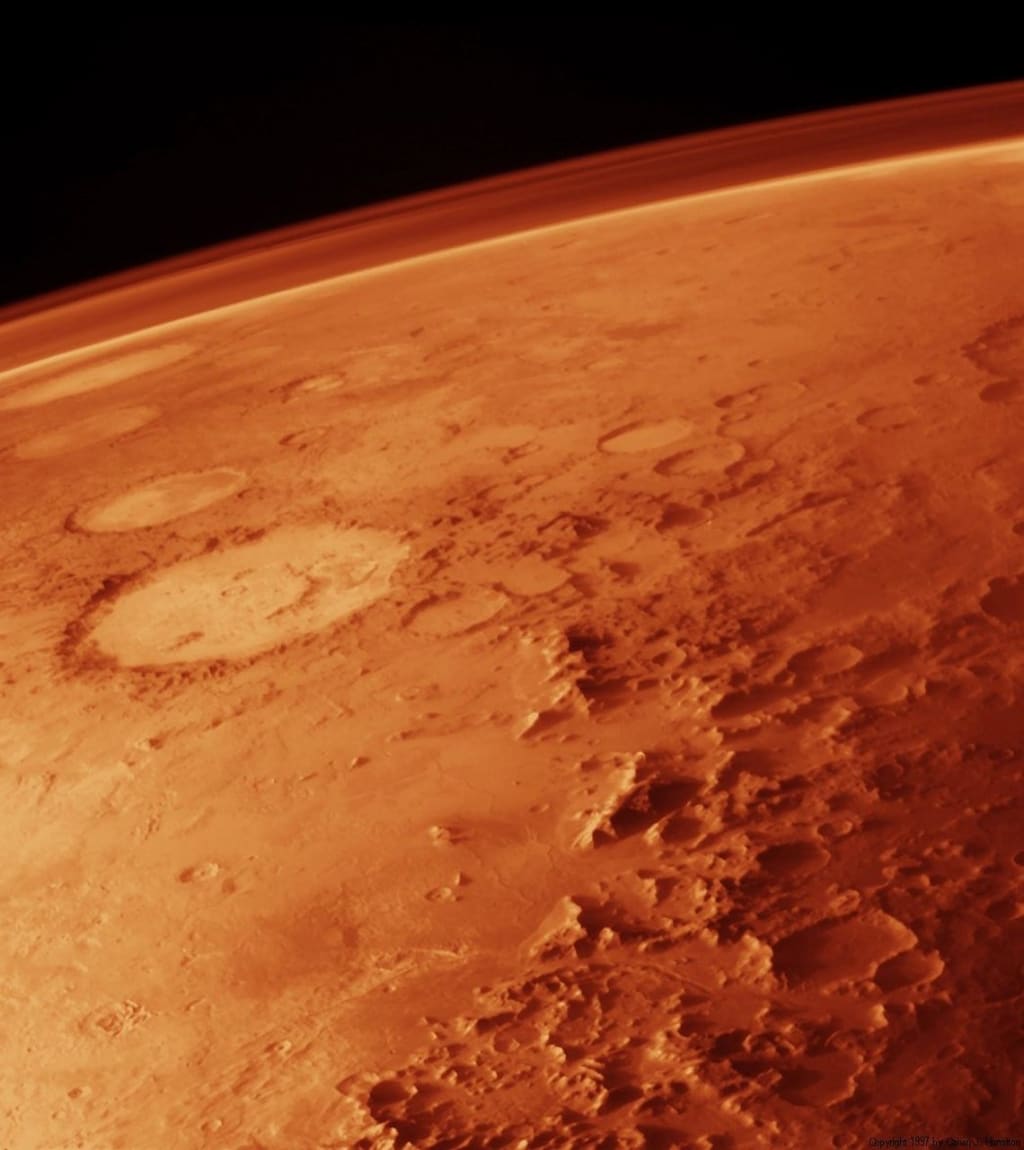
It’s night, somewhere on Mars, and a transaction is about to take place. It’s a pretty big deal, if everything goes to plan. But if something goes wrong, someone will need to take the fall.
And that is why Max Tonto has been chosen to take care of it.
The building is an old, blocky, concrete prefab, the kind they used to drop from orbit years before settlers arrived. The number 123 is painted on the front airlock in blocky, yellow letters. Set in the center of the bossed metal door is a small plastic window. An ad drone, unable to find a set of eyes, whirs down the street, announcing the new Thermtech Thermal Suit, guaranteed to keep you warm in those cold Martian summers.
Inside the door, the main room is the center of a frantic operation. Skinny, skimpily dressed men and women move back and forth, carrying chemistry sets, powders of various colors and viscosity, illuminated by black lights. The air is thick with smoke. The people are covered in a variety of tattoos, without much consistency or apparent meaning. Everyone is sweating.
The one commonality between all the workers is their breathers. These masks cover the nose and mouth of the wearer, and have sets of tubes protruding from them. These tubes flow down to small metal canisters worn around the waists and on the back. Not a single one of the workers is wearing their breather strapped to their face; there is clearly oxygen in this building. But some of the more nervous of the bunch wear their breather around their neck, and their tanks clipped to their belts. Others carry them clipped to their belts. Some even have custom rigs, wearing their tanks like small backpacks or rigs.
In a small breakaway room off of the main center of activity, two men are talking. The first man is dressed in the garish fashion of Albion, an orange pleather jacket decorated with neon lights, and beneath it a black jumpsuit stylized to vaguely resemble a shirt-and-pants combination. He is tall, lanky, ginger, and the glisten on his brow is far wetter than the heat in the room would suggest.
The other man is dressed similarly to the chemists moving around outside, with a sweaty tank top and old coveralls once dyed a deep purple. He is small, with darker skin and jet back hair. He has a deep, old scar running vertically down through his eye on the left side of his face, but he is young, apparently. Age can be hard to tell on Mars- some colonists toil on the radiation-heavy surface. Others live their lives indoors, and their skin never sees the light of day. This man is the second type. He paces around the room, pausing, gesturing, monologuing. This is Max.
Max is talking. He talks slowly, breaking his speech with awkward pauses, squinting and nodding at inopportune moments.
"Right," he says, "and you are… sure… that no one knows that the... dep is missing?"
He steeples his fingers in a manner that implies he isn't sure why people normally steeple their fingers, but feels it is the correct thing to do.
The other man looks exasperated almost, but still sweats and fidgets with an anxious energy.
"Yeah Max. The only people who know that this exists are your people and myself."
The two of them simultaneously glance at the object on the table. A square piece of plastic and metal so generic that not a single person throughout the system would fail to recognize it. A hundred years ago, this would have been known as a USB drive, though a scarce few would use that name these days.
The two men regard it as if it were the shroud of turin.
Max breathes, deeply, and attempts a look of thoughtful control. "You understand the deal, okay? These photos don’t go away. And we know where you live.”
“We’re both screwed if this surfaces. So, listen, as long as the cops can mind-spike my corpse, we’re all in this together. And if we’re all in this together, then we can all grow very rich in the future.”
“Yeah, we’ll get rich. Let’s see if you don’t drop this all on klax,” said the darker man. He presses a finger to the device on his wrist, which is a dark bracelet. His left eye lights up as the small screen hidden in a contact lens flickers to life, feeding information to Max. He makes a gesture with the finger still touching his bracelet, and in turn the ginger man’s eye lights up. For the first time since entering the room, the ginger man looks like he relaxes.
“Well, now that you mention it…”
“I’ve already deducted the cost of your usual. Chat to the doormen, he’s got it ready.”
“You’re a good guy, Max. I’m… I’m going to go now,” said the ginger lamely, scratching absentmindedly at his neck.
“Go on.” Max had picked up the dep, and was sitting down at the table. Awash in purple light, he regarded the small piece of electronics in his hand with reverence.
The ginger leaves the room, and walks into the main hall. As he does, his attention is grabbed by another man, who is making his way across the room. This new man is tall, to the point of awkwardness, and dressed as if he was trying to clash. An old, white cheesecloth shirt is worn underneath a worn velvet vest, which appears to be a relic of a bygone era. His jawline is cruel, and sharp.
“Federico,” says the ginger, “Hey, Fede. Max said you had my usual. Klax. Fede.”
The tall man regards the ginger through the side of his eye, and doesn’t break his pace.
“Fede,” repeats the ginger.
“Yeah, yeah,” says the tall man, already moving past the ginger. “Just got to go take a dump. Priorities.” He grumbles with an unusually deep voice.
He walks to the opposite door, which leads to a back alley. He haphazardly places his mask over his face, turns to the operation and shouts with a muffled voice, “BATHROOM BREAK. BREACH.” Some of the chemists closest to the door reach for their masks, but the majority of folk don’t even look up, just move to secure any paper or loose powder looking around.
He grasps the heavy red lever on the door, and pushes. The aggressive sound of depressurization sounds, in addition to the sounding of an old filthy klaxon, barely audible over the heavy beating of the EDM. He, with haste, steps outside, holding the mask over his face, and slams the door behind him. Within the room, the hissing sound continues, quieter, as the room re-pressurizes.
Two hundred years ago, stepping out onto the surface of Mars wearing only thin cloth would have killed a man. The moisture on your skin and the saliva in your mouth would immediately start to boil, your eardrums would rupture, and in around five minutes you would die as ice crystals form on your skin. If somehow you managed to survive all of that instead of collapsing from shock, unfiltered UV rays and cosmic radiation would have undoubtedly given you cancer.
But thanks to eighty years of the Atmospheric Thickening Project, these days the surface of Mars was just painfully cold, rather than deathly cold. The pressure had been raised above the Armstrong Limit some decades ago, and currently resided at an uncomfortable 0.3 earth atmospheres. The air still isn’t breathable and not just due to the air pressure. The atmospheric content is currently only marginally oxygen, the majority being nitrogen and carbon dioxide. The nitrogen needed to be imported from Titan, the carbon dioxide and oxygen produced at the poles from the dry and wet ice fields. People talked of reaching a breathable atmosphere within the next half a century. Some old fashioned outlanders disliked the idea. Some people will always be in favor of the status-quo.
Therefore, the lanky man Jax secures his breather to his face only once he steps from the airlock. He does so quickly, haphazardly, and in a practiced manner. There’s a squeaky hiss as the rubber gasket seals to his skin, and he takes a few deep breaths. He moves his way towards a portapotty that would be at home on earth some two centuries before. Some designs don’t evolve with time. The only improvement is that the thin Martian atmosphere mutes the smell. There is a small screen set in the door. It is currently advertising a new brand of air freshener, promising to destroy any bad smells, even those permanently ground into your air recycler. The man swings open the door to reveal a water closet that has not been cleaned, possibly ever.
The man closes the door and sits on the toilet, oblivious to its desperate state, resting his full weight on his arm, chin in hand, deep in thought.
A sound cuts through his thoughts like a knife. He can hear the sound of plastic bootheels on metal tiles through the thin plastic walls of the porta john. Behind the plastic stall door, the sitting man’s eyes widened. The man on the toilet holds his breath, counting footsteps. Three. Maybe four.
The steps continue, and then stop. He hears a faint metallic zip, and then the sound of piss hitting a wall. Someone else is taking a piss, up against the wall of the building.
“Seriously man?” asks a disembodied voice. It’s pitched down an octave, artificially deepened by the thin martian air, and muffled by a breather.
“It’s good luck”
“Fuck me. Let’s just get this over with. What’s the “just cause” again?”
“Freelance klax production.”
“Brass doesn't like competition.”
The urine stream stops. The man in the stall silently moves his hand to his side, where his pistol is strapped. He still has not taken a breath in. He slowly pulls the weapon from it’s holster, but his movement frees the haphazardly secured elastic bands securing his breather to his face. It falls off.
“Fuck!” The oxygen deprived gasp comes unbidden from his mouth, and his anus clenches.
His refuse barely hits the water before the gunshot rings out, piercing the cheap plastic of the door, and then the shitting man’s chest.
Inside, work stops at the sudden sound of gunfire. The workers scramble for their breathers, and their firearms. After this brief interlude of frantic activity, an eerie quiet settles over the room. The men and women have the barrels of their mismatched weapons pointed at the back door. In the side room, Max, who's gun still lies strapped at his side, slowly reaches across the table and pockets the datadep.
Then the door breaks down.
Some workers are fast enough to pull the trigger. Some are immediately gunned down by the drone. A one-ton, six-legged disk of black metal and gun barrels moves its way into the room. It’s eyes are red lasers that cut through the smoke. It eliminates target after target without impunity.
Max cowers behind his sheet metal and plexiglass barrier. The ginger bursts back into the room,
“Max, you-” are the words he gets out before a bullet pierces his heart, and he falls to the ground without another breath.
The sound of sustained fire comes from the mainroom.
“Shit, shit.” Max whispers. His voice is muffled by his Max, and deepened by several octaves by the sudden decrease in air pressure. He first affixes his mask. Then, he struggles to pull his own pistol from his holster. He handles it with an awkwardness that belies his lack of experience with firearms.
But while the practicality of guns may be beyond Max, he is well aware of how the octopus drone works. Max needs to empty his clip into the now dead-ginger’s head before he can leave, otherwise the corpse will be mind-spiked, and Max will be killed, by any of the invested parties. But a gunshot from Max will be returned with a precise armor-piercing round through the wall into Max’s heart. On top of all of this, there’s no way out of the prefab without dying to the drone anyway.
Max believes he is out of luck.
But he's wrong. Unknown to Max, a klaxmaker in the other room is struck in the heart by a precision shot from the octopus. The cook falls to the ground, dead, and a stray electrical impulse from her intact cerebellum causes her finger to twitch on an already depressed trigger, and the bullet from the barrel of her gun strikes the top of a nitrogen canister racked to a nearby wall. 2000 pounds-per-square-inch of pressurized gas turns the bottle into a deadly ballistic weapon, and its trajectory takes it straight into the octopus drone. The machine’s computer recognizes critical damage, and in order to preserve corporate technology, detonates the lump of crystalline explosive at its core.
The explosion would have killed everyone in the building, on Earth. But given the room depressurized when the octopus drone breached the airlock, the detonation is lessened. There is just one survivor.
When Max finally gathers the balls to pull his hands from their position of covering his head, and open his eyes, as they were scrunched tight after the explosion, he finds himself in the ruins of his gang's old drug den. The octopus is dead. The klaxmakers are dead. Behind the octopus are two corpses that Max doesn't recognize, but based on their outfits he guesses they're the corpos who brought the drone with them.
The sound of Max’s breather, a mechanical rhythmic click-hiss, cuts through the eerie silence. He takes a step, and something clatters around the floor. He looks down at the metal shard he has accidentally kicked across the floor. It landed next to the body of the ginger. The body used to have a head, but now has a block of cement and rebar.
No head, no mindspike, thinks Max, and an idea begins to form. He fingers the datadep in his pocket, to make sure it's still there, and he looks up towards the city of Albion.
Like most cities on Mars, Albion exists on the precipice of the planned and accidental. The city consists of rings which have an orderly feel to them. Bright white domes, evenly spaced, denote living-communities. These domes are connected with large transparent tubes, cutting through the red cratered surface, like varicose veins pumping the lifeblood of the city- people, goods, and ore.
Towards it's center, the city rises up into a central peak, an incredible vista of skyscrapers and prefabs designed to look like old-earth buildings. Skyscrapers are an engineering challenge to keep the air pumping and the pressure comfortable. But they shouted the power and wealth of those capable of erecting a skyscraper on Mars.
In-between the skyscrapers and suburban domes is an ugly scarred web of makeshift buildings and habs, constructed from old ship parts and welded sheet metal, just barely holding pressure. It's an impossibly complex system of tubes, tunnels, and outdated buildings. These are the "outskirts," outside the purpose-designed transport tubes, neighborhood domes, and city center. They are a monument to both a lack of centralized planning and human tenacity. They are full of life.
But life is precarious at best. In Albion, if you look long enough, or get lost enough, you might encounter strange symbols from a bygone era: NASA, USSF, CNSA, ISRO. Ancient anagrams of a lost time, before Mars became her own master. The symbols mean one thing for sure- that Albion was falling apart as fast as she was growing. Albanites learn to listen to the city; an unexpected groan or hiss may mean the final failure of a critical O-Ring three decades past its sell-by date. It was said that three decompressions happened per day, and no-one noticed. No-one important, anyway.
Somewhere in the city outskirts, the glow of overused purple and orange lights illuminate the dull metal surfaces with energetic and omnipresent advertisements. Walls are coated in screens advertising the latest chemical-flavored drink, jump-suit design, or breathing device. Gorgeous, computer-generated models cheerfully talk about the new features of the Britta Waste Water Recycler, which can remove even the most stubborn traces of urine flavor. Cancer treatments, emergency oxygen generators, make-up and perfume. They advertise the newest food guaranteed to prevent obesity, which affects over fifty percent of the sedentary Martian population. Helicopter drones buzz down streets, seeking out unoccupied individuals, and project brightly-colored videos on the nearest empty surface. The fine for damaging an ad-drone is disproportionately high, and the debt is immediately applied to your account. The people of Albion think of them like mosquitoes.
And in the street corners and doorways, beneath the glowing world of the shiny new is the thin layer of brown dust coating practically every surface. The lethargic Martian dust accumulates like sadness. It fills corners and doorways, piling up in forgotten hallways, and covering every external surface in Albion.
Albion, the jewel of the red planet, the gateway to the colonies, and the largest city on Mars. It’s a faceted gem of bright neon, radiating blue and purple for miles into the dusty red wasteland surrounding it.
Max looks at the magnificent vista spread out in front of him, and he fingers the data stick in his pocket.
Then he runs in the opposite direction.
About the Creator
Keep reading
More stories from Matt Tanner and writers in Fiction and other communities.
Ghost Bus Tour
A man with ruddy cheeks smiles warmly at me from behind the scratched plexiglass barrier. He slides a single red ticket across the dividing metal tray which serves as the bridge between his world and mine. “ADMIT ONE,” it states. The red ticket is followed by a small black plastic rectangle with antiquated earbuds wrapped hastily around it. All this cost me only five dollars.
By Matt Tanner4 years ago in Fiction
🅼🅸🅳🅽🅸🅶🅷🆃 🆂🅽🅰🅲🅺🆂
"It's 10 in Tuscon! We all know what that means... It's Time for Midnight Snacks with your man, Gerald Gee! Ready to spend the night together? Me too! I'm full of snacks and can't wait to regurgitate them all back into your hungry ears. Crack a brew! Pop some corn! Anything to get ready for one hell of a show where the talk maybe cheap but the words cut deep...
By Lamar Wiggins6 days ago in Fiction


Comments
There are no comments for this story
Be the first to respond and start the conversation.