

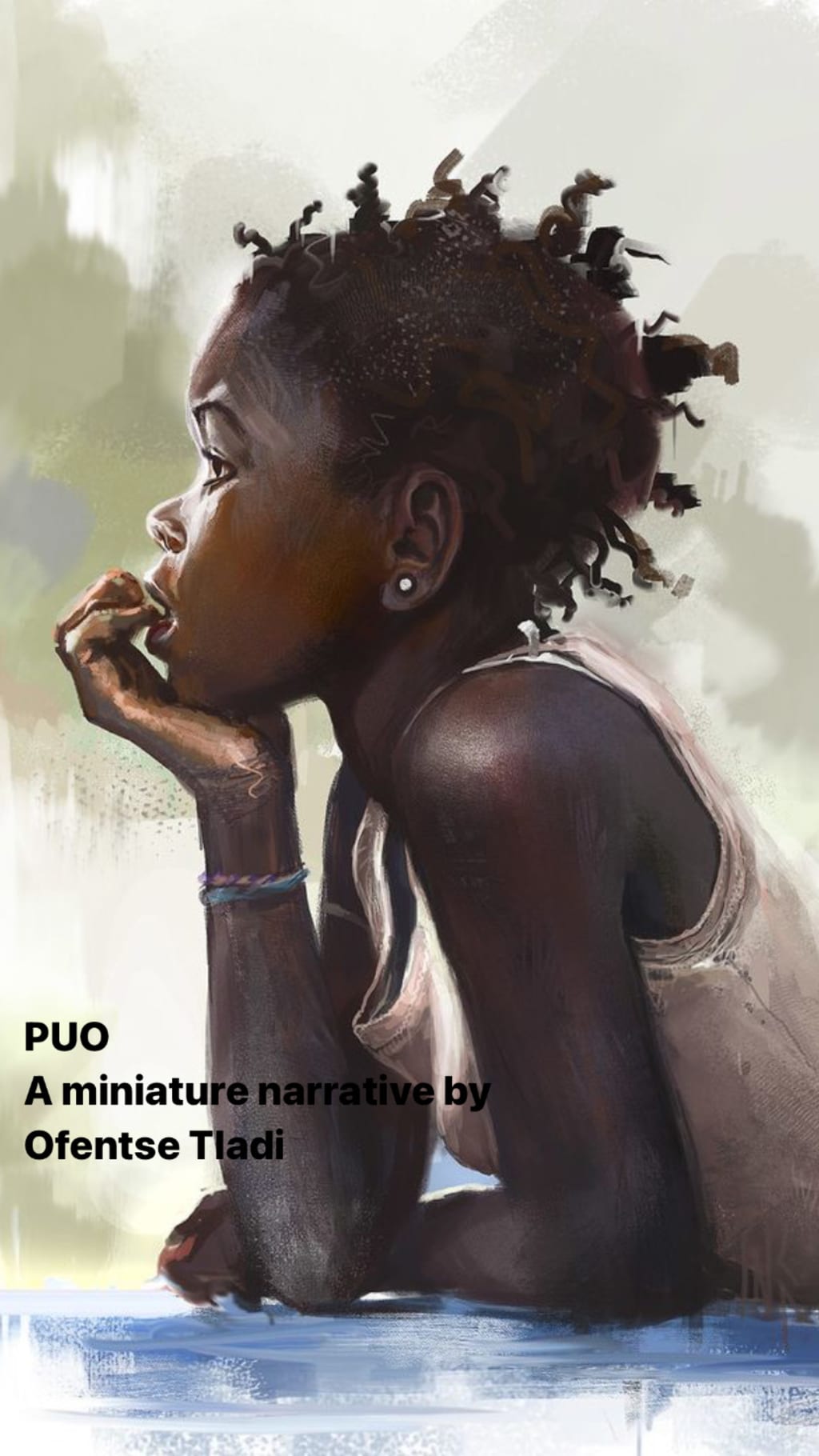
Ke lorile ka lewatle. Ke lorile noha ka metsing. E ne e tshosa. Ke ne ke batla ho ba hole le yona. E ile ya nkisa ka hare ga metsi empa ha ya mpolaya. E ne e le bonolo, e nthata. Ke lorile ke thabile le noha ka metsing.
The words stared back at 13-year-old Paballo. She wasn’t a poet nor had she ever attempted writing poetry but in some way, she felt content with what she had written. For her, it didn’t have to be dramatic. It didn’t have to have hidden meanings. It just had to arrive exactly the way it was, spoken exactly the way it sounded.
She didn’t want to change it to English. English was Shakespeare’s language and she didn’t like the words he used: the complexities the words held, the need to impress, to be superior, to speak and love a universal language. She believed her roots were in the simple things: Greeting her mother in SeSotho instead of English, learning how to count in SeSotho, thinking in SeSotho, polishing her shoes in SeSotho, praying in SeSotho.
Although she tended to struggle in these simple things, she understood that it was just the start. That soon she would speak and love SeSotho as much as she spoke and loved English. “The people before us never knew English and yet they still lived and loved,” her mother often said. Those people were her great grandfathers and grandmothers.
They often looked angry in those photos. Like they somehow knew that their language would soon be forgotten by their children’s children. Paballo felt guilty, saddened. She couldn’t understand why she couldn’t grasp the language as quick as she thought she would. Wasn’t it in her blood? Her DNA?
Even when she spoke, it wasn’t fully SeSotho. It was a mixture of other South African Languages and she just couldn’t get as fluent as her mother was.
Did the language have its own complexities? It’s own need to impress, to break past the notion of being inferior?
Were the hidden meanings planted by her great grandfathers and grandmothers or have they always been there from the birth of the language?
Could SeSotho arrive the way it exactly is, be spoken the way it exactly sounds and still be COMPLEX, ASTONISHING, MIND BLOWING, DRAMATIC.
Was there a need for it to be dramatic? Or was there beauty in the simplicity?
What was SeSotho to her? What did writing the poem in SeSotho really mean to Paballo?
Was it just a black struggle or was the beauty in the COMPLEXITIES, THE AWE AND THE DESIRE TO CRAFT ART KA PUO YA BO NTATE MOGOLO?
Paballo sat quietly as these questions puzzled her mind. Her teacher had already started calling out learners to read their poems in front of the class. Many poems were praised, loved but Paballo couldn’t shake off what she felt.
No one said a word in their mother’s tongue. No one clapped to the sound of poetry in their mother’s tongue. It was the default setting, it was no one’s fault.
“Paballo,” her name was uttered in between her pile of thoughts. She thought of the angry faces in the photos, the times she envied her mother as the SeSotho words practically danced their way off her tongue.
Slowly, she walked to the front of the class. She knew her poem off by heart.
“Ke lorile ka lewatle,” she began.
“Ke lorile noha ka metsing,” she noticed the looks of confusion.
“E ne e tshosa”
Her teacher immediately interrupted her.
Whispers filled the room and Paballo felt a wave of embarrassment rushing over her.
“This is an English class and so I expect all poems to be written in English,” her teacher added.
“Can you translate it to English?”
She was silent. Like her mother’s tongue, she had gone quiet.
No one dared to say a word in their mother’s tongue. No one dared to clap to the sound of poetry in their mother’s tongue.
THE END.
About the Creator
Ofentse🌸
South African Based Writer 🇿🇦❤️
“Simply writing to hold onto my sanity”
~ anonymous.
Reader insights
Outstanding
Excellent work. Looking forward to reading more!
Top insights
Easy to read and follow
Well-structured & engaging content
Excellent storytelling
Original narrative & well developed characters
Expert insights and opinions
Arguments were carefully researched and presented
Eye opening
Niche topic & fresh perspectives
Heartfelt and relatable
The story invoked strong personal emotions
Masterful proofreading
Zero grammar & spelling mistakes
Tatt~Master
— Assembly Line Tatt Machine ~ Impressions to Impress — As I begin to understand more about the Tattoo Phenomenon. I've written silly, yet verbatim, dating site anecdotes in 'Frazzled.' So let me ask you: Would you be More attracted to someone slathered with tattoos, or Less?
By Jay Kantor6 days ago in Humor


Comments (9)
It highlights the resilience standing up for your roots
Wow. This is top tier. So sad, but so beautifully written. There's so much honesty and wisdom here too. I'm also seeing this exact thing happen with my own kids: they're half white American (from me), half Haitian American (from my ex wife). My kids great grandma doesn't speak any English, only Haitian Kreyol. Their grandma is fluent in both, but her primary is Kreyol. Their mother's primary is English, but she's at least conversational in Kreyol. But my kids aren't picking up on any of that. Back when I was with my ex, I often begged her to speak kreyol to the kids so they'd learn enough to understand their roots and their elders. She didn't feel comfortable doing that. Now that we're split up, I have primary custody of all three kids and I know I can't teach them that side of their heritage other than the little bits I know about the food and music. It feels like such a terrible loss. I only really understand English. I'm like a 4th generation mix of a bunch of different backgrounds, especially Italian, and only speaking assimilated English I feel like I've lost some culture that I never personally had-- but there was a sense of beauty and identity that my great grandparents had, and it's somewhere in my blood but my mind is barren of any real understanding. Anyway, sorry for the lengthy response. Your story really moved me, I think the girl in your story reminds me of my own kids, and makes me grieve the things I can't give them.
The angry photos. What a masterful device for this story.
This was so sad but also the bitter truth. So many languages are not being spoken anymore. Loved your story!
Very good story, unfortunately, together with the loss of the language, a piece of culture, a piece of ourselves, goes away.
Thank you for sharing this, it is very sad to read but beautifully done 😢❤️
A great and sad story about the Sesotho language !
I always feel a sense of loss when I hear my African family passing by, speaking in a tongue which I should understand. Strangers to me on the streets, yet familiar in such an echoing way. This touches me at the core of my being. Well said Ofentse.
Ooph, it was all leading to that ending, wasn't it.