
"Poseidon: God of the Sea, Earthquakes, and Horses"
"Exploring the Myths and Legends of the Powerful Olympian God"

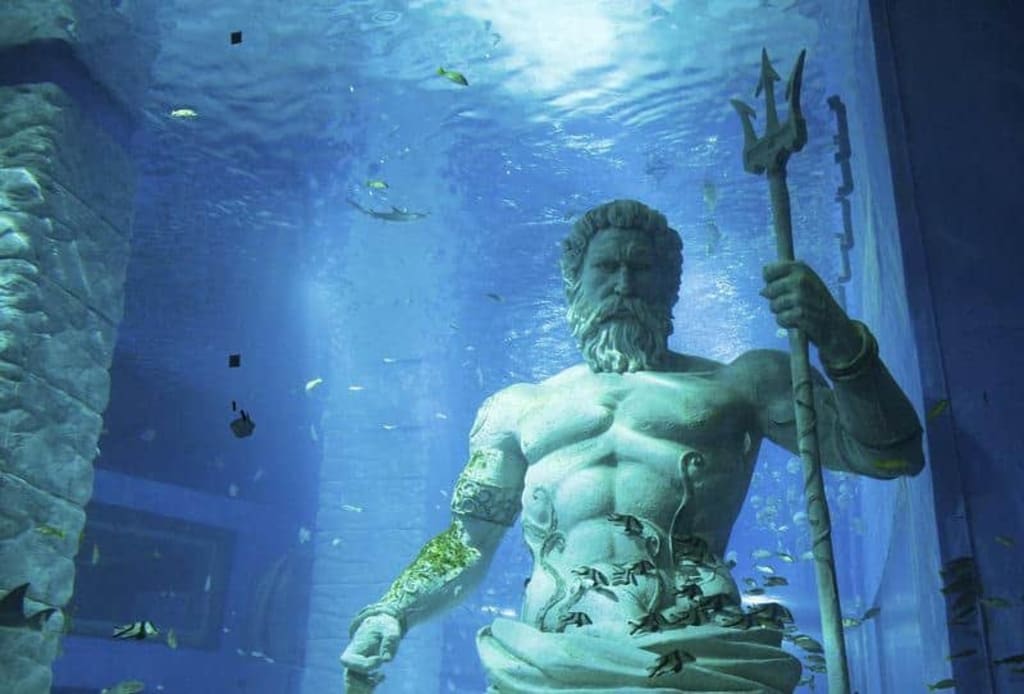
Poseidon was the god of the sea, earthquakes, and horses in ancient Greek mythology. He was one of the twelve Olympian gods who lived on Mount Olympus and was the brother of Zeus and Hades.
Poseidon was often depicted as a powerful and imposing figure, with a trident in his hand and a fierce expression on his face. He was known for his volatile temper and was said to be able to cause earthquakes by striking the earth with his trident. He was also believed to have the power to calm the seas and create new sources of water, such as springs and rivers.
One of the most well-known myths about Poseidon is the contest for Athens. The city of Athens was in need of a patron god and so the people held a contest to determine who would become the city's protector. Athena, goddess of wisdom and warfare, and Poseidon, god of the sea, both claimed the position. The people of Athens asked the goddess of wisdom to offer a gift to the city, Athena offered the olive tree, which would provide food and oil for the people, and the city accepted her gift, and she became the patron of the city.
Another famous myth involving Poseidon is the story of the abduction of Persephone. Persephone was the daughter of Demeter, goddess of the harvest. Hades, god of the underworld, fell in love with Persephone and decided to abduct her and take her to the underworld to be his queen. Demeter searched the earth for her daughter, causing all the crops to wither and die. Eventually, Zeus intervened and negotiated a deal with Hades to allow Persephone to return to the world above for part of the year, thus explaining the cycle of the seasons.
Poseidon also had many mortal children, including Theseus, the great hero of Athens, and the giant Polyphemus. He also had many consorts, including Amphitrite, who was his wife and queen of the sea.
Poseidon was also associated with horses and was said to have created the first horse by striking the earth with his trident. He was often depicted riding on a chariot pulled by horses, and was considered the patron of horse-racing.
Poseidon was also a god of earthquakes, and was said to be able to create them by striking the earth with his trident. This was a reflection of the ancient Greeks' understanding of earthquakes as a natural phenomenon caused by the actions of the gods. In addition to earthquakes, Poseidon was also believed to have control over other natural disasters, such as storms and floods.
One of the most famous stories involving Poseidon is the story of the city of Troy. The city was founded by the Trojan prince Paris, who had been given the task of judging a beauty contest among the goddesses. Paris awarded the prize to Aphrodite, goddess of love and beauty, and in return she promised him the most beautiful woman in the world as his wife. This woman was Helen, who was already married to the King of Sparta. Paris abducted Helen and brought her back to Troy, and her husband, with the help of several other Greek kings, launched a massive expedition to retake her. The Trojan War, which is the subject of Homer's epic poem the Iliad, was said to have been caused by the anger of the gods, particularly Poseidon, who was said to have been offended by the Trojans' refusal to return Helen.
Poseidon was also known for his role in the myth of the Labyrinth and the Minotaur. The Labyrinth was a maze constructed by Daedalus on the island of Crete to contain the monstrous Minotaur, a creature with the body of a man and the head of a bull. The Minotaur was said to be the offspring of Pasiphae, the wife of King Minos of Crete, and a bull sent by Poseidon. The Labyrinth was said to be so complex that anyone who entered it would be unable to find their way out. Theseus, the prince of Athens, was able to defeat the Minotaur and find his way out of the Labyrinth with the help of Ariadne, the daughter of King Minos.
In addition to these stories, there are many other myths and legends associated with Poseidon in Greek mythology. He was a complex and multifaceted god, and his stories continue to be a source of inspiration and fascination for many people today.
About the Creator
Paul Andrew
I'm a storyteller & content writer with 2 years of experience. Crafting engaging articles & blog posts on a variety of topics. Let's explore the world through my words!
Keep reading
More stories from Paul Andrew and writers in Fiction and other communities.
"The Evolution of Ares: From Ruthless God of War to Protector and Guide"
In ancient times, there was a god of war known as Ares. He was the son of Zeus, the chief god of the Greek pantheon, and the goddess of love, Aphrodite. Ares was known for his fierce and ruthless nature, and he was said to be the embodiment of violence and bloodshed.
By Paul Andrew3 years ago in Fiction
Miss Persephone's Manual to a Seemingly Ordinary Life
Miss Persephone was found at the dining table, her blue eyes swollen, her tears arriving and retreating like the tides of the ocean. Earlier that day, her family had visited her in the retirement home where she had lived for eight years. It was her eightieth birthday.
By Imola Tóth3 days ago in Fiction




Comments
There are no comments for this story
Be the first to respond and start the conversation.