
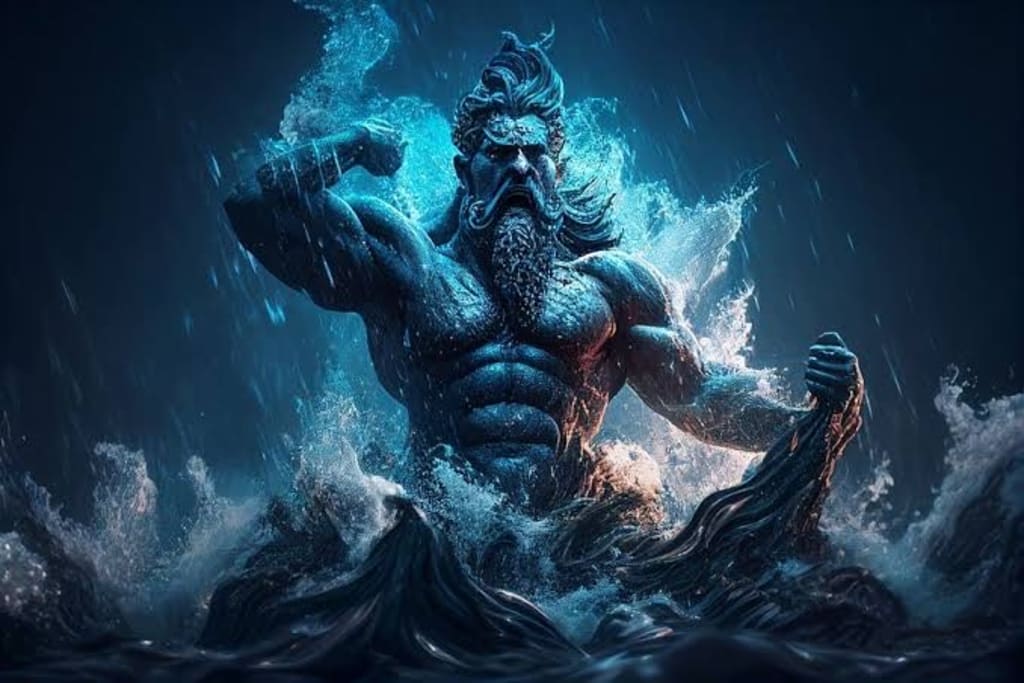
Poseidon is one of the most prominent of the ancient Greek deities, known for his power over the sea and his role as the god of earthquakes and horses. He was revered by sailors and seafarers who relied on his favor for safe voyages across the treacherous waters of the Mediterranean.
In Greek mythology, Poseidon was the son of Cronus and Rhea, and brother to Zeus, Hades, Demeter, Hera, and Hestia. Like his siblings, he was swallowed by his father at birth, but was later freed by Zeus during the war against the Titans. After the Titans were defeated, Poseidon and his brothers divided up the world, with Poseidon receiving dominion over the seas and oceans.
Poseidon was often depicted as a powerful and imposing figure, wielding a trident and riding in a chariot drawn by horses. He was known for his hot temper and his ability to cause earthquakes and storms at sea. Despite his fierce reputation, Poseidon was also seen as a protector of sailors and fishermen, and was often invoked for safe passage across the seas.
In addition to his role as the god of the sea and earthquakes, Poseidon was also associated with horses. He was believed to have created the first horse, and was known for his fondness for the animals. He was often depicted riding on horseback, and was sometimes referred to as the "tamer of horses."
Poseidon was also a significant figure in Greek mythology and religion. Many temples were dedicated to him throughout Greece, and he was often worshipped alongside other deities, particularly his brother Zeus. One of the most famous temples dedicated to Poseidon was the Temple of Poseidon at Sounion, a beautiful and imposing structure on the southern tip of the Attic peninsula.
In literature, Poseidon played a significant role in many of the most famous stories and myths of ancient Greece. In the Odyssey, he is portrayed as a vengeful and angry god who seeks to punish the hero Odysseus for blinding his son Polyphemus. Poseidon's wrath causes Odysseus to endure many hardships and delays as he tries to make his way home to Ithaca.
In the myth of Perseus, Poseidon plays a crucial role as the father of the monster Medusa, whom Perseus is tasked with killing. Poseidon is also an important figure in the story of Theseus and the Minotaur, in which he is the father of the Minotaur and the cause of the hero's many challenges.
Overall, Poseidon was a powerful and influential figure in ancient Greek mythology and religion. His role as the god of the sea and earthquakes made him a feared and respected deity, while his association with horses and chariots added to his significance and influence. Today, Poseidon remains a fascinating and enduring figure in the realm of mythology and ancient history.
About the Creator
Keep reading
More stories from Ikechukwu Irem and writers in Fiction and other communities.
Zeus
Zeus is perhaps one of the most well-known deities in Greek mythology. As the king of the gods, he played a central role in the myths and legends of ancient Greece. Known for his power, strength, and wisdom, Zeus was both feared and revered by mortals and immortals alike. In this article, we will explore the history and mythology of Zeus, examining his various roles and the significance of his character in Greek mythology.
By Ikechukwu Irem3 years ago in Fiction
The Dust Bunnies are Revolting!
Seeing the loose way people use the word “hate” these days, I guess can say that I hate a lot of things. I hate soggy spinach. I hate dark rooms. I hate visiting relatives I don’t like, just because they’re sick. But nothing, nothing matches the hate I have for dust bunnies. They are vile, evil little things. I will do everything I can to wipe them out.
By Kimberly J Egana day ago in Fiction




Comments
There are no comments for this story
Be the first to respond and start the conversation.