
Planets in our Milky Way galaxy that are habitable can be supported by at least 10 billion stars.
Habitable-exoplanet_milky way galaxy
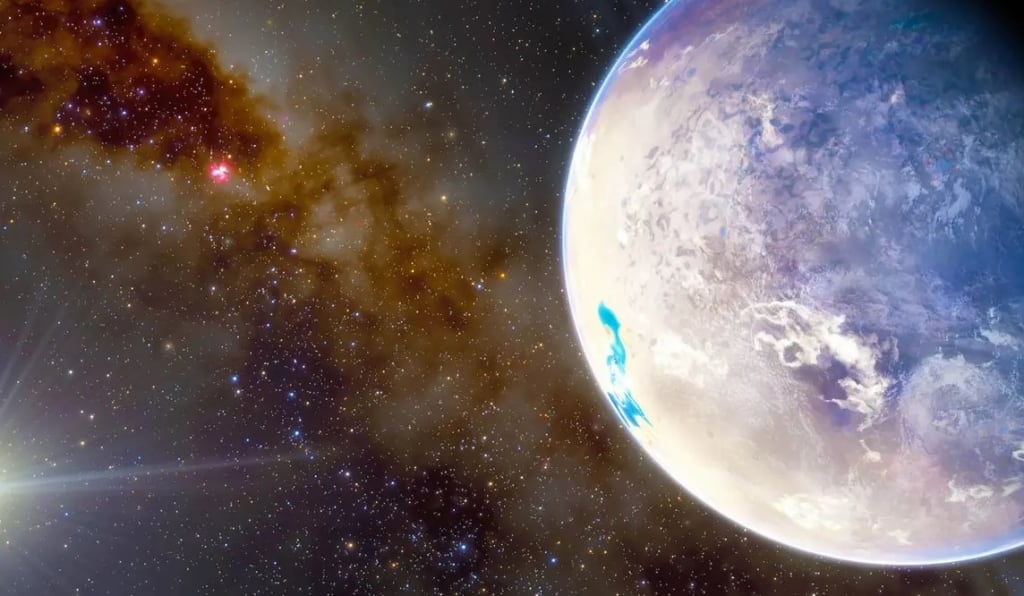
Stellar corpses are supposed to cool, fade, and mind their own business. Yet a new climate modeling study hints that some of these faint objects – white dwarfs – could keep nearby planets toasty enough for liquid water to exist.
That possibility expands the hunting ground for habitable worlds by billions of targets and challenges the old idea that life can flourish only around stars that are very much alive.
Today’s tools make that hunt more than wishful thinking. Proving that planets can survive their star's violent endgame, the James Webb Space Telescope (JWST) has already observed gas giant candidates circling white dwarfs. Astronomers can now examine rocky worlds the size of Earth using Webb's infrared eyes. That capability sets the stage for fresh computer experiments comparing two very different star systems.
White dwarf corpses don’t chill out
After a Sun like star sheds its outer layers, its core contracts into a white dwarf that is roughly as big as Earth but packs about half the Sun’s mass.
Current models suggest the Milky Way hosts around 10 billion of these embers, and more than 97 percent of all stars will finish their lives the same way.
Aomawa Shields of the University of California, Irvine, and colleagues wondered whether such dim stars could light the way for life.
“While white dwarf stars may still give off some heat from residual nuclear activity in their outer layers, they no longer exhibit nuclear fusion at their cores. For this reason, not much consideration has been given to these stars’ ability to host habitable exoplanets,” Shields explained.
"Our computer simulations suggest that these planets could have more habitable real estate on their surfaces than previously thought if rocky planets exist in their orbits."
Two sun water world
The team compared the climates of two hypothetical ocean-covered planets with Earth-like atmospheres using a three-dimensional climate model normally used for Earth's environment. The two exoplanets were modeled to be in orbit around two different stars.
One exoplanet was placed in the so called habitable zone of a hypothetical 5,000 K white dwarf that has passed through most of its lifecycle and is on the slow path to stellar death.
They placed the other exoplanet, Kepler 62, in the habitable zone around the main-sequence star for comparison. This is a K-dwarf star that has an equivalent temperature to the white dwarf, but is still actively fusing hydrogen in its core. Kepler-62 is in a similar life stage as our Sun.
Both modeled planets were assumed to be tidally locked, with one hemisphere fixed in daylight and the other in eternal night. This arrangement is typical of worlds that hug small stars. The climates of the two test exoplanets diverged unexpectedly, despite receiving the same amount of starlight overall.
White dwarfs are kept warm by speed.
Every ten hours, the white dwarf planet circles its star. Compared to Earth's orbit and Kepler 62's 155-day grind, that tight orbit forces a 10-hour day, which is significantly faster. Strong winds caused by rapid rotation carry heat from the day to the night and back again. The thick, reflective clouds that typically gather over the hot hemisphere of a slow-moving planet are also blown away by those winds. The white dwarf planet's surface temperature was 25 °C higher than that of the planet orbiting Kepler 62. Shields made the following observation: "We expect synchronous rotation of an exoplanet in the habitable zone of a normal star like Kepler 62 to create more cloud cover on the planet’s dayside, reflecting incoming radiation away from the planet's surface." Planets that orbit close to the inner edge of their stars' habitable zones typically benefit from this because they have a better chance of cooling down rather than losing their oceans to space in a runaway greenhouse. But for a planet orbiting squarely in the middle of the habitable zone, it’s not such a good idea.
Clouds, winds, extra shoreline
The model showed that fewer dayside liquid water clouds let more sunlight stream down, while stronger greenhouse gases on the nightside trapped outgoing heat.
“The planet orbiting Kepler 62 has so much cloud cover that it cools off too much, sacrificing precious habitable surface area in the process,” Shields continued.
However, "on the other hand, the planet orbiting the white dwarf is rotating so quickly that it never has time to build up nearly as much cloud cover on its dayside," which means that it retains more heat, which is advantageous to the planet. Taken together, the temperature bump and the efficient heat circulation spread balmy conditions over a larger fraction of the white dwarf planet’s globe.
This result is important because the best opportunities for life on tidally locked worlds are often found in real estate close to the terminator, which is the ring of perpetual sunset between day and night.
More space for planet hunters to explore
Planets in orbit around dead stars are no longer hypothetical. WD 1856+534 b, a Jupiter-sized object that circles its white dwarf host every 34 hours without breaking apart, was discovered by astronomers in 2020. In 2024, the Webb telescope directly detected two more gas giant candidates orbiting separate white dwarfs, demonstrating Webb’s knack for sniffing out faint planets against dim stellar backgrounds.
“These results suggest that the white dwarf stellar environment, once thought of as inhospitable to life, may present new avenues for exoplanet and astrobiology researchers to pursue,” Shields said.
We may be entering a new phase in which we are studying an entirely new class of worlds around previously unconsidered stars as powerful observational capabilities for assessing exoplanet atmospheres and astrobiology, such as those associated with the Webb telescope, have come online.
What takes place next?
Every white dwarf cools for billions of years, providing a stable light source to any nearby planet for much longer than the Sun can last. With ten billion of these stars scattered through our Milky Way galaxy, even a tiny fraction hosting temperate rocky worlds would translate into a staggering number of potential abodes.
The next step is clear: point Webb and its successors at the brightest white dwarfs, catch a transit, and read the atmospheric fingerprints. If the models are right, the ghostly glow of a dying star could someday soon reveal a living planet.
About the Creator
The Wild Boy
The Wild Boy While chasing monkeys, we unknowingly entered deep into a dense forest. The monkeys were hanging from tree branches, leaping from one tree to another, and running swiftly, while we ran after them. We had heard many stories about the mischief of monkeys, but that day they truly played a trick on us.
By Sudais Zakwan7 days ago in Fiction


Comments
There are no comments for this story
Be the first to respond and start the conversation.