
Pharaoh's Dragons
Chapter One: Apep’s Children and the Region of the Night


There weren’t always dragons in the Valley.
The great and terrible Apep, who lurks just over the horizon – sometimes you can hear his voice when the clouds are big and the lightning flashes – was once alone.
These days he’s not allowed to show his ugly face here in the realm of the mortal – but his children? They are everywhere.
Apep’s children pull our plows in the fields. They lug carts of stone through the streets, pull chariots of men from one part of the battlefield to the other, and can even, sometimes, be trained to be ridden like a horse—although many a fool has lost his life trying. Every once in a while one of Apep’s children will lose its mind and stretch its wings and fly away. Most of them have been taught not to do this. Most of them are thoroughly domesticated.
Here in the realm of the mortal, we get a lot of mileage out of our dragons.
That’s where I live: the realm of the mortal. Because, you know, I’m a mortal. All eleven year old girls are. It is a fact that all humans will eventually die and travel to the underworld, where they’ll have all kinds of wild adventures that you don’t get to have up here in Kemet.
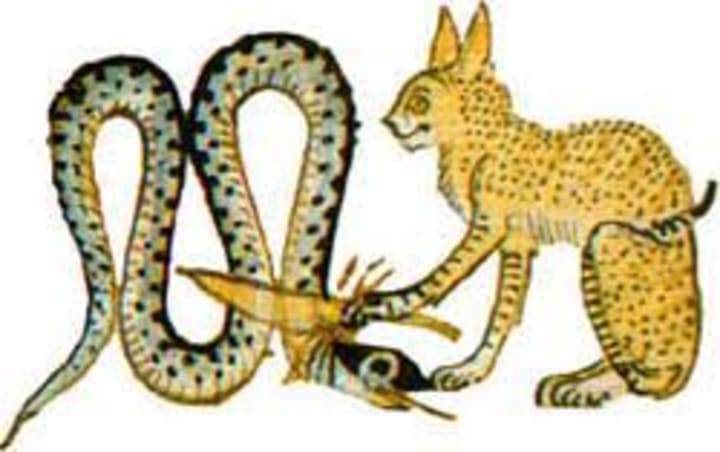
For reasons I have trouble understanding this simple fact makes most adults afraid. Most adults don’t want adventures. They don’t want to travel the track of the sun, or sail a lake of fire, or hide behind a great iron wall while Ra takes the form of a cat to battle Apep, who wants night to last forever.
But the way I see it, if you’re already dead then what on earth are you afraid of? Dying is the scary part. Dying is the part that I don’t want to do. Because there’s always the doubt, the little voice in the back of your mind that whispers, what if this is it? What if our brief life here in the Black Land is all we have? If so, I’d be proud to live in such a beautiful place. To everyday watch the sun rise over the Red Sea and set behind Khufu’s Great Tomb… there are worse fates, right?
Apep, the great and terrible dragon of the night, was alone for who knows how long. Dad says thousands of years, well before the Black People (that’s us) ever came to the River. I don’t always believe what he says, though. You see, my father is a bit of a goofball. Not like my mother. She’s strict. Very strict.
Maybe I should take a moment to tell you a bit about my family.
My father was in the last war. The one with the wretched Southerners. We’re supposed to hate them, so I’ll go ahead and hate them. Bah! Horrible Southerners, with their different ways!
The thought of Dad doing anything even remotely violent is pretty much unthinkable. I mean this is a guy who, at the end of a long day in the field, will sit on the floor by the hearth and make a little straw bed for himself and drink wine and squeeze our cat, Mouse. This is a guy who, when a field hand mouths off to him, doesn’t say a word. Just points at the road. I don’t think an ironic sentiment has ever passed his lips. He’s an unwavering force of even temper. So to picture him flailing an ax in the air and giving a battle cry makes me laugh out loud.
My mother, on the other hand. Whoa. Here is a force of nature. Here is an unbounded will, a will that floods like the River. When she has a thought, however big or small, she cannot allow it to go unarticulated. She must drown it with words. Often this means laughing with her sisters around the garden, or expounding some hair-brained idea to Dad about how things could run more efficiently in the farm or even sometimes politics. But more often then not it means yelling at me or my brother and sisters. “Don’t put that there!” “How dare you talk back?” “Why are you always lazing around?” She rules the home with an iron fist, stalking from room to room in a long flowing dress, her thin neck poking out of it. Like a stork treading through a shallow pond, looking for fish.
We live in Bastet. Our god is, you guessed it, Bastet. Even if I had not been born here, she would have been my favorite. Sometimes when I can’t sleep at night, worried about Dad being called up for the war, or even Gyasi (who will be thirteen next winter), I imagine Bastet coming into the bedroom. My sisters are asleep. Bastet, who takes the form of a tall woman with the head of a cat (I picture Mouse’s head), steps gently over them, then comes and lies next to me. She takes me in her arms, and purrs. And then I purr.

And all the while we lay there, we can hear Apep’s children in the fields, pulling the carts while the lazy night watchman drifts in and out of sleep in the orange light of the dragons’ throats.
My sisters are annoying. They are young and frivolous. They can’t do anything right. They’re going to be useless as grown women. They do nothing but giggle together in corners, talking in their secret language. They are twins. I’m not going to say their names because they’ve annoyed me today by breaking my favorite cup. They’re pretty and I dread the day they become old enough to realize it. It’s probably a good thing though because if they had been born ugly, such willful girls would never have stood a chance in this old world.
I am the oldest sister. Not much to say about me. Mom hates me. “She’s too clever,” she always says, which is ridiculous because I’m really not. I’m just quiet. I’m not pretty like the twins or brave like my brother or calm like my father or strong like my mother. I’m just in the middle in every sort of way. There are worse places to be than in the middle. But there are better, too.
Gyasi is my brother. He’s worth three of any of the rest of us. Where my Dad’s even temper can sometimes be misinterpreted as meekness, Gyasi’s equanimity is universally respected. All the grown-ups say of him, “He’s wise beyond his years.” But like the twins, he understands the value of play and can waste an entire day with us playing hide and seek. He’s funny, smart, and most of all he is intrepid. No fear keeps him back from doing something he wants to do. And yet he’s not stupid about it. He doesn’t take risks without first calculating the odds.
Except for once.
It all started with a dream. Mom woke up around dawn screaming. She’s somewhat prone to hysteria, which is to say that she knows how to pretend to be affronted at judicious moments; but this was different. She was really upset.
Mom was white as a ghost after Dad shook her awake. She kept looking around the room like it was filled with unfriendly spirits, and huddled close to him. Gyasi was already gone; presently he returned with my mother’s sisters.
“Tell us,” instructed Anat, my oldest aunt. She spoke solemnly, even a little proudly. “Tell us your dream.”
A cock crowed in a neighbor’s yard. Our dragon snorted in its pen. It was the wet season and the air smelled humid as the eastern sky turned the color of a blue eye. We huddled around mother. She spoke.
“Here is my dream. Gyasi is a grown man, a tall warrior standing upright in a chariot. A dragon pulls the chariot through thick crowds of men toward the enemy flank. An arrow suddenly pierces the dragon’s neck. In its rage the dragon veers off toward the center of the enemy line, ignores Gyasi’s cries, and then collapses, flinging Gyasi out of the chariot into the sand at the feet of the enemy.”
We were listening intently. I suddenly felt Mouse brush against my arm; he’d come in through the window while Mother was speaking. He plopped down in my lap and purred.
“The dragon flailed and roared in its death agony,” Mother continued. “With one hand, Gyasi fought off the enemy. With the other, he tried to end the dragon’s suffering. The dragon, not understanding, breathed a ribbon of thick flame at Gyasi, and burned him. Burned him until nothing was left of my son, the great warrior, but a charred husk. That was the dream.”
There was a long pause.
“It could be interpreted as a good omen,” Anat said finally. “In trying to free the dragon from suffering, and protecting it from the enemy, he was doing his duty.”
“Then why did the dragon kill me?” Gyasi, standing forcefully up. It was improper to speak out of turn like this, and quite uncharacteristic of him. But Aunt Anat was patient. The dream was about him, after all.
“To remind you that dying for Kemet is noble. Could you ask for any nobler ending to the life of a warrior?”
Mother was quiet, but the way she looked at Gyasi seemed to show that she shared his fear and not her sister’s optimism.
But Aunt Anat, the eldest woman, had spoken the final word. Mother said nothing.
For a whole week, Mother barely let Gyasi outside. On the first day she kept him inside from dawn til dusk. This was not proper, since he should have been helping Dad in the field, but Mother’s atypical silence and solemnity was so new and intimidating that Dad said nothing.
The next day he was allowed to help in the field. But in the morning, I saw Mother take Dad aside and whisper in his ear. For the rest of the day Gyasi was not allowed anywhere near our dragon.
The neighbors, like neighbors do, noticed. Word got around about Mother’s dream. Some of the local boys, mostly ratty, uncultured kids with ringworm scars and uncouth manners, started to taunt Gyasi. He was much bigger than they, so none of them would do it to his face; but when he passed down the street, he would hear, around the corner of a house, or in a doorway, snickering voices that hissed things like there goes Dragon Boy.
Gyasi was proud. These taunts were starting to get to him. He dared not confront mother, and was too proud to complain to Dad even when it was just the two of them in the fields, but I could see that he was burning to do something, anything, to reassert agency, to display bravery.
Well, he got his chance at the end of that week.
Our neighborhood quartermaster was a short and fat man with a face covered in pock-marks and a giant mole on the very tip of his nose that looked like a big booger. His name was Kesi, which means “born of a troubled father.” Most people would be ashamed to have such a name, but Quartermaster Kesi seemed to be grotesquely proud of it. He would ride his camel (poor animal!) down the streets, shouting orders at his little scribe, pointing this way and that and proclaiming, at least once a minute, “Kesi is here! Kesi has arrived!”
What a fool!
We all hated him, naturally. Because it was wartime, austerity measures had been imposed by the pharaoh. Although the official decree sounded reasonable enough when they were read to us at the beginning of the war, in reality what the measures meant was that the quartermasters and stewards could come and take whatever they wanted from anyone at any time.
Kesi could point at Mother and say, “Ten pounds of wheat and whatever beer you have.” And she’d have to send me to the storehouse to fetch it, and give me a smack on the back of the head if I took too long. And that would be getting off lucky.
The neighborhoods endured the Kesis of the world because, one, there was nothing we could do about it, and two, because we were, after all, at war. Sacrifices must be made. We tried not to grumble too much.
At least, that is, until they came for the dragons.
Kesi came down the street one morning at the end of the week of Mother’s dream, looking more smug even than usual. Dad took one look at him out the window and said, “Uh oh.” That smug look usually came out when Kesi had been given some new specific authority.
To our surprise and consternation, instead of simple shouting at us from the street without getting off his camel, Kesi actually dismounted in front of our house.
He knocked on the door and said, with saccharine professionalism, “Greetings, citizens. May Quartermaster Kesi enter?”
We were eating breakfast. Gyasi gripped his spoon so tightly that it looked like he’d snap the wood in two. Mother drew in a deep breath. I felt galvanized looking at her. When her rage was directed toward me, I resented it; but when directed at a common enemy, I worshiped my Mother’s hot tongue.
Dad opened the door and said politely, “Good morning, Quartermaster. Please enter.”
Quartermaster Kesi did his best to stride in impressively, but achieved more of an extended wobble that made him look utterly ridiculous. Behind him scurried his little scribe, a tiny man with a wedge of wet clay and a stylus that he’d press into the clay a mile a minute when Kesi was speaking. He seemed to me like a magician, encoding a spell. Our magic is called heka, which is also what the whole world is made out of: the earth, the gods, the animals and plants and mountains and everything else. A clever person can learn how to use the substance of the universe for their own ends. With a single word a little man like Kesi’s scribe could ruin our crops or make one of the twins deathly ill. We accorded Kesi’s scribe far more respect than Kesi himself. They both knew it, but Kesi wielded more direct power over us at the moment.
“As you all know,” the Quartermaster sighed theatrically, sinking into Dad’s chair by the kitchen table (Gyasi gripped his spoon tighter), “we live in times of war. The barbaric tribes of the north continue to misbehave. As such, I have been a familiar presence in your neighborhood for a year or more. I fear I seldom bring good news to you. You must grow to resent my visits.”
Dad shook his head politely. “We could never resent a representative of the Pharaoh.”
The Quartermaster grinned, and bowed haphazardly. “Unfortunately, I would be unsurprised if that changed after this morning.”
Mother sighed with misgiving. Even Dad, usually impassive, furrowed his brow. “Please continue,” he said.
“Frankly, I have been instructed to inform the families of Bastet that the war effort is flagging. Apep, says pharaoh, has been infecting the hearts of the young men of Kemet with laziness and cowardice.”
“That’s not true!” Gyasi said sharply, tossing his spoon against the floor.
“Gyasi!” hissed Mother. Father rose a hand to strike him, but the Quartermaster, laughing, waved him off.
“No, no, that’s good! Perhaps not all the young men of Kemet lack courage.” Kesi eyed Gyasi thoroughly for the first time. He smiled insidiously, and muttered to Mother, “Such a brave young man belongs at the front.”
Silence.
“No, it is not your boy that I am here to take today.” Suddenly Kesi stood up, and assumed a brusque, business-like tone. “I’m here for your dragon.”
I, Gyasi and the twins were affronted, and protested loudly. Mother finally lost control over her tongue and claimed that this would be impossible, that without our dragon we would be wholly unable to till our fields, that there was still much plowing left to be done before sowing.
Father rose a hand to quiet us. He said, quietly, “Quartermaster Kesi, my wife is quite right. If you take away our dragon, then our crop harvest will be more than halved. During wartime, surely this is a mistake? I know that Amsi’s family, in the field adjacent to ours, has completed three-fourths of his tilling, and possesses two dragons. I beg your forgiveness for my impertinence, but would it not be wiser to take one of his dragon instead?”
Quartermaster assumed his tragic persona. He put a hand to his chest, and closed his eyes. “Yes, indeed, that is a good suggestion. The army will requisition Amsi’s dragons.”
Confused by the tentative success of his rhetoric, Dad seemed ready yet hesitant to breathe a sigh of relief.
“The army,” continued the Quartermaster with a malevolent grin, “will requisition all the dragons of Bastet.”
“All of the dragons?” I repeated haltingly. Mother and Dad were too horrified to chastise me for speaking out of turn. The Quartermaster pretended not to hear who had spoken, but said, “All of the families of Bastet will have the honor to give their dragons to the war effort. They shall serve to pull the chariots and to burn the flesh of the enemy. Each dragon will be marked, and thoes which survive will be returned to their families.”
“There will be famine,” Dad warned lowly. Kesi shrugged, as if to say, that is not my concern.
The Quartermaster said, “Lead your dragon into the road. Soldiers are already there.” He rose, and unceremoniously left. The scribe lingered on our doorstep. “If we lose the war,” he said with an apologetic tone, “then what good will your fields be?”
Father rose to do as the Quartermaster instructed. When Gyasi did not budge from his chair to help him, instead of chastising him Father looked at me. So I followed him into our dragon’s pen and together we brought it into the road. Mouse followed at my heels.
“Gyasi is being disobedient,” I said.
“I know,” Father returned. "He's upset. We'll let it slide today."
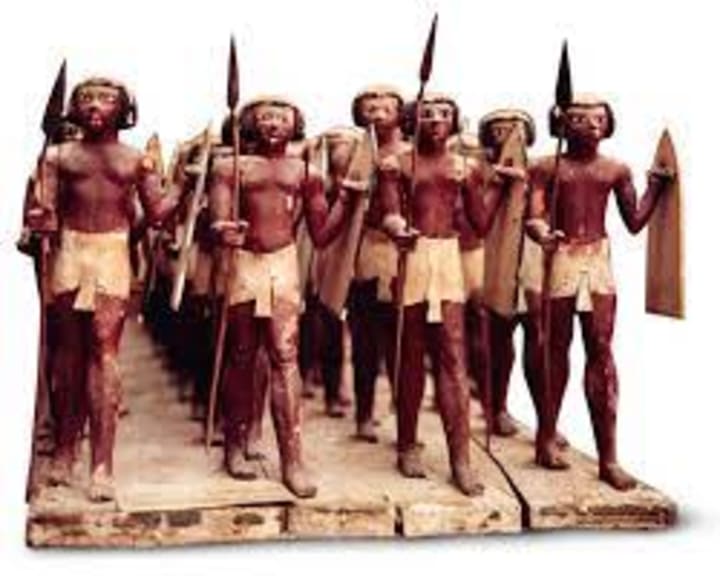
The soldiers in the road were working with sloppy speed, trying to get the dragons processed before they could congest the street. Get too many dragons together in close quarters and one might get agitated and burn itself and others.
We stood next to ours, an old one with grey hide that, in my opinion, wouldn’t last a single afternoon in a battlefield.
“Aren’t you mad?” I asked.
Father shook his head.
“Why not?” His equanimity could sometimes frustrate me. Did nothing perturb this man?
“With whom should I be angry?” he asked.
“With the Quartermaster! With the scribe! With the soldiers, with pharaoh, with the enemy, with the situation!”
“It would be dishonorable for me to be angry with Kesi, since he is only a fool. It would make little sense for me to be angry with his scribe, since the scribe did nothing wrong. I cannot be angry with these soldiers because most of them have been conscripted into service, which means they aren’t doing this because they want to but because they have to. As to being angry with pharaoh, that is laughable. You can’t be angry with God. Might as well be angry with a mountain or with the sea, or with your own human nature. I am not angry with the enemy because I have no enemies. Finally, the situation does not inspire me with anger. It inspires me with fear.”
Seeing that this soliloquy, however fluent, failed to assuage my temper, Dad suddenly laughed. He said, “You are a carbon copy of your mother. You think of anger as self-expression.”
“Don’t you think anger can be useful?”
Father was suddenly serious. “Yes. I think that, sometimes, anger can be useful.”
“What would make you angry?”
Dad looked down at Mouse, who had plopped in the dirt by my feet and was taking a nap. “If someone hurt Mouse, I would be angry at them.” He bent down and stroked the cat’s belly; she started purring.
“Seriously,” I insisted.
Exasperated, Dad exhaled through his nose. He looked at me and thought. Finally, he said, “Waste. Waste makes me angry. Wasted emotion, wasted effort, wasted life. If I thought these Children of Apep were being wasted, I would be angry.”
Then the soldiers took our dragon.
That night, Gyasi and I lay awake. I could hear the slow rising and falling breaths of the twins. A rustle in the bushes outside the window: Mouse? Distant voices of soldiers carousing at a tavern. The soft smell of sweet hay. The moon through high clouds.
“I have to do something. Without our dragon, we won’t be able to finish plowing and we’ll be stuck with less than half a yield of wheat. We can’t afford to hire more field hands and certainly can’t afford an ox or some other beast,” Gyasi whispered.
“But we still have our garden. We won’t starve.”
“It’s not about our own meals, stupid. It’s about the harvest. When autumn comes and all the farms of Bastet harvest a fraction of the normal wheat, it’ll be like Dad said: famine. Our gardens will be requisitioned and redistributed and we’ll see hardly any of it.”
“The war may finish before then. We may get our dragon back before the end of the season.”
“We may. Then again, we may not.”
We were silent long enough for Gyasi to think I’d fallen asleep. I could hear him rise, slowly, trying not to wake me. Then I could hear him gather a few things and approach the window. I lay tense, not giving away that I was still awake.
When I opened my eyes, Gyasi was gone.
“What’s happening?” one of the twins whispered groggily, rubbing her eyes.
“Go back to sleep, stupid,” I scratched her hair, just like I do with Mouse. She head instantly drooped back to the hay and her eyes closed.
I maneuvered, as quietly as I could, to the window. I pulled myself up and dropped into the garden, and felt something squishy and warm beneath my feet.
A little noise, a cross between a meow and an oomph, sounded. Mouse. I’d stepped on her tail. Thankfully the garden soil was moist enough for the tail to sink harmlessly in.
“Come on, Moucy. Where did Gyasi go?” I crept around the side of the house and into the road. My companion was close by my heels. I looked up and down the moonlit street, just in time to see a boy vanish at the far north end.
I was about halfway down the road when a harsh human voice arrested me.
“Girl.”
I nearly shrieked. In the shadows underneath a row of low palm trees with huge leaves like tables, a deep sapphire color in the night light, sat a human shape. I looked closer, and sighed with relief. It was only Ped.
Ped lived on the street. She wasn't a cackling looney or anything like that, but she was definitely not really all… there. Like a third of her brain was in a different world, and the remaining two thirds were all she had to work with here.
“Not now, Pep.”
I ran on a few paces, and heard Pep behind me: “I wouldn’t go after him, you know.”
Slowing to a stop, I turned. “Why not?”
Pep sighed. A long, world-weary intake of breath.
“Gyasi must work alone tonight. As must you. Your chapter takes you elsewhere.”
“My chapter?”
“Yes. Your story. Gyasi’s tonight will take him to the soldier’s camps, to the dragon pens. His chapter will end, tonight, with a burning.”
I felt a chill. Pep had confirmed my – and my mother’s – worse fear. My father’s words came back to me. You are the carbon copy of your mother.
“Then that is where I must be. What kind of sister am I if I don’t protect my brother?”
“You wish to protect your brother?”
“Of course.”
Pep sighed again. From far away, came the sound of the steady flow of water through irrigation channels. A night bird sang mournfully on a roof edge.
“Do you think you can protect your brother by dragging him by the heels away from his fate? Have twelve year old boys ever worked like that?”
To this I had no counterargument.
Pep chuckled. “Your chapter tonight, as I said, takes you elsewhere.”
“Where?”
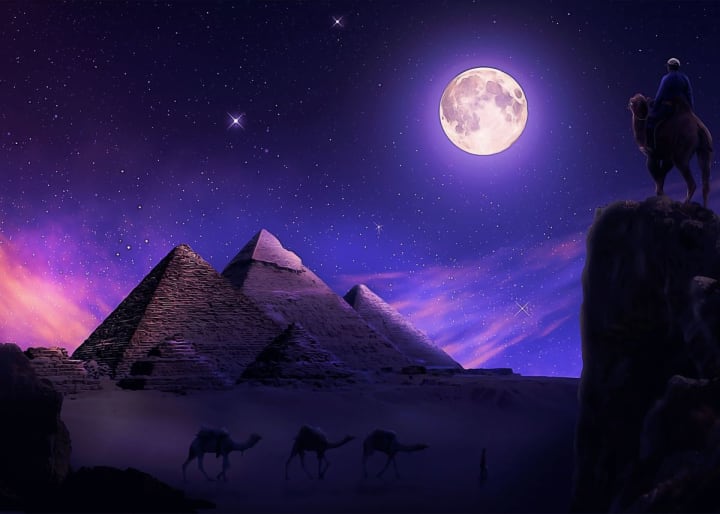
Pep rose silently. She moved down the road. Mouse and I followed. She took us through a neighbor’s field, scrupulously avoiding treading the plants. We came out upon an open vista. Three great black triangles stood out against the nocturnal horizon. The Pyramids.
Pep pointed.
END of CHAPTER ONE
About the Creator
Eric Dovigi
I am a writer and musician living in Arizona. I write about weird specific emotions I feel. I didn't like high school. I eat out too much. I stand 5'11" in basketball shoes.
Twitter: @DovigiEric
Reader insights
Outstanding
Excellent work. Looking forward to reading more!
Top insights
Excellent storytelling
Original narrative & well developed characters
Easy to read and follow
Well-structured & engaging content
On-point and relevant
Writing reflected the title & theme
Compelling and original writing
Creative use of language & vocab
Expert insights and opinions
Arguments were carefully researched and presented
Eye opening
Niche topic & fresh perspectives
Heartfelt and relatable
The story invoked strong personal emotions
Keep reading
More stories from Eric Dovigi and writers in Fiction and other communities.


Comments (2)
Great, great. I enjoyed your work.
Whoaa loved this different take on this challenge