
Phantasmagoria
A short story-Trigger warning: drug addiction/use

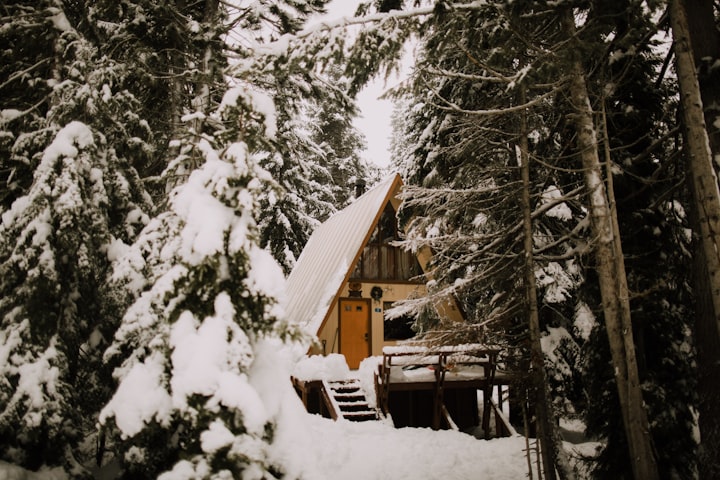
We drove up the snowy, winding road towards the cozy A-frame cabin. Or at least, that’s where I hoped we were headed. According to the map, we should be less than four miles away, but I don’t recognize anything yet. The GPS had been useless for the last two hours, as soon as we had hit the mountain range. Hence the physical map. It was a wonder I still remembered how to use a paper map. I sent a silent prayer of thanks for the many summers I spent navigating for my father from the passenger seat using the Rand McNally. I guess it’s like riding a bike, although it is admittedly harder to both navigate and drive at the same time. Especially on roads like these.
I barely register the beautiful landscape as it passes us slowly by. Frozen waterfalls stand as miniature sentinels intermittently spaced along the serpentine road. Icicles hang from the otherwise barren trees dotting the mountainside, and snowflakes fall in a lazy dance towards the ground. Like a painting come to life. Dangerous weather for driving, though, at least for any inexperienced tourists brave enough to venture this far out into the snow. Fortunately for us, we are not tourists.
It is every bit as beautiful as I remember it being. Yet I can barely focus on taking it all in, on appreciating this homecoming of sorts. We never stayed here for more than a few months at a time, but it still feels like coming home. Like the one place I’ve spent the rest of my life trying to get back to, perhaps simply because the developmental age I was when I was here produced sufficient chemicals in my brain for me to forever associate this place with the happiest times of my life. Or maybe they really were the happiest times of my life. I wonder if returning will feel like it did when I was a child, if it will return me to myself. If it instead will ring hollow and somehow both be a disappointment in the present as well as taint the glowing memories of my youth with the cold knife of reality. I wonder if it was a mistake, coming back here. If it was a mistake to bring him here. Possibly.
He’s in the backseat. I don’t dare to risk a glance back at him. As relatively confident as I feel on the road, I know better than to take my eyes off it for one second. Not worth the risk, not with my precious cargo. I used to be terrible about being a distracted driver. I wouldn’t text and drive, but I certainly pushed the limits of what I should be doing while simultaneously operating a motor vehicle. Given all the years I’d been driving, it is a miracle nothing catastrophic ever happened. As soon as I became a mom, all of that stopped. I never took my eyes off the road, tried to blink as infrequently as I could, hands perpetually tightly gripped at ten and two on the wheel. Terrified. I tried to drive as little as possible, at least with my son in tow, but sometimes it couldn’t be avoided.
My driving wasn’t the only thing that improved once I became a mom. I got sober. That was harder than the driving, the detoxing process worse than I thought it would be, but I made it. I only rarely crave it now, though at first the absence was a constant, itching ache over my whole body. That is the second thing in my life that I feel most proud of: getting sober. I cut all ties with my dealers, with my old junkie friends, all the dead weight of my former life, anything and anyone that might suck me back into who I was. What I was. I got clean for him. He is, obviously, what I am most proud of. Though maybe “proud” is the wrong word. I’m not sure I can claim any achievement by bringing him into the world; maybe the better word is “grateful.” He is the best thing in my life, pride or gratitude or whatever word suits it best. Maybe it is a little sad, thirty-eight years of life and there are only two things about which I will admit to feeling some degree of pride. I know a lot of people could point to many more achievements than me, but seeing as how I’d once figured I’d be dead by my twentieth birthday, I’m okay with having only two things to call accomplishments.
I still can’t see the cabin, but we’re close enough now that I finally recognize my surroundings, enabling me to throw the map into the passenger seat with a relative degree of confidence in my abilities to get us the rest of the way. I have no idea how long it’s been since someone has been to the cabin. Dad didn’t know when I’d asked, but then again, he barely knows his own name these days. The man I knew is long gone into a haze of drugs and booze. He’d flirted with sobriety all his life, but it never stuck. The months I remembered spent at the cabin had been during one of his sober stints. One of the longer ones. Maybe that’s why I liked the cabin so much. We’d holed up here a couple of times from early autumn all the way through the winter. He taught me how to play chess, cooked us huge batches of stew that we’d eat off of for days, and even sometimes told me stories of the mother I was quickly forgetting. We were happy.
Dad hadn’t always been an addict. He claimed when he was younger it was a recreational hobby, one that had no hold over him. He only indulged in it initially because the guys in his office all did, and expected him to do so as well. Except none of the other guys in his office had their wives leave them and their four-year-old daughter out of the blue one night, no note, no goodbyes, no indication of where she went. He didn’t spiral right away; he was convinced it had been a crime, that she’d been taken, murdered, or trafficked. He filed multiple police reports, none of which seemed to help anything. He was filled with purpose and rage and a determination to find my mother, or to find justice for her. I think the idea that something terrible had happened to Mom against her will was easier to bear than the simple truth: she just left. Left him. And me. We didn’t have any clarity until about a year later. Turns out she hadn’t even gone that far. We ran into her at a gas station two towns over, another man’s arm around her, belly swollen in the telltale later stages of pregnancy. As soon as she’d spotted us, she’d turned away without a word. Dad was stunned, but he didn't follow her, or so much as call out after her. He just whispered her name to himself. I was young but I remember the look in his eyes, hope shattering like spilled ice. That night was the first time I saw my dad get high. The first of many.
None of the guys from the office helped Dad, even though I know they must have seen him spiraling. They knew he had a kid to take care of, and fired him anyway. Yet none of them called the state ‘cause no one ever came to take me away. I’m still not sure if I would have wanted them to. Would it have helped any? Changed anything? I’ve seen my fair share of low-budget treatment facilities and shelters over the years, and some of the doctors told me addiction can have a genetic component. So maybe even if I’d been put into foster care, taken from Dad, I still might’ve ended up a junkie. I certainly didn’t stand a chance growing up like I did, on the road with him. That’s what he called it; “on the road.” Such a romanticized way of labeling “homelessness.” Though it didn’t feel like homelessness, not in the way I’ve come to view it now: panhandlers on street corners, clearly mentally ill individuals roaming around alleyways, overcrowded shelters and overwhelmed food banks. No, it felt like an adventure, like one of the books I’d steal from libraries and devour as Dad drove us from state to state. Always hustling, usually high, but never failing to keep me safe. He made sure I read, learned math, kept up on history. I attended school here and there, and he offered insights when he could, but mostly I taught myself.
I know now what he was, and maybe I should be angry at the way I grew up, at the stuff I missed out on, but I’m not. I just feel bad for my dad. Grateful that despite everything, he loved me. Kept me shielded from the shady people he dealt with. He did the best I could, and I’ve never been able to muster up any anger towards him. I’m not even mad at my mom, not anymore. I don’t care enough about her to be angry with her.
At last, we round a final corner, and the cabin comes into view. It looks exactly the same, like I conjured it out of the dregs of my memory the way it was the last time I saw it. Snow heaped on the roof of the A-frame, pine trees towering over it on either side, stone path leading to the front door. The woodpile is even stocked, protected enough from the elements that building a fire shouldn’t be too difficult. Despite myself, I smile. It feels good to be home. Doesn’t matter if it technically wasn’t home for long, it’s home to me. And it will be for him too. But in a more permanent way than it used to be. My son will have it better than I did, I will make sure of it.
I ease the car into park and put the parking brake on for good measure. The driveway itself is flat, but close enough to a steep drop-off to make me a bit nervous. I leave the car running for a moment as I awkwardly alternate between jogging and walking to the front door, checking that the key is where I remembered it was. It is, and I quickly unlock the door and make short work of building a fire, checking on him every few minutes. I don’t want him to be in the cold for longer than he needs to be. Once the fire has started warming the house, I run back to the car, shut it off, and lift my sleeping son out of the backseat. His chubby arms hang limply at his sides as I carry him gently inside.
Torn between not wanting to track snow into the cabin and not wanting to wake the boy in my arms, I opt for a clumsy shuffle in lieu of stomping to knock off as much of the snow as I can from my boots. The fire has quickly warmed the small cabin, mercifully preventing him from waking up, indignant, in the cold. I lay him gently onto the couch, draping a blanket over him before braving the cold once more to unpack the car.
He naps for hours, longer than usual, but I think he is getting over a slight cold, so I am not overly concerned. When he does wake, he is fussy. He refuses to eat, and his forehead is slightly warm to the touch, jut shy of feverish. The cabin has a back porch, jutting out into the mountainside forest, trees sleeping until spring under a moonlit sky and blankets of snow. Dad and I used to sit out there when we came, never talking much, just watching the peaceful sliver of the world before us. I wonder what would have happened if we’d never left here.
I take my son out there now, hoping the cold air will soothe him. He cries intermittently, unable to decide if he is content or disgruntled. Despite his shrieks, I feel his body relax into my arms, the muscles slowly releasing their tension, and I know I have won half the battle already. Stepping out into the night, I leave the door to the cabin open so we have warmth at our backs to alleviate the biting winter air. Slowly, I ease into a sitting position, and gently move into a rocking motion, back and forth, swaying in time with the uppermost branches of the trees far above us. His cries grow farther and farther apart, and after a time he falls silent, lulled by the rhythmic motion. We both are. For how long we stay like that, I don’t know. My son, the trees, and I swaying together, dancing to the music of the wind and stars. I am at home once more.
Megan looks through the window in the door at the woman, Jo, rocking to and fro on the floor beside her cot. Crazy Jo, most people call her. She looks to be about sixty, though she is closer to her mid-thirties. Living on the streets has a way of aging people well before their time. The room is empty, save for the cot and a few blankets. Completely devoid of anything that she could use to inadvertently hurt herself when she comes down. She’s been in and out of the shelter many times over the years, since long before Megan’s time. Ever since Jo was about sixteen, dropped off by her putative father. She wanders in every other month or so, usually only when she is too far gone to fully realize where she is. Sometimes she is escorted by other homeless women, her friends who are worried about her but unwilling to stay at the shelter with her. Megan has come to learn a lot of them are like that, so used to homelessness that they are uncomfortable with the idea of sleeping somewhere enclosed by four walls. They give rooms to the ones who will stay, food and supplies to the ones who won’t. The days are getting shorter and colder though, so it should be easier to convince them to stay. Jo came alone this time though. Likely muscle memory that drew here there.
The intern coughs, startling Megan out of her reverie. He’s a sophomore, she thinks. Called Brian. Twenty years old and already balding, poor kid. Working towards an eventual degree in social work. He means well, but he’s awkward with the clients, clearly uncomfortable, but still passionate about the work. He has significantly improved since his first day, she'll give him that. She'd rolled her eyes when he first strolled in, a bright-eyed walking savior complex. He knows a little better now, but he still lacks the easy and somewhat defeated demeanor that time has given Megan.
“What’s her name again?” he asks, fumbling with his clipboard. He’s getting better; this is only the third time he’s asked for her name.
“Jo,” Megan responds, checking over the chart in her hand. She was admitted six hours ago, and it doesn’t seem like she has moved at all in that time.
“Crazy Jo? I’ve heard about her, Mike was telling me-“
“Her name is Jo. Just Jo.” Megan says firmly. She knows most of the people who filter through here have nicknames, knows many of them don’t even know their birth names, knows she is one of the only staff members who refuses to use nicknames behind the clients’ backs, but she doesn’t care. While they are here, they will be spoken to and about like human beings, not caricatures. She doubts the clients would even care, doubts Jo would, but she cares. Stubbornly, perhaps pointlessly.
“Sorry,” Brian mutters, sheepish. “Jo. Mike told me she’s been coming here a long time. Said she asked once if there was space for her kid, but that she’s never sober enough to make much sense. Where is her kid? Does he ever come with her?”
Megan shakes her head and jots down No change in status on her chart. “She doesn’t have a child. Some of them do,” she clarified. “They’re people, and a lot of them had what you or I would call ‘normal’ lives before ending up on the streets, for one reason or another. Jobs, degrees, families, you name it. But not her. She’s rarely sober, and even when she is she rarely makes sense. But no. She’s been coming here since she was sixteen, and she’s been here frequently enough that we would know if she had ever been pregnant or had a child. And even if she had, the state would’ve taken it a long time ago.”
Brian was quiet for a minute. Megan started to move down the hallway to the next door.
“What do you think she’s thinking about?” he asked softly, still gazing at the woman on the floor. Megan resisted the urge to roll her eyes, but reminded herself that he was still very fresh. And that maybe that wasn’t a bad thing, maybe she herself could do with less cynicism and more feeling. More curiosity. She was just so tired.
Megan studied him for a moment, taking in his earnest face, the sadness and the pity that were written there, before turning and continuing down the hall without a word. She didn’t know what Jo thought. Didn’t particularly want to.
Jo sat, alone and unobserved once more in the sterile room, rocking back and forth into the small hours of the night.
About the Creator
Chloë J.
Probably not as funny as I think I am
Insta @chloe_j_writes
Review of 'Man on the Run'
My wife and I saw Man on the Run, a nearly 2-hour documentary on Amazon Prime, about Wings, Paul McCartney's group that flew around the world from shortly after The Beatles broke up in early 1970 to shortly after John Lennon was murdered at the end of 1980, making a Beatles reunion forever impossible.
By Paul Levinson7 days ago in Beat



Comments
There are no comments for this story
Be the first to respond and start the conversation.