
Penguin Sledding and Other Cool Concepts
An Exploration of the Greatest Franchise


Will you go penguin sledding with me?
A simple question from a silly child took us by the hand and led us into one of the greatest fantasy worlds ever crafted. Most fans of Avatar the Last Airbender would say their interest began with the now iconic introduction:
Water, Earth, Fire, Air. Long ago the four nations lived together in harmony. Then everything changed when the fire nation attacked. Only the avatar, master of all four elements, could stop them, but when the world needed him most he vanished.
While I won’t argue the intro serves its purpose of being informative, and captivating when analyzed, it’s nothing we haven’t heard before; A world in peril awaiting a chosen hero. It is when the titular hero is revealed to be a playful child, whose first thought is to go penguin sledding, that the world truly becomes intriguing. What the heck is penguin sledding? What is this crazy world with elemental abilities, flying bison, and penguins large enough to be used as sleds?
One of the best fantasy series ever created.
The cultural impact of the series is undeniable. Since its inception it has spanned into multiple animated series, a live action movie (however terrible it was, it does exist), an upcoming live action Netflix series, a plethora of video games, novels, comics, art books, apparel, and other merchandise. You’re unlikely to venture into any pop culture convention without seeing a costume that references the series in some way. It is a series that is both visually and narratively amazing. It has captivated children and adults alike with its unique world and the stories found within it.
The World
The world itself is a refreshing break from the medieval European fantasy setting that plague other popular fictional worlds. The world of Avatar is heavily influenced by Eastern, and Native cultures. In this world there are no overused knights, wizards, or mythical relics. We instead have air nomads, the Kyoshi warriors, and the Avatar cycle. The mundane groundedness of other fantasies that seek to mimic medieval Europe are blown away by the inclusion of fantastical elements of hybrid animals like the badger moles, turtle ducks, and otter penguins.
Overdone, boring battles of swords and magic are exchanged for grand elemental conjuring duels, where fighting styles are derived from real world martial arts.
The repetitive and bland locales of castle, fort, and forest are outdone by the wonder of the frozen ice city Agna Qela, capital of the Northern Water Tribe, and the lofty Air Temples that are only accessible by flight, as well as the impenetrable city of Ba Sing Se with its giant earthen walls.
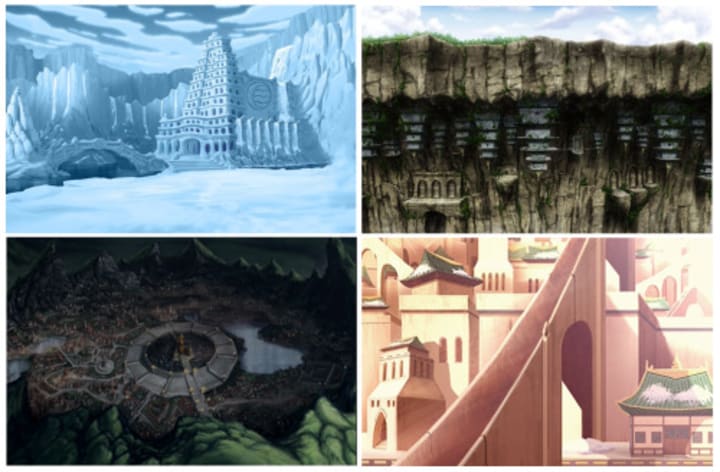
One of the most innovative things this series does is naturally teach the audience about the cultures of each location. By the time we depart each we have a true understanding of how the citizens live, what systems govern them, and the traditions they keep, all while feeling organic to the story.
The Lessons

What the series integrates even better into these cultural snippets are important moral and life lessons. We learn of the sexism in the Water Tribes first from the immature Sokka, and later again from the venerable master Pakku. These ideals are confronted and changed when Sokka is defeated by the Kyoshi Warriors (an all female ensemble) and when Pakku is challenged by our heroine Katara. Another of our heroines, Toph, is blind. This disability gives others the perception that she’s helpless. This idea is turned on its head when her lack of sight is shown to be her greatest advantage, and she proves herself to be the greatest earthbender alive. The series never shies away from difficult topics of that nature. Time and time again it touches on the topics of grief and loss. First with Aang and the loss of his culture and people, then with Katara and Sokka and the loss of their mother, again with Zuko’s relationship with his mother, and finally with Iroh and the death of his son (the story that broke us all in the fandom).
Speaking of Zuko and Iroh, they and their entire country are initially portrayed to be villainous. Throughout the series we see that the citizens of the fire nation are genuine people fighting for what they believe is right. They aren’t some nameless horde of orcs or white walkers — they’re ordinary people who've been fed misinformation and propaganda from their government. This series humanizes war in a way that many series purposely avoids for the sake of exciting battles.
The Combat
Now I’d be remiss if I mentioned battles and didn’t speak on the beautifully choreographed fights within this series. As previously stated, battles in this world are fought primarily through an art called bending. Bending is control over one of the four basic elements in that world: water, fire, earth air.
The concept is interesting enough, but what truly sets this system apart from others is that each elemental being style is based on a different real world martial art, and each elemental itself embodies something uniquely different. Water is the element of change, and waterbending derives its movements from Tai Chi. Fire is the element of power, and it's mostly based on Northern Shaolin style with some others mixed in. Earth represents substance, and its movements are mainly borrowed from Hung Gar style, with a mixture of other Southern Chinese martial arts. Finally air is the element of freedom, and its fighting style is derived from Baguazhang style martial arts. This makes battles a beautiful blend of purposeful motion, and impact. Every movement has an intent behind it. Every encounter is a back and forth dance resulting in victory or death.
This is even more true for non-benders who have to navigate the ballroom without the same advantages as everyone else. The dance floor becomes even more chaotic when elemental specialists such as metal, blood, and lightning benders arrive. All of this mixes seamlessly with a heavy focus on narrative, to create an immersive fantasy world.
Come Explore
This is a fantasy world that has captivated so many of us, and for so long. No one is ever the same after finishing the series, much like no character within the series is the same at the end as they were when introduced. The series gives us a refreshing new world filled with genuinely fascinating lore that we explore along with compelling characters. We watch Aang grow from a playful child to the Avatar master of the elements; Sokka from a sexist oaf into a capable leader, warrior, and inventor; Katara blossoms from emotional teen to a motherly master waterbender; Toph from a selfish and egotistical blind bandit to a caring and capable earthbender, the greatest in the world; and Zuko ascends from irredeemable banished prince to the trustworthy ruler of his people. There are so many more iconic moments and memorable details that make Avatar the Last Airbender the greatest fantasy world, but I wouldn’t want to spoil things for those who’ve yet to take that first penguin ride down the snowy hills. So grab your flying sky bison, polar bear dog, or eel hound, and come join us in this enthralling world.
About the Creator
Vagabond Writes
I sometimes write things. Currently eager to write more, and provide quality content. If you like my writing consider subscribing or pledging. Thanks for the support!
Also follow my Instagram @Vagabond_Writes
Keep reading
More stories from Vagabond Writes and writers in Fiction and other communities.
The Forsaken Land
“This land once belonged to them, those foul creatures birthed from Gaia. Humanity they were called. Vicious monsters full of greed, and violence. They wasted Gaia’s precious resources, and polluted her lands without remorse. This is why we were born, little ones. We were born from Gaia’s need to rid herself of those parasites. Perfect beings with divine purpose.” The voice of the speaker was deep and resolute. He spoke in such a way that those in attendance had no doubt in his words. His knowledge was absolute and true.
By Vagabond Writes5 years ago in Fiction
Lightning Never Strikes Twice
The distant rumble, the sudden deluge, the crescendo of sound, the flash of light, the explosive energy — it never gets old. I became an amateur storm chaser about two years ago. My wife, Cindy suggested it. Sort of. She said, "Alex, you know this cancer is killing me. I've come to terms with that, but you're smothering me. Go join a band, write a book, or become a storm chaser, for all I care. I love you, but you need a hobby."
By Julie Lacksonen3 days ago in Fiction
Ascension Day
Welcome, everyone, to our coverage of one of the most important days in our calendar. Ascension Day. Stay tuned for a brief history lesson into when and why Ascension Day became so important, interviews with members of The Ascended, and all you could ever want to know about the Intake of 2086. We will speak to the individuals shaping our future and the families they will be assigned to life with.
By Paul Stewarta day ago in Fiction




Comments
There are no comments for this story
Be the first to respond and start the conversation.