
Path to Freedom
When robots have taken over, heroes fight back, leading refugees to find a new freedom
Path to Freedom
By Laura Brady DePace
We huddled in the darkness, waiting for the robot troops to pass by. Holding our breath, quieting the babies as best we could. The older children, scared silent, hid their faces in their mothers’ skirts. The darkness protected us. Or so we hoped.
The troop moved on. We could breathe again, but no one was talking. We waited, just to make sure.
After a few minutes had passed, I quietly stood, staying in the darkest shadows. I peeked around the edge of the ruined building in which we were sheltering, looking down the muddy road in both directions. Holding my breath, I listened, straining my ears for the slightest sound that might indicate that this was a trap, that the troop was hiding as we were. Nothing. Silence.
I turned back to the huddled women and children. Holding a finger to my lips to enforce silence, I gestured for them to rise, to gather themselves to move on. Slowly, ponderously - as silently as possible - they got to their feet. Mothers carried infants. Older children helped younger ones. The elderly leaned on each other.
I tried to muster an encouraging smile, but it trembled on my lips, faltering, dying out. Hope was hard to come by in the desperate, despairing darkness.
Angela, a favorite of mine, reached for me. She pressed my hand with her tiny one, nodded encouragement. She raised her other hand with the symbol for Peace. Hopeful. Hopeless. So very dear. So seemingly impossible.
I took courage from her bravery and dredged up that smile again. With another cautionary finger to my lips to shush them, I gestured “follow me.” Putting Angela behind me, I took another peek around the corner, and we set off.
The street was dark and deserted. The stores had been closed for weeks, of course, and even the looting was done. Broken windows gaped on empty buildings. But the empty streets and dark back alleys offered some protection for my little band of refugees. We slipped from one dark space to another, a ragged line of ragged people.
Although we missed the protection of those buildings, it was a relief to finally pass the edge of town and make our way into the woods. Though still dark and desolate, it felt somehow safer. And familiar. I had grown up here, among the woods and fields, in the little farmhouse with its tidy barn and garden. I had been happy here. Before.
Before the Illness. Before the Plague. Before the military took over the country, wresting power from the sick and dying. Entrusting that power to the machines that they thought they controlled. Until the machines escaped their control, as we should have known they would do, and assumed the power for their own uses. The machines that had been our servants now made us their slaves.
Now, my knowledge of these fields and woods was put to good use, helping the refugees to escape from the sad cities, to guide them to the shores where there were always ships waiting, just out of sight, to whisk them across the sea to safety.
I signalled a rest to my charges, and they sank down in the shadow of a huge willow tree, exhausted, numb, oblivious. We had been traveling for over a week now. Our journey had started in Oxbow, in the tiny schoolhouse where so many sought sanctuary. I had gathered them up and led them out of the town, through the dark city, and finally into these woods. Leaving them there with a gesture that told them to stay, I cautiously scouted ahead.
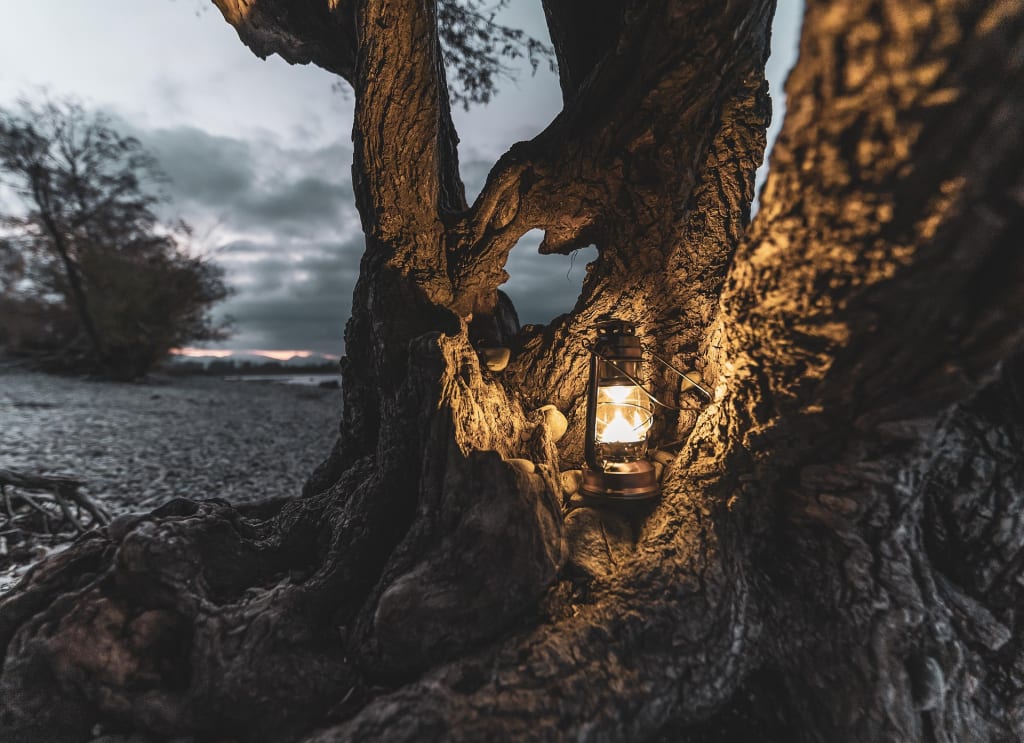
I knew it would be there: the lantern. The first in a long chain of lanterns that would guide us to the shore. A light in the darkness, literally and figuratively.
The Light-Keepers were a diverse group of people dedicated to the rescue effort. Doctors, lawyers, teachers. Maids and gardeners. Veterinarians and meteorologists. Astrophysicists and farmers. They came from all walks of life, drawn together by the need to do something - anything - to help those who could not help themselves.
The first Light-Keepers had been teachers, like me. We had begun by leading our classes of children out of the schools, into the woods, where we cowered, watching the bombs dropping, obliterating the life we had always known. Those who had fallen to the Plague, fighting for life in the hospitals and clinics, were beyond our reach. It was heart wrenching to abandon them, but we knew we had to save the ones we could.
Oddly enough, it was arcane knowledge that allowed us to organize. Messages were sent by Morse code. Signal fires were lit on mountain-tops. Codes were hidden in books, in libraries that were closed by military order. But libraries are known for holding tight to their secrets, and hold tight they did. These abandoned storehouses of knowledge became an integral part of our rescue plans.
The leaders of our rescue movement had gleaned what they could from pilfered library books. Our civilization - so-called - would have to re-learn the old ways: farming, gardening, cheese-making, meat preserving. All of those skills that we had voluntarily surrendered to the machines. Until the machines took over and cut us off. Without the robot-driven factories and processing plants, we would starve. We would be left in the dark when public power was cut. We would be stranded wherever we were when the transport system was shut down.
Or.
We could re-learn. We could remember how to find information in books. We could trace back the legends and folk tales to their sources, and re-discover the old ways. We could evacuate the cities, one small group at a time, and return to the wild lands that had been abandoned when we had forgotten how to live independently of the machines.
And we could set up an Underground Railroad of sorts, a lantern-marked chain of pathways that snaked through the woods, slithered along stream-banks and riversides, wove through marshes, and led to the sea. We could recruit Light-Keepers to keep those lanterns burning. We could build a network of guides to lead our people to freedom.
And so here I was, at the edge of the woods, by dark of night, searching for the lantern that would lead me and my charges on our journey. There. Just ahead, propped in a hollow at the base of a huge oak tree. I returned to my charges, got them up, and we moved on, following that trail of light.
All through the night we traveled the dark paths, led on by the carefully placed lanterns. Just as we were beginning to give up, just as I was wondering if I had led my charges astray, lost my group in the darkness, another tiny spark of light would appear before us.
Dawn was beginning to lift the darkness when we stopped for the day. Ahead we could see the dark shape of an old barn, our intended refuge. I left my group at the edge of the woods and slipped silently forward, a black-clad ghost, to make sure our destination was safe. I slipped to a gaping window, glass long gone, and peeked inside. And froze.
Silver. Steel. The movement of an intelligence that was not human. Damn! The robots had gotten here first. How many of them? It looked like only two. But I knew that there was always one more than you thought there were, so I kept looking.
There. Up in the hayloft. Another metallic shape. Three, then. Maybe four?
I returned to my group, and with whispered urgency, I explained the situation. Our “safe house” was no longer safe. The odds - as always, it seemed - were against us. We were too few, too weak, to take on this adversary. We would have to find another way.
I organized a small group of the older children, paired them up, and set them the task of searching for an alternate shelter. I reinforced the importance of being stealthy, of evading the attention of the machines. They set out in all directions, too solemn for their years, carrying too heavy a responsibility, but we had no choice. We all knew that.
For my part, I searched through my backpack for something that might give us an edge, might offer us an out. I had one charge-gun that still worked, but what could one weapon do against so many? Still, it might come in handy. I could at least take one of them out.
My scouts returned, and one pair had found a potential hiding place. It was a small cave. It would be very crowded, with so many of us, but Ajia, the speaker of that pair, assured me that we would all fit, leaving no trace on the outside of the cave to lead our enemies to us. Trusting his word, I allowed him to lead us to it.
Sure enough, we would fit, but it would be very close quarters. There was also the bonus of a small spring at the back of the cave to provide water to our thirsty crew. We filed inside and managed to settle ourselves for the day.
I could not get the machines that had taken over our safe house out of my mind, though, and found it impossible to settle myself to rest. I couldn’t just leave them there. What about the next group that made for that sanctuary? Would they see the danger in time, or would they be sitting ducks? No, I had to do something.
Looking over my charges, my eye settled on Ajia. He was - what? - thirteen? Fourteen? Almost old enough. He caught my eye and raised an eyebrow. I sighed and waved him over. He made his way carefully over the already-sleeping bodies of his companions.
Briefly, I explained my concern over the robots that had forced us to reroute. I had to go back and do something about them. I would probably be fine, but if I wasn’t…
He nodded gravely. “I’ll lead them to the next light. I won’t let you down.”
I blinked back tears of pride, gave him a quick hug, and slipped out of the cave. As I arrived back at the barn, I could see the robots leaving the building. One…two…three. Just three? I waited. No, there was a fourth, trailing far behind the other three. Far enough behind that I hoped the others wouldn’t see when I took it out. Slipping carefully closer through the brush, I boosted myself through a window of the barn. A piece of rusted equipment, a plow of some kind, sat just inside the door. With a mighty shove, I pushed it out the barn door, then concealed myself behind the door. It went with a satisfying clatter. The robot stopped, turned, and advanced on the barn. I waited until it was so close that I couldn’t miss, and shot it with the full force of the charge-gun. Electricity crackled, making lightning traces across its body, until it glowed blue, then went black. Shorted out, it crumpled to the ground.
Although taking this one down was very satisfying, I couldn’t delude myself that I could get the other three single-handed. No, I would have to take the win with this one enemy, and use it to warn other groups.
I returned to the barn and poked about until I located a wheelbarrow. With much huffing and puffing, I managed to load the robot into it. Then I rolled it away into the woods at the edge of the clearing. I sat it up in the wheelbarrow and used the duct tape in my pack to make silver “X-es” over its eyes. Dead robot. Then I consulted my worn and tattered map. Tracing the stream and the contours of the map, I located the likely location of our cave. Using arcane runes, I scratched directions into the shiny surface of the robot. I added a set of misdirections, with the rune for “no,” on another obvious spot. Hopefully, any unknowing eyes would pick up on this bit of subterfuge and head off in the wrong direction.
It wasn’t perfect, but it was the best I could do. Then, retracing the steps that had led us here last night, I located the lantern we had followed. I scratched more runes into the bark of the tree, warning of danger ahead. Then, satisfied that I had done all I could, I returned to the cave. Nodding to Ajia, I curled up and fell instantly asleep.
The next night our journey continued. Again, I led my group down barely-discernible pathways that led the way from lantern to lantern.
At one point, we seemed to have lost the trail. There was no lantern where there should have been one. I remembered this tree. But where was the Light? I settled my little group around the base of the tree while I cast about in an ever-widening circle with the tree at its center. Eventually, I found the missing lantern, twisted and cast aside in the underbrush. With the tools in my backpack, I was able to straighten it out well enough to stand, replace the wick, and refill it with my precious supply of hoarded kerosene. I returned it to its niche, lit its merry flame, and moved my group further along the path.
I was relying heavily on remembered childhood knowledge now as I picked my way through the thickets of spiny multiflora, their thorn-filled arms reaching out to pluck at our sleeves. Roots and stumps tripped us. This wood had been wild not that long ago, and Nature had repossessed the man-made paths.
Despite our day’s rest in the cave, and a subsequent day’s rest in an abandoned monastery, my raggedy band was nearing exhaustion. Our rest-stops became more frequent. It was more difficult to get my group moving again after we stopped. We were reaching the end of our rope, but we had not yet made it to the end of our path.
We should be nearly there now, I thought, looking around as best I could in the gloom. Surely it must be time for another lantern? But strain as I might through the darkness, I saw no sign of a Light.
With a smothered sigh, I settled my little group under the protective umbrella of a weeping willow. Ajia made as if to come with me, but I signaled him to stay with the group. Leaving them there in what I hoped was sufficient concealment, I cautiously slipped into the wood again. A clear patch beckoned me. Not far from it, I could see the hulking shadow of an ancient maple tree. Maybe there…?
As I approached the tree, a shadowy figure suddenly rose from the ground beside the path. Grasping hands reached towards me - hands, not mechanical arms - but then again, not all of our enemies were robots. My self defense training, fueled by fear, desperation, and a hot blaze of anger, kicked in. One hand reached for my attacker’s eyes, while the other slapped at an ear. A leg-sweep brought them to the ground. A quick turn, a knee on their chest, an elbow to the throat, and my attacker lay still.
“Friend!” he gasped. “Friend!”
“Prove it!” I snarled.
“All that is gold does not glitter,” he hissed.
“Not all those who wander are lost,” I whispered the response. I climbed off his chest and helped him sit up. “Who are you?” I demanded. “And why did you attack me?”
“Geez, I’m sorry I did,” he croaked, rubbing his throat. I glared at him stonily. He held up a placating hand.
“I’m Swallow,” he said, using his code name. “You?”
“Wren,” I responded.
“Oh! Wren!” he said, recognition lighting his voice. “I guess the stories I’ve heard about you are true! It’s an honor to make your acquaintance!”
“Pleased to meet you, Swallow.”
“Your people?” he asked.
“Back a ways,” I said, pointing an elbow in the general direction. “Why are you here? Where’s the Light?”
“The Light was lifted by those damn robots,” he replied, pointing to the hollow in the tree. I could see the twisted remains of the lantern there, unlit but marking the spot. “Two days ago. I haven’t been able to fix the lantern - they smashed it up pretty good - so I’m here to guide you to the next lantern.”
“Oh.” I nodded. “Um - sorry I - well -”
“No problem,” he replied, a faint smile glimmering in the twilight. “Looks like your group is in good hands. Let’s get them to that last Light.”
We returned to where my group huddled under the sweeping fronds of the willow. I introduced Swallow and explained that he would be guiding us to the next Light.
“The final Light,” he assured them, “that brings you to the ships.”
The news that we were so close strengthened my flagging charges, and we moved forward through the darkness with a glimmer of hope rekindled.
At long last, just as the dawn was beginning to paint the sky, we reached the final Light. Swallow took the Light from its hidden niche in the old willow tree and brought it down to the edge of the sea, waving it in the agreed-upon signal. We caught the faint glimmer of a reply. Swallow replaced the Light in its spot, and the refugees anxiously awaited the ship that would carry them away to freedom. An uncertain freedom, to be sure, but freedom all the same.
The graceful ship approached, sails shining in the first glimmer of a new day. Rowboats were dispatched to ferry the refugees across.
Ajia approached me, as the last rowboat awaited him. “Can I stay?” he asked earnestly. “Can I stay to help you?”
I gave him a grateful hug. “No, Ajia, I’m afraid not.” I gestured to the ship of hope, the rowboats with their loads of pioneers. “They need you more. Help them. Help them to rebuild the world.”
He nodded and boarded the last boat, turning to raise his hand in the Peace sign. I returned his wave and watched as he boarded and the ship raised anchor, setting her sails to the future. I turned away, and Swallow and I returned to the woods. Ready for our next charges.
About the Creator
Laura DePace
Retired teacher, nature lover, aspiring writer driven by curiosity and “What if?” I want to share my view of the fascinating, complex world of nature. I also love creating strong characters and interesting worlds for them to live in.
Reader insights
Outstanding
Excellent work. Looking forward to reading more!
Top insight
Excellent storytelling
Original narrative & well developed characters
Keep reading
More stories from Laura DePace and writers in Fiction and other communities.
A Love Letter to Charlie
Dear Charlie, I don’t want to say goodbye to you but after you were flipped on your side by Mardi Gras revelers two weeks ago, the insurance company considers you totaled. Breaks my heart that one stupid prank ended our run. Note: my father-in-law is delighted by the news as he considers you a widow-maker and insists we find a safer vehicle for his future progeny. (Shoot, we’re not ready for kids… just got married a few months ago. Can’t we have a little time before the honeymoon ends?)
By Cathy Schieffelin5 days ago in Fiction



Comments (2)
Fabulous story ✍️🏆♦️♦️
In a dystopian future, hope always lies with the brave. You have done a masterful job in describing the despair and destruction of a robot army and the resolve of those who resist them—excellent story and very well written.