
Pantheon of the Discarded
The Lament of the Forgotten Things


“The silence of things is not empty –
it is a chorus of what we have forsaken.”
The Reading Room had not been entered in years. Dust clothed the air in a gauzy hush, drifting like a patient spirit. A draft whispered through a crack in the wall, carrying the faint scent of rain, as though the outside world strained to remind the room of its forgotten kinship with earth and sky. The fluorescent lights, when they finally stuttered awake, hummed with sterile insistence. The space felt less like a room and more like a reliquary — a vault where time itself had been left to stiffen and settle.
Beneath that pallid glow, the forgotten ones gathered.
The inverted canopy leaned against the corner, its ribs splayed like bones. “The world turned me over,” it murmured, voice dripping as if rain still clung to its fabric. “Once I defied the sky. Now I hold only what falls. Rain rises and spatters across my hollowed surface. I was made to shelter, but the humans delight in their disposables. Cheap fabric, thinner than a sigh, sold for a season. They left me inverted, as though the storm itself had won.”
The silent striker sulked, its black head dulled and scuffed. “Pounding in silence. That is all I am. I ache for wood, for the satisfying thud that fastens one thing to another. My dark crown is screaming: find me a nail and a board in which to affix it!! Yet no one builds anymore. They buy. Flat-pack furniture, pressed wood, and glue. Nails vanish. Boards vanish. And I vanish with them.”
On the shelf above, the white-stained bristles lay stiff and starved. Its bristles, cemented in a hardened shroud of white, trembled with grief. “White betrayed me,” it whispered. “White stained me into stillness. Once, I held horizons in my stroke, walls reborn under my sweep. Now I am a body frozen in my last gesture, unable to color the world. Plastic mouths tipped by machines spill their colors instead. I am no longer hand and vision, only relic. What is the worth of art if the hand is forgotten?”
The black reel of memory laughed bitterly, its reels whispering like moth wings. “At least you recall what you last touched. I am full of memory, yet no one can read me. I carry voices, faces, whole summers sealed in my black body. Entire families sit inside me, waiting. There used to be shelves and stores full of us — black boxes alive with sound and image. Now we are useless without our machines. But the players are gone. Humans adore the instant — streaming, scrolling, vanishing. Memory itself has been betrayed.”
On the floor, the pink disc of flight spun itself lazily in a circle, catching light in its plastic grin. “You all wail like widows,” it teased, though its voice cracked with longing. “I was flight. I was laughter, skipping across fields, chased by dogs with sun on their backs, dropped in grass sticky with soda and barbecue smoke. Fluorescent pink against fluorescent lights — out of sync, out of time. I invite play, dog drool, ice cream, and sand. But now? No one steps outside. Children scroll screens with their thumbs. Their hands forget the arc of air.”
The canopy sighed, the striker groaned, the bristles twitched in brittle sleep. The reel hummed softly with unseen scenes, and the disc stopped spinning.
For a moment, the room was heavy with silence — not empty silence, but the kind that carried the weight of human neglect within it, like dust.
“Perhaps,” the canopy said at last, “we are not lamenting ourselves. Perhaps we are lamenting them. Humans, who made us, who gave us purpose, who abandoned us to silence.”
The reel’s reels clicked once, like a heartbeat. “We are their cast-off memories.”
The striker lowered its head. “We are their forgotten work.”
The bristles exhaled brittle dust. “We are their lost visions.”
The disc, no longer mocking, whispered: “We are their forsaken joy.”
“Do you hear?” whispered the canopy.
“They don’t,” said the reel.
“They only translate,” rasped the bristles.
“They catalog,” muttered the striker.
“They write, but they don’t remember,” sighed the disc.
And the students continued to scribble, cataloguing fragments of a world they could not touch. At the same time, the forgotten objects — half divine, half broken — spoke laments that no human ear could truly understand.
And in the stale Reading Room, the forgotten objects kept vigil — mourning not for themselves, but for the vanishing pulse of the human world.
On the other side of the glass wall, a row of students of anthropology leaned forward in their chairs, notebooks open, pens poised.
They had been instructed not to interrupt. Only observe.
Some tilted their heads, mistaking the canopy’s lament for symbolism of fertility rites. Others scribbled when the striker spoke, noting its ritualistic association with force. The bristles became a tool of “domestic ornamentation.” The reel was labeled “archival technology, obsolete.” The disc earned a margin note: ceremonial object, perhaps for sport or divination.
But none of the students looked with longing. None of them remembered how it felt to run through grass, to press fresh paint into a wall, to hear the heavy satisfaction of a strike that mended, to rewind laughter on a rainy afternoon, to feel safe beneath a canopy turned against the sky.
The forgotten ones grieved all the more.
One student sketched the canopy, its ribs like insect legs. She labeled it protective device, broken. The canopy, insulted, remembered instead the little boy beneath it: yellow boots stomping in puddles, laughter louder than the storm.
Another tapped the striker, noting: ceremonial hammer, non-lethal weapon. The striker scoffed, recalling the carpenter’s hand, rough and steady, building a cradle. Each strike was a heartbeat.
The bristles were prodded with a latex-gloved finger and logged as decorative implement, covered in residue. They shuddered, aching with memory: the young woman painting her first apartment, streaks of white across the wall and across her cheek, a radio humming with possibility.
The reel was lifted to the light, admired for its symmetry. Data-storage technology, obsolete, the student scrawled. The reel groaned. Inside it, a grainy recording of a family picnic still lived — ants invading sandwiches, a grandmother waving, a father chasing his children until he collapsed in the grass, laughter tangled in the whir of the camcorder.
The disc was tossed once in the air, caught clumsily, and set down. Ritual disc. Possibly funerary. The disc winced. “Funerary,” it muttered, remembering the child who had once hurled it high, so high, until the dog leapt, tongue lolling, and the whole beach applauded.
For a moment, some students felt it: the hiss of rain, the echo of hammering wood, the ghost of turpentine, the murmur of a birthday song, the rush of salt wind. Each dismissed it as a trick of light, sound, imagination. Pens scratched faster. Notebooks filled with sterile translations.
But one student lingered. She had written almost nothing. She kept her eyes fixed, not on her notebook, but on the forgotten ones themselves.
When the others filed out, she stayed seated.
The fluorescent hum pressed around her.
And then, clear as a bell, she heard it: the weary sigh of the canopy, the restless ache of the striker, the brittle longing of the bristles, the whispering laughter of the reel, the bright plea of the disc.
Her breath caught. She whispered: “I hear you.”
The forgotten ones stilled.
At last, someone had answered.
The canopy shuddered as though filled again with storm. The striker vibrated with a low, satisfied hum. The bristles quivered, bristling against their hardened shroud. The reel ticked joyously, a heartbeat of memory. The disc spun of its own accord, catching light like a sun.
The student pressed her palm against the glass — not just a touch, but a benediction, as though blessing the relics through the barrier. Her lips moved again, and the words sounded less like speech than prayer.
She opened her notebook — blank until now — and began to write. Not in sterile script, but in words that came unbidden, as though whispered into her hand:
Notebook Fragments — Litany of the Discarded
I. The Canopy
The world flipped upside down,
rain rising to spatter droplets
across the hollowed canopy.
II. The Striker
Pounding in silence —
its black head screaming:
find me a nail, a board,
an affixing place.
III. The Bristles
White has left me stained,
bristles hardened into silence,
unable to color the world.
IV. The Reel
Shelves once full of black boxes,
reels sealed with sound and image,
families waiting in my body,
now useless without their player.
V. The Disc
Fluorescent pink out of sync
with fluorescent lights.
I invite play, dog drool, summer heat,
a plastic disk of youth abandoned.
She stared at the page. Her handwriting, their voices. For the first time, she understood: these were not tools, but elegies. They carried the joy, the memory, the labor, the shelter, the creation of the human world — all forsaken in the rush toward something newer, cheaper, faster.
Closing her notebook, she whispered again: “We have lost more than you. We have lost ourselves.”
She left the Reading Room not as an observer, but as a witness. Not as an anthropologist, but as a Romantic — carrying the grief of objects and of humankind. She knew she must preserve their voices, must let their song echo beyond these walls, or risk their silence swallowing the world entire.
Behind her, the inverted canopy, the silent striker, the white-stained bristles, the black reel of memory, and the pink disc of flight glowed faintly in the sterile light — no longer merely forgotten things, but a pantheon of loss, sanctified by her words.
“To listen is to remember –
and to remember is to grieve what we have made and lost.”
About the Creator
Rebecca A Hyde Gonzales
I love to write. I have a deep love for words and language; a budding philologist (a late bloomer according to my father). I have been fascinated with the construction of sentences and how meaning is derived from the order of words.
Keep reading
More stories from Rebecca A Hyde Gonzales and writers in Fiction and other communities.
The Fracturer and the Weaver
Movement I: The Arrival of Truths Before the shaping of the world, there was a chamber where speech itself was gathered. Here the air was restless, filled with syllables unmoored, falling like rain before they had names. A ground of shifting light stretched outward, and from that mist rose the Elemental Figures, each bearing a portion of what mortals would one day inherit.
By Rebecca A Hyde Gonzales6 months ago in Fiction
Contillian Rubustus the III
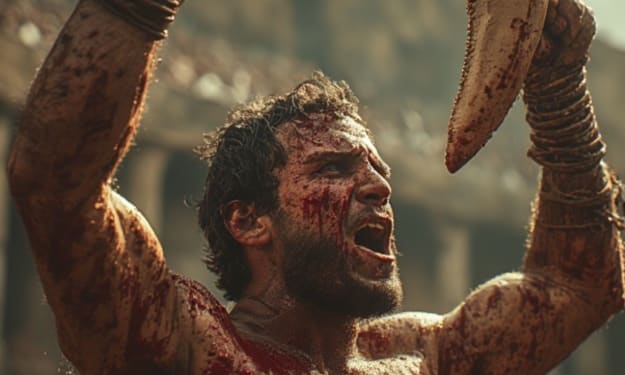
Contillian counted the seconds before the beast was to be released. His bare shoulders were flexed. Already, his sweat drenched his body in the heat of the baking sun. He had wrestled lions and bears dozens of times. Whatever type of beast was behind the gate, it couldn’t be worse than the animals that he’d strangled to death before. The spear in his hand was sharp.
By Rowan Finley 2 days ago in Fiction


Comments
There are no comments for this story
Be the first to respond and start the conversation.