

"The past isn't dead," Mrs. Latch often said. "It's just catalogued."
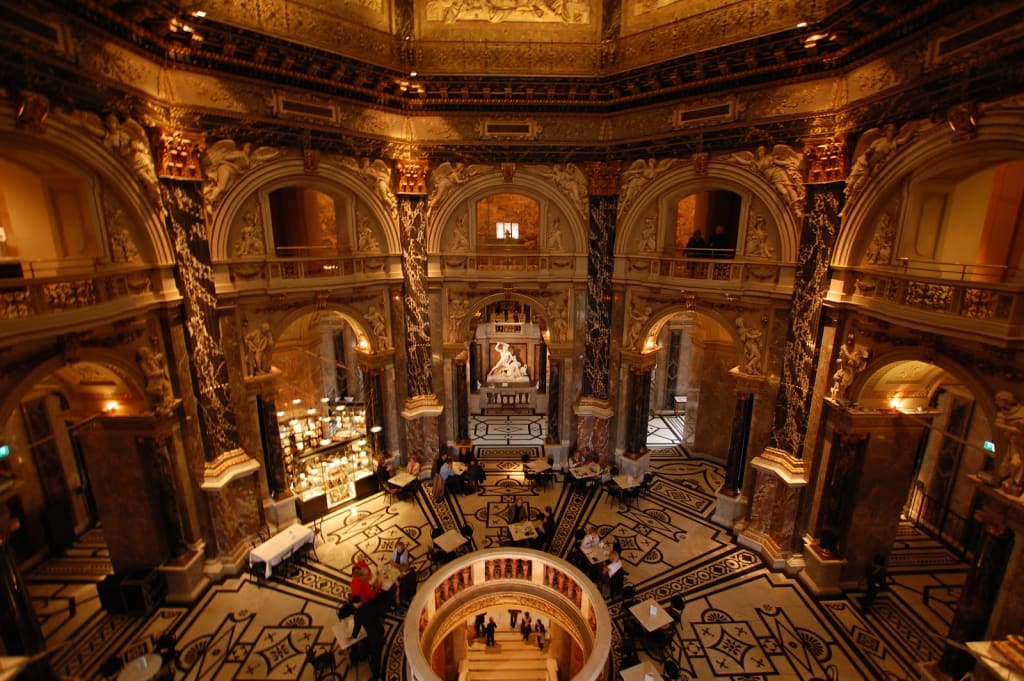
Bellwether Museum was not on any map, now did it have an address. It sat politely between a bakery and an abandoned tax office, in a town that didn't remember building it. No one questioned its existence, some said it had always been there, others insisteed it appeared sometime after to flood of '53. Regardless, everyone agreed on one thing: it was only open on Tuesdays.
The museum itself was narrow but deep. From the street, it looked barely wide enough for a broom closet. Yet once inside, visitors found endless rows of glass cabinets, odd paintings that changed slightly when unobserved, and drawers that rattled when ignored.
Mrs. Latch was the sole curator, archivist, and receptionist. She wore a rust-colored cardigan, lace gloves, and a brooch shaped like an eye. Her hair was always perfectly pinned. Her smile was kind but firm, and her eyes held the weight of someone who had lived far longer than the calendar did.
No one remembered ever seeing her eat, or sleep, or age.
There were rules. Posted clearly by the door, framed in gold leaf:
1. Only enter on Tuesdays.
2. Do not touch artifacts.
3. Do not donate items without permission.
4. Do not speak to the exhibit in the glass hallway.
Most people chuckled at the last rule. Some assumed it was part of the museum's charm-- a bit of theater to keep things mysterious, but Mrs. Latch never laughed when asked. She simply looked at them with that still, glassy patience and said, "That one is quite serious."
On the Tuesday in question, Bellwether Museum welcomed four visitors. An older man with a limp. A child in a yellow raincoat, though it wasn't raining. A teenage girl wearing headphones she never took off. And a man with no shadow.
They entered silently, one after the other, greeted by the soft chime of a bell that rang slightly after the door opened. Mrs. Latch stood behind the reception desk, polishing a set of antique keys.
"Welcome," she said, smiling faintly. "Mind the rules. Exhibits are self-guided. Do ask if the walls shift."
She did not say if the walls shift. She said do.
The museum had a habit of rearranging itself based on mood, weather, or unspoken guilt. The child wandered through a room of dollhouses that hummed when passed. The old man stared into a mirror that showed a different war each time he blinked. The girl with headphones paused before a carousel horse mounted on a pedestal, where the brass pole pulsed like a heartbeat.
And the man with shadow-- he went straight to the glass hallway.
It wasn't marked on the map (not that maps in Bellwether stayed the same for long). The hallway appeared only when it wanted to. Sometimes in the west wing. Sometimes through a cupboard. Sometimes alarmingly, underfoot.
This Tuesday, it was at the end of the archive room, where the lights buzzed slightly too loudly.
The glass hallway was narrow, and unnaturally clean. The walls shimmered faintly with their own inner glow. Within its transparent enclosure stood a single object: a tall, antique phonograph, its horn twisted slightly wrong, like a snail shell bent by heat.
Visitors were not to approach it. They were certainly not to speak to it.
The man with no shadow stepped inside anyway. Mrs. Latch did not follow, but her gaze snapped to the hallway, like a magnet. She moved more quickly than usual, setting down her polishing cloth, her gloves fluttering as though caught in a draft.
But she was too late.
The phonograph was already speaking.
"Do you remember me?" it asked.
Its voice was warm, wet, and too close.
The man with no shadow tilted his head. "Yes," he said softly.
The hallway grew brighter.
"That's unfortunate," the phonograph replied.
Mrs. Latch arrived at the threshold of the glass hallway just as the light dimmed. The phonograph had gone silent. The man with no shadow stood still, as if listening to something no one else could hear. His eyes were closed, but his mouth was not.
He was smiling.
"Sir," Mrs. Latch said gently, but with an edge that could slice glass, "this exhibit is not interactive."
He opened his eyes. They were wrong now-- just slightly. Too still. Too patient. As though they remembered everything and nothing at once.
"I didn't touch it," he said softly. "I only listened."
Mrs. Latch stared at him for a long moment, then reached into the pocket of her cardigan and pulled out a small, rusted key. She turned it in her fingers three times, and the hallway's glow dulled to a soft gray. The phonograph recoiled slightly-- visibly-- and the glass grew misty, like breath had fogged it from within.
"Then you've heard what cannot be unheard," she replied.
Back at the reception desk, the bell rang again-- once, then again.
The man with no shadow did not leave.
In the room with murmuring dollhouses, the child in the yellow raincoat found a miniature replica of Bellwether itself. Tiny porcelain people wandered frozen paths. The child leaned in and whispered something. One of the figurines turned its head.
The girl with headphones was now lying flat on her back in the planetarium, watching the painted constellations rearrange into shapes that had no names in any language. Her music had gone quiet. The carousel horse behind her twitched.
And the old man vanished entirely.
Only Mrs. Latch noticed.
She locked the glass hallway behind her. Not with a key, but with a word she whispered into the brass hinge. The word sounded like the creak of a rocking chair in an empty attic.
She turned back toward the museum and sighed. The exhibits had begun responding-- shifting subtly, like animals waking up too early from hibernation. Cabinets clicking softly. Painting exhaled.
It was beginning again.
Years ago-- perhaps decades, perhaps more-- someone had spoken to the phonograph. A young man, full of regreet. He had offered it a question: "What did I leave behind?" It had answered, what the museum warped for weeks. Rain had fallen inside the coat closet. Latters began appearing in drawers written in handwriting no one recognized, addressed to people who had not yet been born.
They called that the Tapering.
Mrs. Latch still had the original question on file, tucked inside the locked ledger at the back of her desk. It had scorched the page when she catalogued it.
She was getting too old for another Tapering.
That evening, well after the bell stopped ringing and the sky above Bellwether turned that peculiar color between blue and bruise, the museum finally settled.
Mrs. Latch brewed a small pot of tea in the staff kitchen-- a room that had not existed before 1981-- and unlocked the desk drawer containing the visitor log.
She flipped to the current day. Four names were listed. Only three had signatures.
The fourth line simply read:
"Returned."
Beneath it: a small ink sketch of a phonograph horn twisted like a snail shell.
The museum did not sleep.
It waited.
Long after the visitors left (those who could), and the lights dimmed to a soft twilight hum, Bellwether settled into its deeper state. Behind the walls, something clicked its tongue. The dollhouses exhaled dust. In the hallway of lost clocks, all the pendulums had synced to the same deliberate rhythm.
Mrs. Latch didn't go home. She never did. She walked the museum's spine, her gloved fingers brushing gently along the cabinets, offering reassurance. "Still catalogued," she whispered to them. "Still quiet."
But tonight, quiet wasn't holding. In the exhibit of unclaimed items, the carousel horse had turned to face the doorway. In the room of sentimental artifacts, one of the paintings had shed its frame.
And somewhere-- just outside the corner of knowing-- the man with no shadow stood in a hallway that wasn't on the blueprints. The phonograph hadn't spoken again. It no longer needed to.
In the back office, Mrs. Latch poured herself tea and opened the black ledger.
This book did not keep records of visitors. It recorded moments.
-When the whisper first appeared behind the exhibit glass in 1972.
-When the custodian's reflection walked away without him in 1985.
-When the twins donated a mirror that never stopped reflecting them, even after they were buried.
She flipped to todays date. A line had written itself in deep red ink:
Rule Four Breached.
Underneath, new words began scrawling across the page, without ink or hand:
"He remembered. We remember. The exhibit is no longer content to be observed."
Mrs. Latch pressed her gloved palm to the page. "Not again," she said, voice paper-thin.
Down in the children's wing, the girl with headphones hadn't left either. She sat cross-legged in front of a music box that wasn't supposed to open. But it had.
It played a melody that hadn't existed since her grandmother's name was spoken for the last time. The tune called something up inside her-- something she didn't understand but didn't want to let go of.
And the child in the yellow raincoat? Gone. Left no trace. Only a small puddle beneath the dollhouse exhibit, and a figurine in the miniature Bellwether that looked suspiciously like her.
The name with no shadow eventually returned to the front desk. He was holding something behind his back. Mrs. Latch stood, slowly. Her brooch-- the one shaped like an eye-- had turned a faint, pulsing red.
"You spoke to it," she said.
"I answered it," he replied.
"That's worse."
He smiled. "You're afraid."
"No," she said, stepping around the desk. "I'm responsible."
From behind his back, he revealed what he'd taken: a key. Brass, heavy, shaped like the letter "R." No lock in the museum matched it. Because it didn't open anything inside the building.
It unlocked departure.
"You can't leave with that," she said, voice still calm. "It doesn't belong in the outside world."
"I was never meant to stay here," he replied. "None of us were. You've made a museum out of memory. But memory doesn't like being caged."
The lights flickered.
A deep sound rolled through the museum, low and hungry. Glass rattled. Paintings twisted slightly on the walls. In the glass hallway, the phonograph turned itself slowly toward the nearest cabinet and shattered it-- without moving.
Mrs. Match reached into her sleeve and removed a ribbon of paper. Not a spell, not a weapon.
A label.
She stepped forward and pressed it gently to the man's chest.
The ribbon read: "Object: Recollection. Status: Temporarily Contained."
He gasped-- more out of memory than pain-- and collapsed into himself, dissolving not into smoke, but into dusty light.
The key clattered to the floor and slid back beneath the reception desk, disappearing into the seams.
Later, after she swept the hallway and locked the ledger with seven words whispered in reverse, Mrs. Latch sat by the phonograph.
It no longer glowed.
She poured herself more tea and stared into its horn.
"I'll give you one," she said quietly. "But just one."
The phonograph trembled.
She reached into her pocket and removed a tiny carved box. Inside was a slip of paper, folded seventeen times. She unfolded it carefully and read it aloud.
"I miss you, Michael."
The phonograph shuddered, then stilled.
Behind her, the museum sighed. The carousel horse turned back to face the wall. The mirror un-cracked itself. The figurine of the raincoat child waved once, then returned to its original pose.
Order, mostly, restored.
At the front door, Mrs. Latch updated the sign in the window. Beneath the hours, beneath the rules, she added a note in neat, cursive chalk:
"No exceptions granted. Even for memory."
And on the street, Bellwether's bakery reopened for the morning. The tax office remained empty.
The museum stood patiently between them, smiling faintly through its front glass.
It was only open on Tuesdays.
About the Creator
Shay Pelfrey
I'm a grad student just writing short stories to help fund my way through school. Each story either fuels tuition, a caffeine addiction, and maybe my sanity. Thank you all for reading!
Keep reading
More stories from Shay Pelfrey and writers in Fiction and other communities.
Dead Letter Day
For twenty-two years after he died, Harvey Wills delivered the mail with unfailing precision, just as he had in life. He rose each morning from the gentle, swirling fog at the edge of Bellhaven, straightened the cuffs of his blue postal uniform, and began his route with a quiet whistle. The notes drifted softly through town, barely audible, carrying memories of an old tune no one quite remembered.
By Shay Pelfrey 8 months ago in Fiction
TUS NUA - ch 49
TUS NUA – ch 49 New Beginnings – Mia and Midnight (*)(*)(*) As Mia spoke on the phone to Ali’s sister, Ellen, Finola slipped quietly away and walked to the stream behind Tus Nua. Carefully, she put a block on her family so no one could know what she was about to do.
By Margaret Brennan6 days ago in Fiction
Choosing the Bear
I wasn’t expecting this. I had to go into town for eggs. Normally, Bessie and Judith and Norbert give me enough that this is never a problem, but for some reason they all got broody at the same time. The fact that there’s a handsome pheasant hanging around the cottage, strutting around like he’s “actually a peacock you know.” Yes, he actually said that. So of course the hens are clucking away. Not that anything will come of it, of course, but, the instincts die hard.
By Meredith Harmon4 days ago in Fiction
Whiskey At Dusk
Guess the whiskey was more important to you in the end, wasn’t it? It was more than the well-being of your friends; more vital than showing up to the places you promised you would and could come to; more critical of a matter than fulfilling your damn responsibilities and getting the press off your back.
By Snarky Lisa6 days ago in Humans



Comments
There are no comments for this story
Be the first to respond and start the conversation.