

He hunches by the tide marker, a battered plastic meter stick secured to a boulder with chicken wire and mechanical-grade duct tape. He watches it for almost a full two minutes, the tide lapping gently against his toes, cold water leeching warmth from the soles of his feet. It confuses his findings somewhat- though he always measures at the same time of day, at the lowest ebb of the tide. The water has receded some two or three millimeters. It’s been receding steadily, the past few weeks. He stands straight, holds up three fingers to the figure sitting in the dingy off the opposite shore. Once he feels she’s seen him- it’s too far to be sure- he changes his three fingers to a thumbs-down, then holds his hand flat and wiggles it in what he assumes to be the universal symbol for somewhat. She appears to understand him, giving a double thumbs up in response.
Three millimeters down. About.
That’s good!
He mirrors her gesture.
Yes, it’s good!
It’s occurred to him that she has no way of knowing the metric he’s using. Probably she intuits it. Centimeters would be too good to be true.
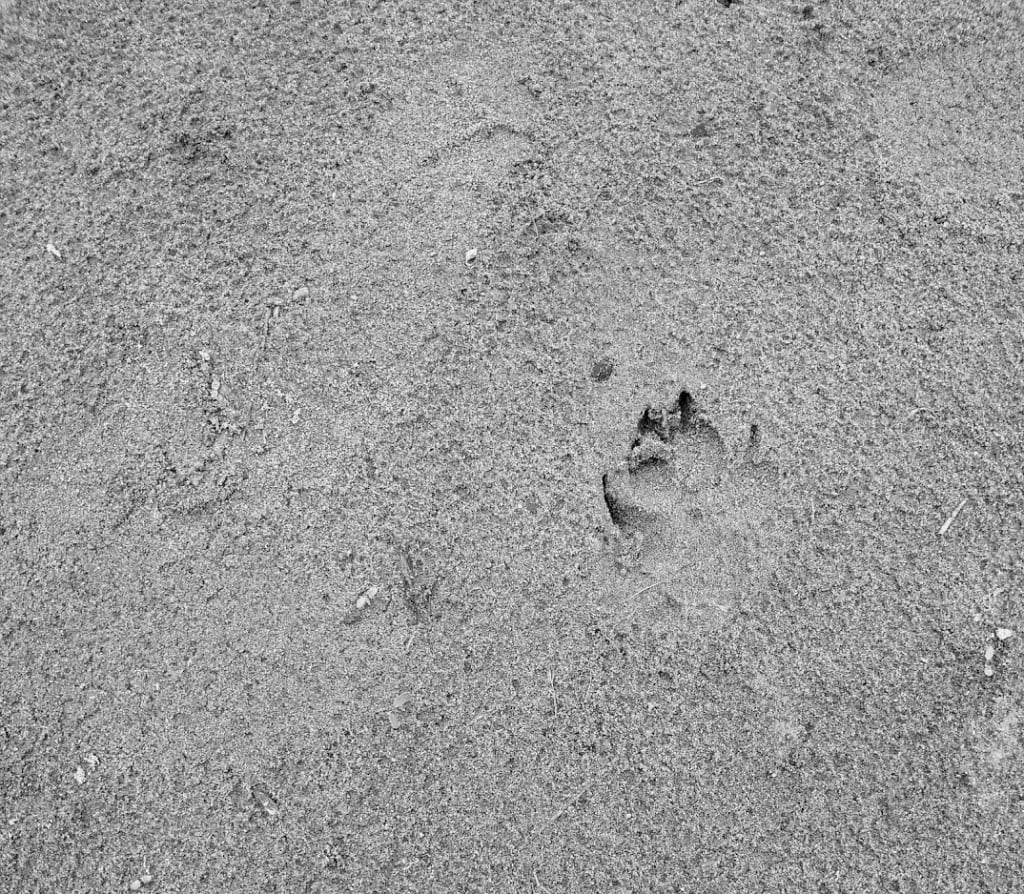
In the distance, the figure returns to her fishing. He heads back towards the house, watching his feet as they make their way across the sand, firm and pock-marked from last night’s rain. There’d been rain, but it hadn’t been torrential, and he hadn’t woken, as he most often does, to wind and hail battering the walls of his small seaside home. He thinks it’s an improvement, but then he’s developed an unusual, watery streak of optimism as of late. He’s in the best mood he’s been since the end of things, maybe since before that. His life, though lonesome, has become very manageable. Before he’d been stretched too thin, taught as skin over the barrel of a drum. He mourns the few he’d loved, mourns the world at large, but it doesn’t weigh as heavy on him as it once did. He wonders about other survivors- doubtless some have formed communities elsewhere in the world. Others, he imagines, have holed up in solitude, like himself and his friend on the opposite shore.
Mostly, he wonders about her.
There’s a heart-shaped locket in his nightstand drawer, upstairs. Real gold, by his reckoning, probably an antique. It looks like the sort of thing that might have once been worn by some nineteen-twenties socialite, a heiress or a silent film star. He’d been out raiding the half-flooded houses that stood abandoned and unbothered by fellow survivors, in those areas where the low elevation has formed wide, shallow lakes. He’s after useful items- canned goods, batteries, soaps and medicine. Most anything solar-powered. It was a frivolous thing to take, the locket, but he’d liked the look of it. He had no pictures small enough to put inside, though, so it lay curled in his drawer with the tweezers, nail-cutters and floss picks. Other concessions to frivolity populate the desks and countertops of his home; a small assortment of plastic dinosaur figurines, troll dolls with tufts of neon hair, a set of hand-painted Russian nesting dolls. Every once and a while he feels compelled to take out the necklace and hold it. It’s weighty, and shimmers pleasantly, smooth against the dry roughness of his calloused palm. He imagines whomever might of owned it, wonders if they’d left it accidentally or intentionally, if it had been a gift from a loved one or perhaps some distant relative, why it was they’d never put in a picture.
He wonders if it’s the sort of thing she’d wear, the woman on the opposite shore, though giving it to her, should he ever meet her, would run the risk of being misconstrued as a romantic overture. He flushes hot with embarrassment at the mere thought of such an exchange.
The day lingers on. Once time had seemed to be forever in short supply, thundering past like a freight train, miles ahead before he could ever catch up to it. An endless list of things to do and a steadily widening aperture between the top and the bottom of the hourglass.
It’s not this way anymore. He tends to his sprawling garden, less a garden now and more a veritable piece of farmland, on which grows a sizeable array of vegetables, mostly tubers. He sweeps a pitifully small cloud of dust out his front door, the apocalypse having inspired rather spartan housekeeping habits. At three he draws water and heats it to bathe, soaking until his fingers are pruned and bloodless, and the water has grown cold.
The day lingers on.
Evening finds him bundled in a thick green wool blanket, cradling a hot cider on the porch. He's struggling through a sudoku from an old newspaper, having amassed a not inconsiderable collection of puzzle pages from his trips inland. The porch light flicks to life on the opposite shore. Buttery light refracts against the gently undulating surface of the water. The woman sees him, raises her hand to him, settles herself in her own porch chair. He raises his hand back. He can never discern her expression- she's at too great a distance- but each time he sees her he catches himself squinting with the effort. She comes out more nights than not, now. One of these days, he thinks, she'll take that little dingy over. Whoever owned the house previously had kept a respectable liquor cabinet and an eclectic assortment of CD’s. He’s plenty of batteries for the player. They could make a night out of it.
Morning approaches on the peninsula. The sun has yet to break over the horizon; the sky is still a deep shade of indigo. It’s conspicuously silent- no wind shakes the window panes. Farther inland has largely gone to desert, dead root systems leaving soil dry and unmoored. Here, though, along the new shoreline, there’s a good many acres of forest. There are deer to hunt, fish to catch, and the land bears fruit. She has rarely left the peninsula since she established herself here, in this strange little home. It’s scarcely more than a bedroom, a bathroom, and a kitchen. The house is square, and constructed of some type of very porous stone, painted in an absurdly cheery shade of yellow. It’s door and window frames are painted in the same shade, and the whole thing looks at a distance like a giant sponge. It’s an odd place, she would concede, if anyone were ever to ask, to have picked to inhabit.
There are other places to be, it would be the sensible thing to go looking. Some cities, somewhere, must still be standing. Certainly there are pockets of people living, roaming, forming communities. She has seen fires burning at a distance, on her trips from home. She moves softly, under cover of night, and gives them a wide berth. Pierrot sleeps in bed beside her, his coat shining even in the low light. He’s a hazard whenever she goes wandering. That coat of his is somewhat of a beacon, bright white barring the three large, not-quite-round spots along his back. Still she could never bring herself to leave him. He’s a good dog, if broadly useless and objectively a drain on resources. He’s good company.
It was a shock, many months ago, when the man on the opposite shore moved in. She’d returned from a week-long excursion, and there he was. Sitting on the porch, entirely unaware of her and Pierrot. There’s no shortage of empty houses in this world, she had no expectations that she’d ever have a neighbor. The first few days after she’d caught sight of him she’d been on high alert, foregoing sleep to watch across the water. It was a good while before she sat comfortably on her porch again, and weeks after that before she returned his wave. He doesn’t approach her, and seems to understand her reticence implicitly.
He’s unlikely to be out at this hour. It’s a good while before she’s due to receive what she’s only recently begun to understand as a tide report.
At some point, she started looking forward to it.
She wonders what sort of crops he grows on that little patch of land, if he hunts. It would be profitable to trade.
One of these days, she might take the dingy over.
About the Creator
Keep reading
More stories from Rowen McCoy and writers in Fiction and other communities.



Comments
There are no comments for this story
Be the first to respond and start the conversation.