
OF LOVE, BETRAYAL AND PATRIOTISM
A historical romantic fiction

SYNOPSIS
The story I’ve penned is based in the then city of Cawnpore, India in the year 1856 – 1857. The genre of this manuscript named OF LOVE, BETRAYAL AND PATRIOTISM is romantic historical fiction. This work is a narrative set in the timeline of the onset of revolt of 1857 and includes mention of some true incidents namely the CHAPATI MOVEMENT, the SATICHAURA GHAT MASSACRE AND THE BIBIGHAR MASSACRE.
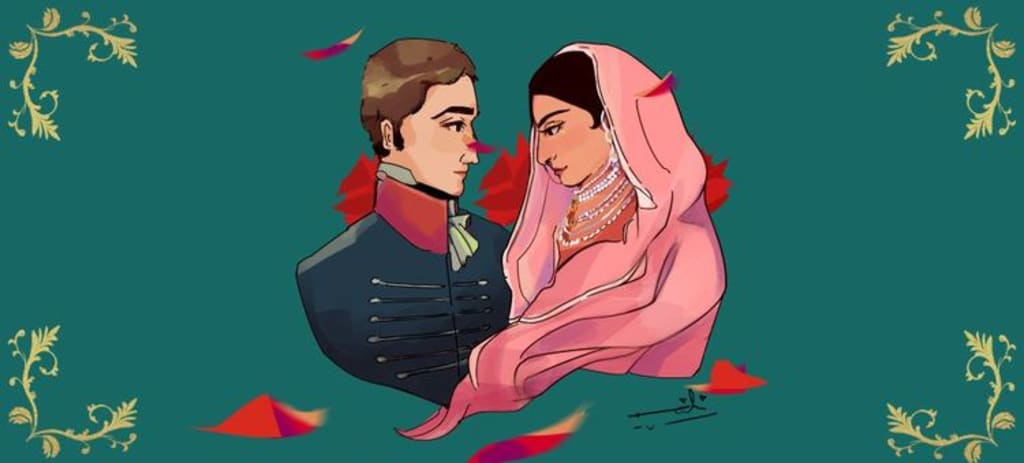
The story I’ve penned is about the true love of Lord Albert Lindsay towards an Indian courtesan Hussaini Khanum in Nana Sahib’s court whose love for him is actually a trap to avenge her parents’ cold blooded murder by his father Lord William Lindsay and a part of Nana Sahib’s plan .
OF LOVE, BETRAYAL AND PATRIOTISM
It was the winter of 1856 when Mr. Albert Lindsay, the son of Lord William Lindsay came to India after his training in civil services for Britain. It was time for him to take charge of his father’s duties as the natives didn’t have a liking towards his father; he was “merciless, inhumane and brutal” as the locals described him and so Albert was appointed the successor to his father’s post. Lord William was once said to have burnt a couple alive for just disturbing him during his hunting sessions.
His son quite seemed to like the atmosphere here in Cawnpore, an amalgamation of two cultures, immense respect from the neighbouring princely provinces and Nana Sahib, gala ghazal evenings by nautch girls and a potential sound life unlike his father.
It had nearly been two months of all things fairy tale since he stepped in and speculations of a weird Chapati movement were stirring. Natives would prepare a few chapatis and distribute it to others who in turn would return the favour to form a chain, as if to convey something. Where it began or the motive was behind it were still unanswered questions. He had deployed a few spies but they were yet to respond. Amidst all of this hubbub, he never failed to take some time out for leisure; honouring the courtesans’ places vernacularly called kothas and horse riding were his favourites.
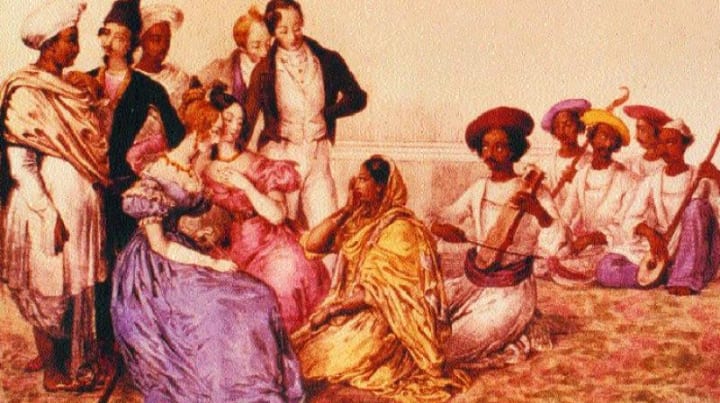
On one such evening, when Nana Sahib had invited lord Albert and his friends over for a leisurely evening, his heart skipped a beat when his eyes lay upon an alluring Hussaini Khanum. The evening was glamourized with her presence and Lord Albert couldn’t help but fall deeply for this ravishing lady. She was about thirty years old, tall with sharp facial features, dark brown curls gently falling on her back, gleaming black eyes and a certain poise which captivated Lord Albert. He certainly did mention it to Nana Sahib who was more than happy to ‘gift’ Hussaini Khanum to him. She would now be allotted a separate residence called Bibighar near Lord Albert’s place along with a few of her fellow nautch girls. He was immensely glad to have Hussaini Khanum under him, he regularly used to visit her and this sparked a chemistry between the two.
On the other hand, as the summers were setting in, he was informed by his spies that the so called Chapati movement was being used for a speculated, potential revolt. All the British officials were alerted and the regiments were readied in case of an uninformed revolt. Lord Albert too did his part and prepared two regiments. The rest of it seemed all at peace in Cawnpore. No sign of betrayal from either Nana Sahib or a threat from the locals. He now had some time at hand to spare and he unquestionably turned to Hussaini Khanum. They used to spend hours together at Bibighar, she performed for her master who had fallen for her and he would oft-times praise her and promise her his loyalty. He even used to confide with her regarding matters of the British administration.
Those were the days when interracial relationships between Britishers and native Indians were looked down upon and highly discouraged. But Khanum seemed to have enticed him to an extent where he was even ready to cut off ties from his bloodkin, father Lindsay, mamma Mrs. Kate Lindsay and his three sisters Caroline, Alice and Frances Lindsay who lived a few chowks away. Of the three, Caroline was his dearest for she helped him skip classes back in Britain.
On the 10th of May 1857, the theorized revolt was now a reality with the Indian sepoys in Meerut turning against their masters. This was just the beginning of a juggernaut of events which would shock Lord Albert and the British Raj to their core. The morning of 11th pitched in the news of a revolt in Delhi led by Bahadur Shah Zafar. An immediate meeting was called and Lord Albert was temporarily appointed as the military chief at Calcutta. He left and then to his office arrives a news of a revolt erupting in Lucknow, he responds to it by arranging for one of his regiments in Cawnpore to be sent to Lucknow for suppression. He is convinced that Nana Sahib and his confidant Hussaini Khanum would take care of things in Cawnpore.
Little did Lord Albert know of Hussaini’s and Nana Sahib’s intentions, the day he met her and her luring him into take her along, gaining his trust and now starting revolt in Cawnpore by holding the elite class including his kin captive were all a part of the plan of this revolt. The lightly taken Chapati movement was a precursing attempt which carried the news and sentiment of revolt against the foreigners in addition to serving as a call for unity among the natives. What followed was a chain of events which led to the Satichaura ghat massacre and the Bibighar massacre where around two hundred women and children including Lord Albert’s parents and siblings were mercilessly murdered. He was even shattered and enfuriated when he came to know of the key conspirator’s name: Hussaini Khanum.
He immediately leaves for Cawnpore from Calcutta. He calls for a meeting at his half combusted residence and asks for Khanum to be presented before him. Just then Hussaini Khanum steps in with a pistol in her hand and fires it at Lord Albert, shouts “Mujhe aaj sukoon mila”(I feel at peace today). She then shoots herself while crying out “VANDE MATARAM.”
Their short so called love story hence turned to dust but the intention of a freedom fighter to free the motherland of these foreigners and that of an infuriating daughter is etched on the pages of Indian history. It is said that the couple who Lord William Lindsay burnt alive were Hussaini Khanum’s parents and she chose to avenge their death all while fighting for her nation too.
About the Creator
sane zane
A fun fact about me, I love french fries dipped in ice cream! I pen stories, poems, quotes and articles.
I also love creating content and would love to be friends with you, hmu on instagram @_fataeh
Keep reading
More stories from writers in Fiction and other communities.
🅼🅸🅳🅽🅸🅶🅷🆃 🆂🅽🅰🅲🅺🆂
"It's 10 in Tuscon! We all know what that means... It's Time for Midnight Snacks with your man, Gerald Gee! Ready to spend the night together? Me too! I'm full of snacks and can't wait to regurgitate them all back into your hungry ears. Crack a brew! Pop some corn! Anything to get ready for one hell of a show where the talk maybe cheap but the words cut deep...
By Lamar Wiggins7 days ago in Fiction




Comments
There are no comments for this story
Be the first to respond and start the conversation.