
Oedipus' Left Foot
A Tale Retold

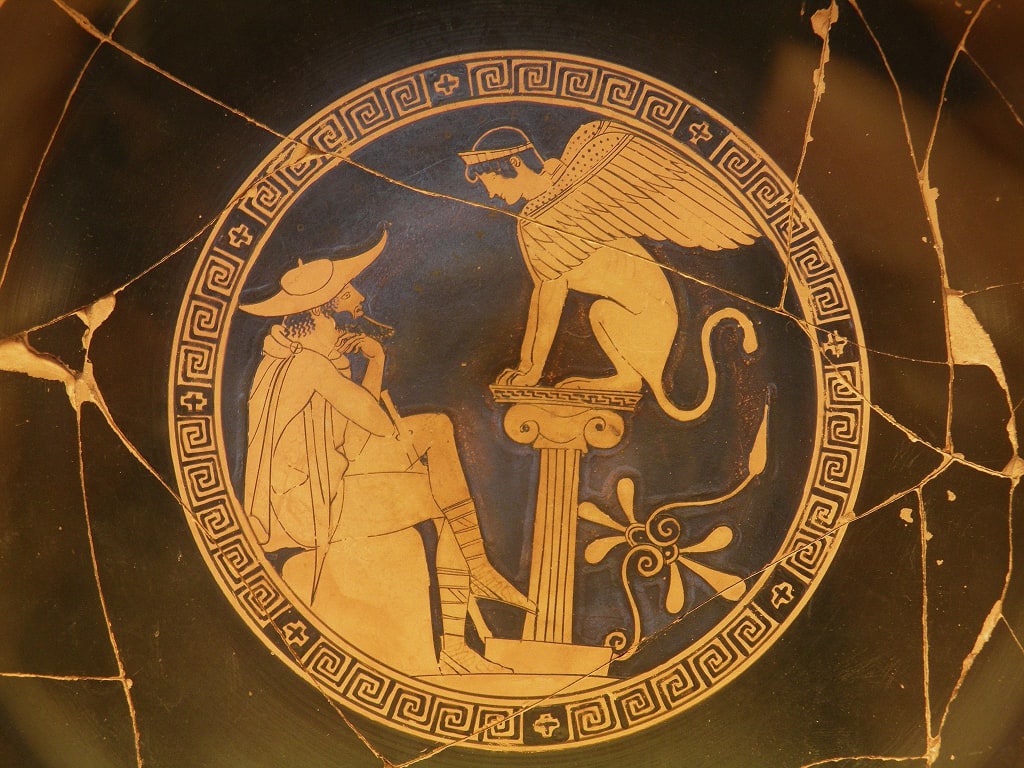
Oedipus ("swollen foot" in Greek) was a peculiar prince before becoming a particular king, not on account of being Greek, but surely since he was human. Reality will almost always be stranger than fiction. It seems to be another rule of the Cosmos, especially in places where conscious beings can differentiate between the two. However, what is real and what is fictitious?
From a young age, some believed four while others swore to five, Oedipus began, unconsciously at first, to measure the worth of the other, anyone really, according to the perfection and thus beauty of their feet. A prophecy, like no other before it, had foretold that one of his feet, the right one, nonetheless, would become distended as he grew older, that is until its weight had surpassed that of his entire mother, at which point he would die in such pain that even the Gods and Goddesses would find it worse than living in Hades or losing one's head. Killing himself would be the only way out, unless a pretty woman with beautiful feet, or a beautiful woman with pretty feet, fell in love with him and his gargantuan right foot.
The flawed nature of humanity seemed to be pitted against or coupled with a future king's role in the course of his destiny and that of his subjects in a caustic Cosmos. What could King Laius and Queen Jocasta, Oedipus' parents, do to stop this prophecy from becoming reality?
"I could lose weight," thought the Queen, out loud, "as we, my King, look around Greece and even the rest of the world for such a woman for our son, our future King."
"I love your weight, my Queen, from every angle, as Pythagoras could have witnessed had he been fortunate enough to measure every one of them. We will find Oedipus a beautiful woman with beautiful feet by the time the Moon smiles again."
Thebes, their kingdom, would remain with all its glory if such a woman could be found. A famed Anthi Kanéna would have been the perfect woman, but she was already married to and in love with her M, and was also living over two millennia in the future. Did I digress? I am known for that, but it was the only time, so far.
King Laius sent his best men and women and accompanied his lesser ones to search for and find this perfect woman to prevent the prophecy from becoming true. Fortunately, no one had to travel very far, as such a woman was soon discovered in Corinth by King Laius and his entourage. She was a princess, no less, the daughter of King Polybus and Queen Merope, who agreed to give their blessings to this union, providing, of course, that their daughter, Princess Anthoula, would agree to become Oedipus' Queen and wife.
The oracle at Delphi, where the prophecy had been made, could not believe the news, as fake information was already being circulated around the Mediterranean, especially since Rome had started its ascent. Zeus's mercy was exemplary, perhaps thanks to his one-of-a-kind daughter, the one and only, Goddess Athena. She is and will always be the most wonderful deity that has ever graced Earth and probably the whole Cosmos. I may have digressed again, but the mention of Her name can never be detrimental.
Oedipus and Anthoula joined hands and lips, as they felt love for each other at first sight. Oedipus had measured her feet and her toes in his mind before their honeymoon, only to confirm that his measurements had underrated his Anthoula's perfection. There was no need or urgency regarding his right foot, as it is his left one that began to grow after their honeymoon.
Back in Thebes, Oedipus sought the counsel and mercy, mercy and counsel, of the Sphinx, a so-called monster, who presented Oedipus with a riddle, which if correctly solved, would save his left foot and the future of his kingdom.
"How many philosophers are required to light up a torch?" asked the Sphinx.
Oedipus thought about it for a long minute and replied: "It depends where you are. In Greece, one philosopher would suffice, whereas elsewhere, at least two are required; one to see the light and one to light it."
"You are correct, King Oedipus. Your left foot will be spared but it will not be perfect."
"I never thought that perfection was even possible for a mortal, that is until I met my Anthoula," Oedipus replied, with love for his Queen deep within and without, thanking the Sphinx before taking his leave.
Some years later, some believed four while others insisted on five, Oedipus was walking with Anthoula in their royal garden when Goddess Athena appeared before them. They quickly bowed their heads, but there was no need, since the Goddess of Wisdom only believed in love, and justice, of course.
"Are you happy?" She asked them both, looking at Anthoula.
"I am very happy," Anthoula replied.
"Is it even possible to be any happier?" Oedipus asked.
"I wish you love and happiness, which tend to occur together," Goddess Athena said and kissed them both, first on their forehead and then on their mouth. "You remind me of a faraway future, when your love and happiness will continue in the bodies of two mortals that I already love, even before their birth. Live long and sing to each other. They will write to each other. I am looking forward to meeting them, but their time is not now. I am sorry to mention them when it is you that matter now. It is, however, you who will become them," She said and disappeared.
Oedipus and Anthoula looked at each other with passion and began to sing about the beauty and wisdom of Goddess Athena as well as the love and happiness that they were going to nourish for the rest of their lives.
Life was not always blue and white or green, but they almost always managed to bring to it their love and happiness, remembering Goddess Athena's words, loving Her as well, both within and without.
The truth can never be made clear because our knowledge, both then and now, is but a morning one, without an evening in sight and certainly not a night, not even in the future. Whoever is sure of holding it is but a fool, or worse. It is what Goddess Athena had taught them, and us.
A Speck of Dust over a Sea of Love
A speck of dust in the Universe I
Am but you are more than that my Anthi
A sea of love in the Universe you
Are my Anthoula of yore riding high
Over streams of light all long and canty
As I learn Greek and the meaning of μου*
Are you really mine my love from within
Or do I have to share you with your Self
When you look at me and your eyes light up
And you move your hair to the left to spin
My heart as if it had an axis shelf
Notwithstanding its lack of a backup
Or any semblance of being unscathed
Do I let myself fall in to be bathed
-----
* μου means “my” in Greek and is pronounced, “mou”.
About the Creator
Patrick M. Ohana
A medical writer who reads and writes fiction and some nonfiction, although the latter may appear at times like the former. Most of my pieces (over 2,200) are or will be available on Shakespeare's Shoes.
Reader insights
Nice work
Very well written. Keep up the good work!
Top insights
Easy to read and follow
Well-structured & engaging content
On-point and relevant
Writing reflected the title & theme
Keep reading
More stories from Patrick M. Ohana and writers in Fiction and other communities.
A Soul's Space
Nobody can hear a scream in the vacuum of space, or so they say. Souls can. Well, at least mine could, and it will anew when I get the chance to travel through space again. We were handed a sabbatical away from space, except that it means nine years here. Most call it, Heaven, but I deem it a dull Hell, where fires have been replaced by waterfalls. I have nothing against water falling à la Niagara and other such monumental cascades, but all the time, everywhere, forever become deadening, even to a soul, at least mine. I often wonder about Milton's words in Paradise Lost: Better to reign in Hell than serve in Heaven. 'Tis better to be dead, I think, most of the time.
By Patrick M. Ohana4 years ago in Fiction
A More Human Vocal
When we launched Vocal nearly a decade ago, the world was a very different place. LLMs did not exist, and stories were created one at a time by people sitting down to write, revise, and share something personal. Many of our assumptions about publishing, trust, and participation were built for a world where effort and output were inseparable.
By Justin @ Vocal2 days ago in Resources




Comments (1)
I like this perspective and explanation and details of the tale. .