
Nvidia is Now Worth More Than… Well, Basically Everyone Else
How Nvidia’s $4 Trillion Valuation Turned It Into the Most Powerful Tech Force on the Planet

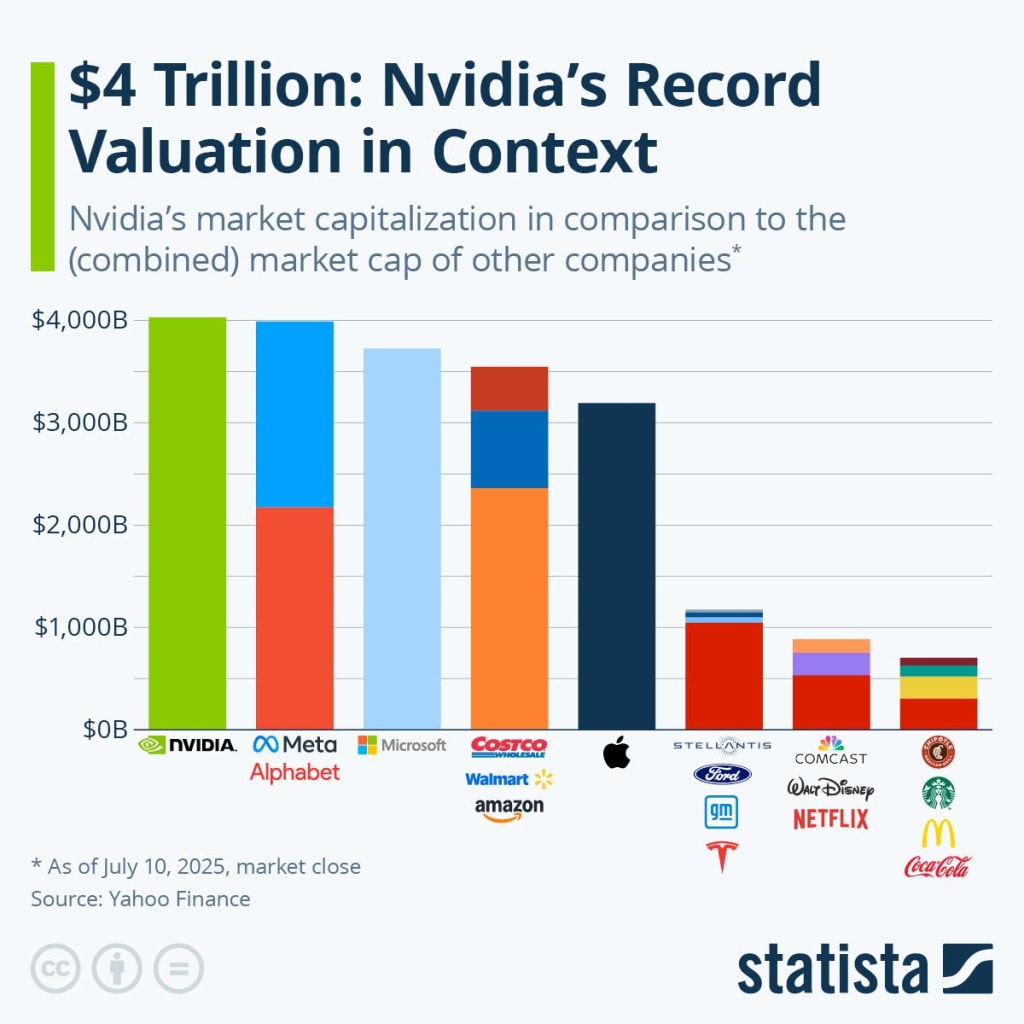
In the world of finance and technology, there are rare moments that make jaws drop. Apple hitting a $1 trillion valuation in 2018 was one. Microsoft overtaking Apple in 2021 was another. But nothing — and I mean nothing — quite compares to what Nvidia has pulled off in 2025.
As of today, Nvidia is worth over $4 trillion.
Yes, you read that right. Four. Trillion. Dollars.
That valuation doesn’t just make Nvidia the most valuable tech company in the world — it makes them, essentially, the most valuable thing not made of gold, oil, or national debt. Their market cap is now higher than Microsoft. Higher than Apple. Higher than Amazon and Google (Alphabet) combined. In fact, Nvidia is now worth more than Meta, Alphabet, and Tesla combined — with billions left to spare.
To put this in perspective: if Nvidia were a country, its GDP would be larger than Germany's. If it were a religion, its believers could fund a cathedral on the moon. If it were a person, it would be richer than Elon Musk, Jeff Bezos, and Warren Buffett — multiplied by three, and then maybe buy a yacht made of diamonds for fun.
But how did we get here?
From Graphics Cards to God Mode
Nvidia was once known as the king of graphics cards. Gamers worshipped its sleek, powerful GPUs that could render realistic explosions, photorealistic water, and pixel-perfect dragons in 4K resolution. If you had an Nvidia GeForce RTX in your PC, you had bragging rights.
But then came AI.
Somewhere between the buzzwords of “deep learning,” “neural networks,” and “transformers,” Nvidia’s hardware became the central nervous system of the AI revolution. ChatGPT, Google’s Gemini, Meta’s LLaMA — all of them rely on Nvidia chips to train, run, and evolve. No chip, no AI. It’s that simple.
While other companies scrambled to pivot to AI or build in-house chips, Nvidia was already there. They weren’t chasing the wave — they were building the surfboard.
Their H100 and now B200 GPUs became so critical to AI infrastructure that entire data centers were being redesigned just to accommodate them. Think of it like this: Nvidia isn’t just selling chips. They’re selling shovels in the middle of a gold rush — and they’re the only store in town.
More Than Just Numbers
Let’s talk numbers for a moment, because they’re frankly absurd.
Nvidia’s annual revenue has exploded. In just three years, they went from about $27 billion in revenue to over $100 billion. Profit margins? Unbelievably high. Their data center segment — primarily driven by AI chips — now makes up over 80% of their income.
This isn’t a bubble built on hype. It’s being driven by very real demand from cloud providers, AI startups, universities, governments, and even militaries.
And with the announcement of their next-gen chips and software platforms, Nvidia isn’t slowing down. They’re building out entire AI ecosystems, expanding into robotics, autonomous driving, healthcare, and even the metaverse (which may finally find relevance with their help).
Nvidia Could Buy Basically Everything
Let’s have a little fun.
With a $4 trillion valuation, Nvidia could theoretically buy:
Netflix ($250 billion)
McDonald’s ($215 billion)
Coca-Cola ($280 billion)
Walmart ($500 billion)
And still have over $2.5 trillion left over.
They could launch their own space program. Build a global network of AI research universities. Create an Nvidia Theme Park where robots serve fries and every ride is optimized with machine learning.
In fact, Nvidia now has enough market power that its decisions influence not just the tech world, but global economics. If they hiccup, the entire AI industry sneezes.
What This Means for the Future
The rise of Nvidia tells us one clear thing: AI isn’t the future. It’s the now.
We’ve crossed the threshold where the most valuable companies on earth aren’t just making gadgets — they’re shaping intelligence. Nvidia is no longer just a hardware company. It’s an infrastructure company for the minds of machines.
Whether that’s thrilling or terrifying depends on your perspective. But there’s no denying it — Nvidia is not playing in the same sandbox as everyone else anymore.
They own the sandbox.
They might own the whole beach.
And if trends continue, they just might buy the ocean too.
About the Creator
lony banza
"Storyteller at heart, explorer by mind. I write to stir thoughts, spark emotion, and start conversations. From raw truths to creative escapes—join me where words meet meaning."
Keep reading
More stories from lony banza and writers in Fiction and other communities.
Davinci Jeremie: From Early Bitcoin Advocate to Modern Crypto Educator
Davinci Jeremie: From Early Bitcoin Advocate to Modern Crypto Educator In 2013, a software developer named Davinci Jeremie made a bold move that would etch his name into cryptocurrency history. With Bitcoin trading at a mere $13, Jeremie released a YouTube video urging viewers to invest at least $1 in Bitcoin. His message was simple yet profound: “If you want to become wealthy in the future, I suggest you take $1, buy some Bitcoins, and put it in a wallet.”
By lony banza7 months ago in Fiction
What Am I Missing?
Day 1 My mission is simple, to learn about humans by becoming one. They’ve got a written history, but I’d rather go in fresh and improvise. I’ve been doing this a long time and consider myself an expert at blending in. Confidence is the key. If you just look like you know what you’re doing, it’s generally accepted.
By Leslie Writes4 days ago in Fiction


Comments
There are no comments for this story
Be the first to respond and start the conversation.