
North American Kaiju
Or, How the Moose Won the West

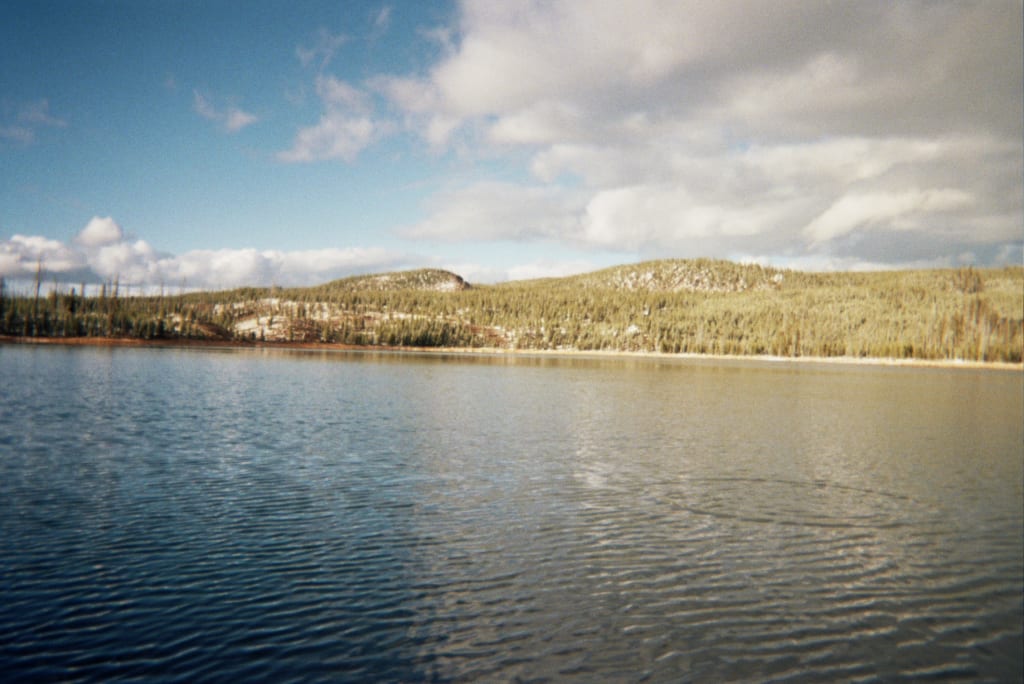
A soft breeze whispers past old bones, rustling dry leaves through the dying grass. The night is new, sun recently set. Sky looks like a blended composition of blue, black, red, orange and pink.
I myself am walking amongst the bones, weaving in and out of the path that crosses under these osseous towers, which loom high above me much like how skyscrapers use to. I remember my parents taking me to the top of a skyscraper once, when I was a kid. I can’t recall the name of that city, but I remember the building was called ‘The Empire’. You could see everything from up there. Everything that would eventually be destroyed.
I pause my hike momentarily for a quick stop at one of the local sunk-in-mud water troughs. I retrieve my ladle and dip it into the pool for a quick sip.
I see it before I hear it. As I slurp down the murky drink, I notice a steady appearance of ripples disrupting the surface of the trough. They appear in moments, in tune and time with a creature’s stride. I crane my neck, and the sound hits my ear: the rumble of footsteps. Large footsteps. Humongous, tree-smashing, city-destroying footsteps. I listen for a moment. Just a moment. Then I return my attention back to the trough to continue guzzling. We all know the beast is out there. There’s no sense in worrying about it now; if it were to turn this way, I’d be prepared for the death I would receive.
The trough I’m currently squat over, and the street I’m walking down, and the shack I live in, and the whole civilization I’m a part of is all built inside the hollow skeleton of a once great monstrous bear; a bear that was slain in battle long ago.
I was a child when giants destroyed this Earth. Fights and scraps between them tore cities to shreds. Millions died. Hell, maybe even billions died. We don’t really possess the know-how to figure out how many of us there are left. Most of the tools for communication are lost to us, save for our hushed voices and the occasional smoke signal.
Traditional folklore and fantasy dictated that giants would be reminiscent of us — giant humans kickin’ it in castles at the tops of beanstalks. Then Japanese cinema, and a few American remakes my father took me to see, shed light on other horrors: giant lizards rising from the briny depths to fight monsters like giant moths or three headed space dragons.
A monster materializing from the deep ocean doesn’t sound all that surprising. But I don’t think anyone ever expected one would emerge from the woods of Canada.
This pantheon of monsters, known colloquially and collectively as the “North American Kaiju”, popped up (seemingly out of nowhere) a little over fifty years ago. The pure randomness of their sudden arrival thrust our world into chaos. One day, everything was all hunky-dory. The next, huge hulking beasts towering a thousand feet high were stumbling through backyards and waging war, leaving paths of mayhem, destruction, and devastation in their wake.
My memory of the time when giants roamed the earth is a bit hazy, but the gaps in my recollection have been filled in by the stories, legends and tall tales told around the community bonfire. The general consensus asserted by us, the leftovers of the race once known as humanity, is that there were five Kaiju, and all took the shape of animals found on the North American continent – a moose, a bear, an alligator, a bald eagle, and an ocelot.
The bear was the first to make a blip on the world’s radar. Just appeared one day, stalking the edge of the Pacific Northwest. People started fleeing the area. They weren’t sure what to make of it. The news started calling him Ursa Major. And at first, he seemed somewhat docile. But then he started stomping through towns and cities. And before we had time to respond, Ursa Major’s big debut was interrupted by the first appearance of the bald eagle, known under the moniker of Uncle Sam. Just up and plummeted out of the clouds, talons at the ready, immediately engaged for a fight. And fight they did.
The entire west coast served as their battleground. They broke the coast to bits. There was no clear victor among the monsters in that first fight, but it became abundantly clear who the losers were: us.
A short while later, the most vicious of this order, the alligator, nicknamed Sobek after the Egyptian god of the Nile (though some modern nursery rhymes call him “Swampy Chompy”), slithered out of the Atlantic and onto a peninsula called Florida. A man I once crossed trails with once, coming from a place called “Warlando”, described to me the carnage that ensued at the ends of Sobek’s paddle feet. He shot out of the water like a cannonball and left most of the peninsula submerged; it was completely gone, erased entirely off the map.
The ocelot, called Felis, sauntered on out of Central America. Of the bunch, she definitely seemed to be the sweetest. Well, as sweet as a thousand-foot-tall cat that leaned toward the unintentional destructive side could be. Pretty quickly folks started rallying around her as this supposed savior of humanity, mainly because she tended to cause the least amount of demolition and death. However, I don’t think her lesser impact was due to an altruistic nature or hero’s status, but rather an attribute to a cat’s natural sense of balance.
The last Kaiju to debut was the moose. The strongest and biggest of them all. It came rumbling and stumbling out of Newfoundland with the grace of a newborn calf. At the beginning it couldn’t bare the weight of its antlers, so it puttered about most of the north, mashing and crashing. Academics called him Megaloceros Alces. But we all just call him Bullwinkle. I have no idea why.
To this day, nobody knows where they came from. In hushed whispers around the bonfire, ideas are put out there. Some say they were not of this world – extraterrestrial beings launching an invasion. Holes can be poked in that theory. Other whispers include ideas of government experiments gone wrong, or figures from an ancient mythology that predates recorded history, or the existence of a hollow earth. A small factor of religious zealots that worship the legend of the Kaiju think of them as gods, sent to punish the sins of humanity. I don’t buy all of that, but they do hand out very persuasive literature.
Rivalries formed among the Kaiju. Felis and Sobek became bitter enemies. Their theater of war mainly stuck to the south, in and around the waters of the Gulf of Mexico. Bullwinkle and Ursa Major battled in the north. And Uncle Sam just attacked everybody.
Humanity was the causality of the war of the Kaiju. Mankind disappeared. Eventually, the giants did too.
Uncle Sam was the first to be slain. During battle with Sobek, he unsuspectingly flew to close to the jaws of the gator, who snatched him and pulled him down into a bloody and salty defeat.
Felis was next. Round after round with Sobek, she’d win one, then he’d win one. I believe they were evenly scored by the time of their final match. I don’t know how Felis died. No one likes to talk about it. But I remember the word going around upon the news of her death: our last hope is gone; we’re doomed.
Shortly after Felis’ death, Sobek disappeared. Rumors circulate that he left to command the seven seas; others say he moved on to terrorize another continent.
Bullwinkle and Ursa Major, the last two standing, engaged in a brutal grudge match that lasted several days and nights. Their skirmish spilled over into my home state, where I lived with my parents. I can remember them carrying me out of the house and sprinting to the car. Over my dad’s shoulder I could make out the giant forms of a bear and moose in a bloody brawl, antlers versus claws.
My parents tried to make the escape. Traffic was congested, packed with others trying to flee. My dad scooped me out of my seat, and we tried to make a run for it on foot. My parents did the best they could. In the end, Bullwinkle stepped on them. Somehow, I survived. I don’t know if it was a miracle or punishment, but somehow, I survived.
The last bout between Bullwinkle and Ursa Major ended with the moose’s victory, with a finishing move that tore the bear in half. Standing in a landscape washed in the blood of its enemy, the moose took a breath, and without hesitation turned and walked away. He’d done what he needed to do.
Those early years were rough. The last remnants of us still around lived in fear of Bullwinkle’s wrath, that one day he’d decide to return to finish us off. For some reason or other, he avoided the spot where the bear’s body lay. We started in camps surrounding the bloody mess. When time eventually ate away the fur and flesh, we moved into the skeleton, where we remain safe, for now.
When the bear was bisected by Bullwinkle, the two halves of his skeleton formed two cities: Greater Ursa, and the Hind Legs. In between is a lantern lit road known as the Moose Tracks, guarded and governed by the Wood’s Watch, an “elite” guard brigade made up of men crazy enough to think they could actually beat Bullwinkle should he comes trampling this way. That’s the problem with most men: they think they can win, but in the end they’re just another flat pancake beneath the might of something far greater than they.
Seems to be a usual night. Seems to be. At least for Greater Ursa. A quick stroll through the Rib Cage District. A few shops are still open at this late hour. Thankfully the bear died along the river, so the water still runs through his skeleton. A vendor tries to push a salmon sale onto me — large salmon, about the size of a golden retriever. Unusually small for this season. A couple of acolytes, members of the Order of the Palmate, try to run their usual scam, forcing gold lockets around the necks of strangers as a show of the great Bullwinkle’s love. Seems like a kind gesture sure, but then they push all their persuasive literature on you and try to convince you to join their order, or at the very least give up most of your food rations to them. I’ve tossed off more of those gold lockets and chains than I can count.
I take this walk every evening, through Greater Ursa and down to the border. Most folks are too scared to make the crossing to the Hind Legs at night. But not me. I’ve seen what that moose can do. I mean Christ, I saw it tear a bear in half. I saw my parents get smushed by it. I’m not afraid of it. Not afraid of it at all.
I shuffle through the snow, down the illuminated lantern-lit path, nodding at each Wood’s Watchmen placed every few hundred feet. I lock eyes with a watchman who’s trembling, but not from the cold. I shoot my attention due west. Far off in the distance, silhouetted against the full moon, I make out the form of the moose.
I walk the Moose Tracks every night, hoping to find him standing over me, just like he did when I was a boy. He spared me then. And I don’t know if I have a death wish or what, but the only ending I see fit for my story is for me to meet the moose once more. If only he’d turn this way. The watchman trembles. I am calm.
About the Creator
Keep reading
More stories from Morgan Campbell and writers in Fiction and other communities.
The Bottled-Nose Dolphin Hotel
“The Bottled-Nose Dolphin Hotel first opened its doors in 1908. Located just south of historic downtown Orida, Florida, nestled along the shores of the Atlantic coast, the hotel has served a variety of famous clientele, including-."
By Morgan Campbell4 years ago in Horror
The Pot Boiling Over
Once, there was a pot of about 340 million drops and droplets. Most of them would like to think they lived together peacefully for decades, but that wasn’t true. Different regions struggled, sometimes fought, with each other. And the mainstreams still often pursued and attacked the minorities. Law enforcers sometimes pushed minority drops out of the pot, never to be seen again.
By Gabriel Shames7 days ago in Fiction
Ludacris and Nelly draw backlash over bookings at MAGA-coded music festival
Ludacris and Nelly headlining a mostly right-wing event is good for them. It’s also great for the genre of hip hop. The two rap veterans have showcased their talents on other stages. Why can’t they perform for mostly MAGA folks and grab that bag?
By Skyler Saunders4 days ago in Beat


Comments
There are no comments for this story
Be the first to respond and start the conversation.