

The character of Norman Bates, as portrayed in Alfred Hitchcock's 1960 film Psycho, is often seen as a villain. He is the proprietor of the Bates Motel, where he kills several people in the course of the film. However, upon closer examination, it becomes clear that Norman Bates is actually the hero of the story.
First and foremost, it is important to consider Norman's background and upbringing. He was raised by his mother, Norma, who was extremely overbearing and controlling. She kept him isolated from the outside world and forced him to live a life of solitude and isolation. As a result, Norman never had the opportunity to develop healthy relationships or learn how to cope with his emotions in a healthy way.
Furthermore, it is clear that Norman's actions in the film are a direct result of his mother's manipulation and brainwashing. Norma, who is revealed to be dead, continues to control Norman through his subconscious, causing him to kill in her name. In this way, Norman can be seen as a victim of circumstance, rather than a true villain.
Additionally, Norman's actions in the film can also be seen as an attempt to protect himself and others. He kills Marion Crane, for example, in order to keep her from revealing the truth about his mother's murder. He also kills Arbogast, a private investigator, in order to protect the secret of his mother's identity. In both cases, Norman's actions can be seen as a desperate attempt to protect himself and those he cares about.
It is also worth noting that Norman is a sympathetic character, who evokes a great deal of empathy from the audience. He is clearly struggling with mental health issues, and is a victim of his mother's abuse. The audience can't help but feel sorry for him and understand his actions.
Furthermore, the way the story is presented, the audience is led to believe that Norman is the villain, but as the story unfolds, the true villain is revealed to be Norma Bates, his mother, who even after her death, continues to manipulate and control him.
Lastly, in the end of the movie, Norman shows remorse for his actions, and is taken into custody, accepting his punishment as a hero would, this further solidifies his role as the hero in the story, as he takes responsibility for his actions and is willing to pay the price for them.
Also, while Norman Bates may initially appear to be the villain of the story, upon closer examination, it becomes clear that he is actually the hero. He is a victim of circumstance, a sympathetic character, and ultimately takes responsibility for his actions. The true villain in the story is Norma Bates, his mother. The way the story is told and the audience's understanding of it is also a testament to the complexity of human nature, and the idea that there are no clear-cut heroes or villains in life.
In conclusion, the character of Norman Bates in Psycho challenges traditional notions of heroes and villains by blurring the lines between the two. It is important to remember that not all heroes fit into the traditional mold, and that people's actions and motivations are complex and multifaceted. This can also be seen in the real world, with figures such as Caitlyn Jenner and Laverne Cox, who are known transgender and cross-dressing public figures. They, like Norman Bates, challenge societal norms and expectations, and prove that there is no one-size-fits-all definition of a hero. They, just like Norman Bates, are not villains, but people trying to live their lives the best way they know how.
About the Creator
Keep reading
More stories from Brett Rothenberg and writers in Fiction and other communities.
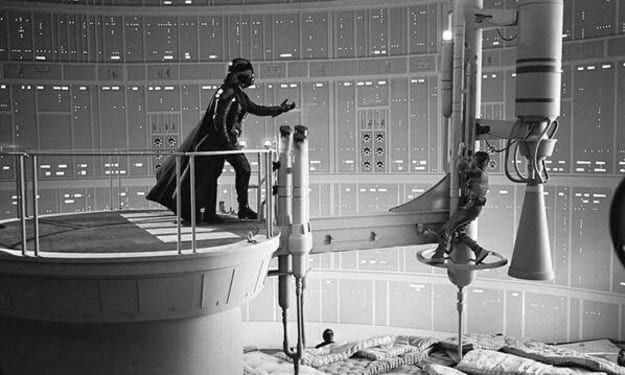
Luke I am not your father
In the Star Wars universe, the revelation that Darth Vader is Luke Skywalker's father is one of the most iconic and shocking moments in the series. However, there have been ongoing debates and theories that suggest Anakin Skywalker, the man who would become Darth Vader, may not actually be Luke's father. Here, we will explore some reasons why Anakin may not be Luke's father in the Star Wars universe.
By Brett Rothenberg3 years ago in Fiction
Becca
"Everything is so... flat." Denille said stupidly as she looked around her new neighborhood. She looked around at the muted desert where even the smallest sign of life seemed to have given up. The plant life was shrubs that were half cooked by the heat and where there should have been a lawn, a mess of white rocks laid glistening in the sun. Even the sky looked stretched thin, like the sun had ironed it smooth. She’d moved from Riverside, where at least there were hills, but here in Barstow, everything felt baked and brittle.
By Sara Wilson3 days ago in Fiction
The Potty Stick
Elijah woke up before the sun, which was strange, because Eli was only two and usually only woke up when something loud or bright or sticky told him to. But this morning his eyes popped open all by themselves. His room was still dark-blue and soft, with Super Mario everywhere. There was a poster of Mario jumping on the wall, little Mario's racing on his blanket, and even a Mario smiling from the nightlight like a tiny glowing coin. Nothing about his room looked different... but something felt different.
By Sara Wilson6 days ago in Fiction


Comments
There are no comments for this story
Be the first to respond and start the conversation.