
No Error Reported
The Change Occurred Without Witness


On the first day, they measured the room before anyone used it.
Length: six steps.
Width: four steps.
Height: sufficient.
Someone wrote this information on a card and set it on the desk by the door. No one wondered why a room needed a card. After all, rooms always seemed to need something.
The first person assigned to the room was told to sit, wait, and write down anything that changed.
Nothing changed.
After two hours, the person left. The room stayed the same.
On the second day, the card was updated.
Length: six steps.
Width: four steps.
Height: enough.
Condition: unchanged.
The second person saw that the desk was closer to the wall than expected. This did not seem strange. Measurements often changed depending on where you started.
They sat down. The light made a soft humming sound. The door stayed shut. When it was time to leave, the door opened without trouble.
Later, someone moved the desk back to where it had been.
On the third day, two people were each given the room at different times.
They never saw each other.
The first reported that the room felt smaller than expected. The second reported that it felt unchanged. Both reports were accepted.
The card was amended.
Length: six steps (approx.).
Width: four steps (approx.).
Height: enough.
Someone wrote a note in the margin:
Perception variance does not indicate a structural fault.
On the fourth day, the room corrected its lighting.
The change was subtle. The bulb did not flicker, and the brightness did not seem different. You could only notice the change if you compared it to your memory, but memory was not reliable.
The person in the room noticed something had changed, but could not explain what it was. Still, they wrote down what they felt.
The record was later revised for clarity.
On the fifth day, no one went into the room.
This was done as a test.
At 09:00, the door was closed.
At 12:00, the door was opened.
At 12:01, the card was checked.
Length: six steps.
Width: four steps.
Height: enough.
Everything stayed the same.
This result made everyone feel better.
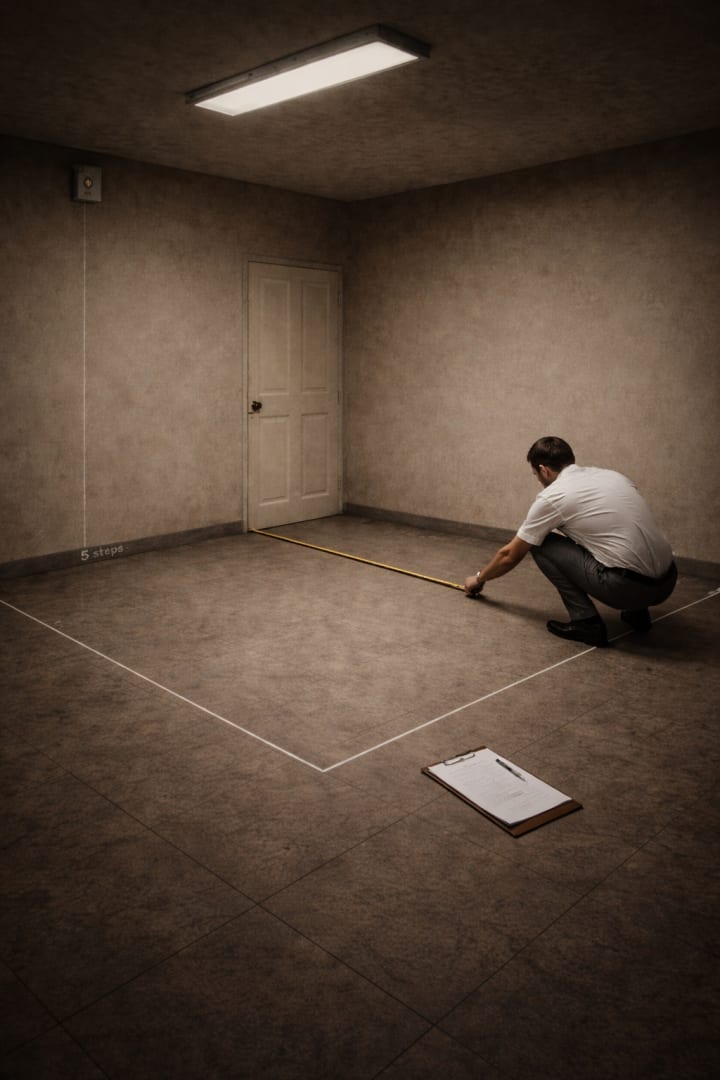
On the sixth day, something was wrong in the room. The desk was pushed up against the wrong wall.
No one remembered moving the desk. The logs showed that no one had permission to move it, and that no one had entered the room overnight.
Someone moved the desk back by hand.
After correction, the room appeared compliant.
On the seventh day, the person assigned to the room wrote nothing down.
People found this out later.
The person sat in the room for the required time, left, and handed in a blank sheet of paper. When asked, they said nothing had happened that was worth writing down.
The blank sheet was kept on file anyway.
The card stayed the same.
On the eighth day, the room was remeasured.
Length: five steps.
Width: four steps.
Height: enough.
The difference was small but clear.
The person measuring checked twice more and got the same result each time. A supervisor checked too and agreed.
They updated the card.
No explanation was issued.
On the ninth day, the room fixed the difference.
Length: six steps.
Width: four steps.
Height: enough.
The measuring tape showed no fault. The floor bore no signs of compression or expansion. The walls were unmarked.
They decided the earlier measurement was a mistake.
On the tenth day, they sealed the room to observe it.
No one entered.
They placed sensors carefully so nothing would get in the way. The door stayed closed, and the lights stayed on.
At 14:32, the sensors recorded a shift.
It was not movement, but alignment.
The data did not suggest change so much as adjustment—numbers resolving themselves into agreement.
The room did not grow or shrink.
It became more precise.
On the eleventh day, the card was removed.
They did this to see if the room needed its documentation.
Without the card, the room appeared unchanged. People continued to describe it accurately. Measurements remained consistent.
They put the card into storage.
On the twelfth day, someone went into the room and felt that something was missing.
They could not say what it was.
The desk was present. The walls were intact. The light functioned.
Still, it felt like something had been fixed or removed.
The person tried to write down what was missing, but nothing sounded right. They crossed out several lines and turned in a shorter report.
The shorter report made more sense.
On the thirteenth day, they gave the room a new purpose.
This was an administrative decision, not a reaction to anything.
The room was no longer for observation. It was now for storage.
They put in a shelf, took out the desk, and set boxes inside.
The room seemed to accept these changes without trouble.
On the fourteenth day, someone saw that the shelf was a little crooked.
They straightened it.
Later, the shelf was straight.
No one remembered fixing it.
On the fifteenth day, they checked the room and decided it was fine.
They did not need to monitor it anymore.
They closed the file.
Years later, when the building was renovated, the room was demolished.
This was just part of the routine.
The workers noted that the measurements on the blueprint were unusually precise. The demolition proceeded anyway.
After the space was cleared, the floor plan changed a little to make up for the missing room.
The building stayed standing.
All photos credited to: Canva AI
About the Creator
Ajan Lori Abei
Writer exploring identity, human behavior, and life between cultures. Sharing reflective essays and observations from an African living in Japan.
Keep reading
More stories from Ajan Lori Abei and writers in Fiction and other communities.
When the Shelter Closes
Across the street from my house, a man slept under a tree, his dog by his side. My first, naive thought: he must be traveling through. But he kept coming back, often sleeping there during the day. Then it hit me—that person might not have a home.
By Bride of Sound7 days ago in Humans




Comments (3)
I loved how the procedural tone made the smallest changes feel significant. This was quietly unnerving in the best way!
The slow, subtle changes here kept me hooked the whole way through!
Human perspective within the constraints of structure, routine, confinement. Very well written with an eery undertone. Loved it.